

The short answer
Robotic lawn mower ROI for correctional facilities comes from crew hours freed on large, mostly open grounds inside a secure perimeter, where mowing repeats on a set schedule within defined boundaries. The return is a savings range, and its size depends on the share of mowing a robot realistically takes, what those freed hours are worth to the facility, and the fixed lease cost quoted after a free site assessment. Payback is only real when freed hours are reassigned or reduced, so plan that before you sign.
Read the commercial robot lawn mower guideSee what a robotic mower costsRun the numbers in the ROI calculator
Key takeaways
- The return comes from crew hours freed on mowing, not from the mower itself.
- A robot that covers the grounds while staff sit idle saves nothing on the crew side.
- Staffing vacancies in correctional agencies raise the value of every hour returned.
- The lease payment is quoted after a free site assessment, and savings are shown as a range.
- Start with a pilot zone and measured hours before committing the full site.
What is the ROI of a robotic lawn mower at a correctional facility?
Robotic lawn mower ROI for correctional facilities starts with the size of the job. The Bureau of Justice Statistics counted 1,821 state and federal correctional facilities in its 2005 census, up from 1,668 in 2000. That is the most recent count of this kind we verified, and older counts are likely understated today, so read the 2005 total as a floor.
Each of those sites has grounds to keep up, including fence lines, recreation yards, staff parking, visitor approaches and open turf between buildings. Much of that ground needs regular mowing on a set schedule, and the boundaries are usually known in advance. That combination is what makes a robot a fit for this setting. The return is the crew time that stops going to the same mowing cycle week after week, and it only shows up once those hours are measured and put to use.
What work does a robot take off the grounds crew?
Mowing is the task that consumes the most crew time by frequency. According to Turf Magazine, labor is roughly 45% of a landscape contractor's P&L, and an equipment industry representative quoted in the article called mowing the most labor-heavy task by frequency. The Bureau of Labor Statistics projects 1,192,500 landscaping and groundskeeping workers employed in 2024, rising to 1,235,000 by 2034, an increase of 3.6%, so this is a large trade with a steady need for mowing labor.
A robotic mower takes the repetitive open-area mowing inside its boundaries. Trimming along fences, buildings, posts and obstacles still needs people with hand tools, as do cleanup, equipment checks and any work near the perimeter that needs an escort. The table below shows how the work splits, task by task.
No published count gives a typical grounds crew size at a correctional site, so the headcount on this page is a planning estimate of two people, to be confirmed during the assessment. Count the people who actually mow, trim and check equipment before you use any number here.

How does the ROI math work?
The math has four steps. Start with the crew hours spent mowing across the whole site in a typical cycle. Multiply by the share of that work the robot realistically takes over, not the share it could take on paper. Value the freed hours at what they cost the facility, whether that is staff time, overtime or a contracted crew. Then subtract the lease cost and any setup and training cost.
The share does most of the work in that calculation. A robot that covers most of the open turf but leaves a crew member standing by saves little on the crew side. A landscape contractor quoted in Turf Magazine made the same point: if the robot covers the whole site while a worker sits idle, labor savings are not realized, so site selection drives savings. A landscape company president quoted in the same article estimates each mower saves about 40 hours of labor, an anecdotal figure that has not been measured, so treat it as a prompt to measure your own hours.
The output is a savings range from our calculator, prefilled for this setting. It is a range because each input is an estimate until it is measured. A fixed robot lease payment is easier to model than a cost that moves with acreage and weather, which is why the quote and the range are shown side by side.
Does staffing pressure make the return bigger?
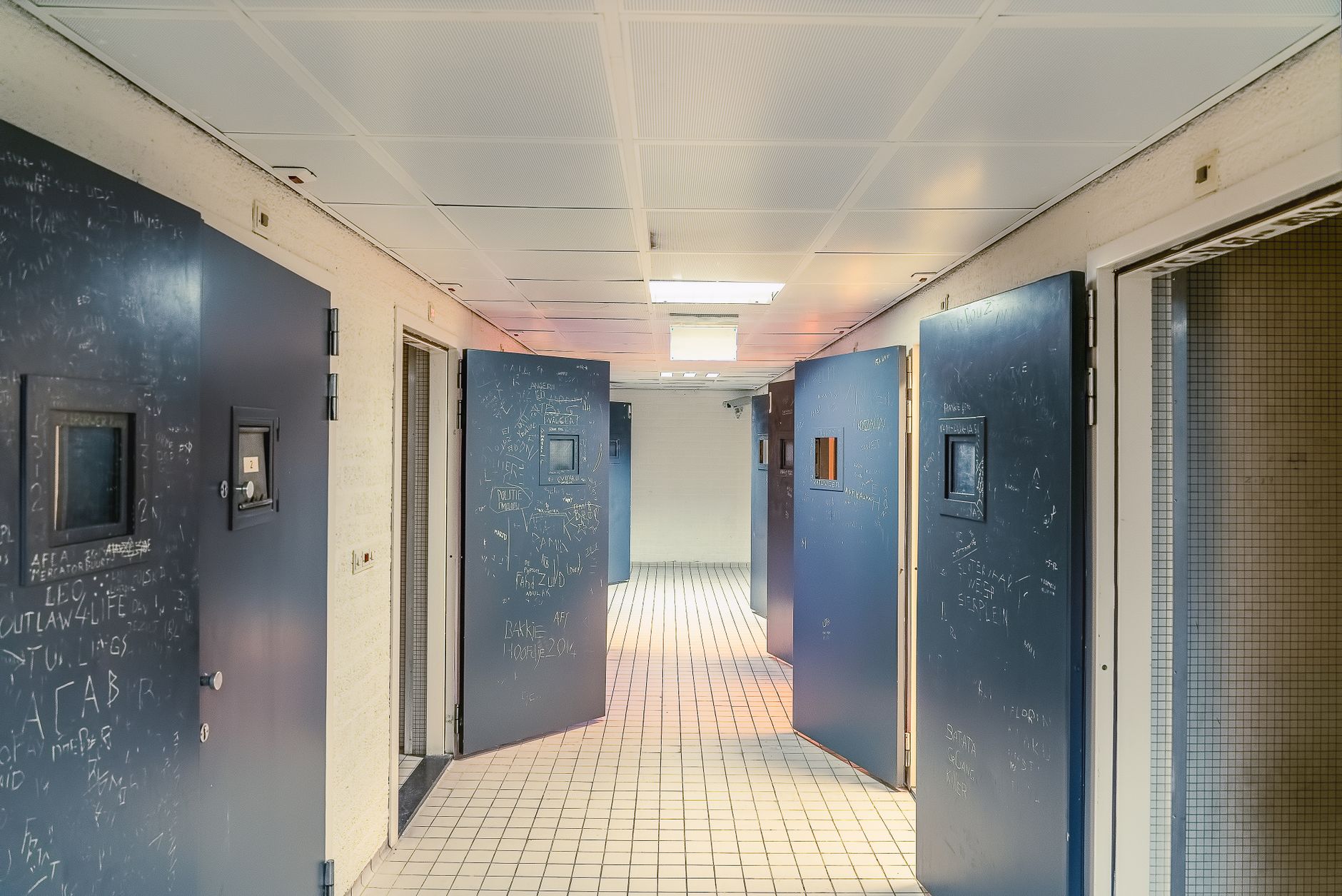
Staffing shortages raise the value of each freed hour. The Dayton Daily News reported in an investigation of Ohio state prisons that they ended 2025 more than 500 correction officers below full staffing, with 7.4% of budgeted positions vacant. The Dayton facility had 18.8% of its budgeted officer positions unfilled.
New Mexico's FY25 Q2 report card lists a correctional officer vacancy rate of 26.7% at public facilities and 37% at private facilities. An American Correctional Association article reports security officer vacancy rates reaching 55% and turnover as high as 48%, undated in the version reviewed.
These are state figures, not a national count, and officer vacancy is not the same as grounds crew vacancy. What they show is that filling posts is hard, so any hour a facility can return to posts or other priorities has more value where the workforce is thin. Trace where your grounds hours go. If staff are pulled to other duties, freed hours go to coverage. If a contracted crew does the mowing, freed hours show up on an invoice. Either way, they need a home before they count.
What changes the number up or down?
Size and shape move the number most. Large, open lawns with few obstacles give a robot long, uninterrupted passes, which means more mowing taken per crew hour. Small, broken areas full of fences, gates, posts and grade changes give less, and each boundary edge adds setup and checking time.
How the freed time gets used matters as much. The same freed hour is worth more at a facility with open posts and a thin crew than at one where the crew is already sized to the work. Growing season and weather days set how many working days a year the mower can run, which affects both the hours freed and how quickly payback arrives.
What are the risks to the return and how do you avoid them?
The biggest risk is an idle crew. If the mowing hours disappear on paper but the people stay on the same schedule, the savings never reach the budget. Write the reassignment plan into the decision before any lease is signed, and name who owns it.
Boundary risk is next. A boundary mapped against an old fence line, or a mower that is not checked, creates a problem a grounds budget never sees. Map the perimeter during the assessment, test the boundary before full operation, and keep a staff check in the daily schedule rather than assuming the grounds run unattended.
Safety belongs in the case too, though it should not be oversold. A safety-training site summarizing Bureau of Labor Statistics data reports 239 grounds maintenance workers killed by work injuries in 2024, a rate of 20.9 per 100,000. A MoneyGeek analysis of federal data reports the fatal rate rising from 13 per 100,000 in 2014 to 21 per 100,000 in 2024. These are industry-wide figures, and they do not measure what a robot would prevent at your site.
How does a robot lease work for a correctional site?
We lease robots through financing, so the facility gets the mowing capacity without carrying the equipment as a large upfront cost. We pick the right robot for the site, lease it, deploy and integrate it with your boundaries and schedule, train staff and service it nationwide. Lease options are discussed in the assessment, not on a price list.
Service covers on-site dispatch, remote triage and emergency response nationwide, with spare unit coverage where the lease calls for it. Ask for the quote in writing so you can see exactly what maintenance, warranty and coverage are included, and what is not.
Two starting points are worth comparing. One is a pilot with a single leased unit on a defined zone. The other is a phased deployment across the grounds, with a backup plan built in. Both start from the same fixed robot lease payment, quoted after the site assessment.
What is the realistic timeline from assessment to payback?
The work moves in phases, and the order matters more than any single date. A site assessment maps boundaries, measures the mowed area and records crew hours. The lease quote is then issued against those measurements, and the unit is selected for the ground.
After signing, deployment and integration set the boundaries and schedule, and staff are trained. A pilot runs on a defined zone long enough to cover a full mowing cycle in the season, and the team compares measured freed hours with the plan before expanding.
Payback starts counting when the freed hours are reassigned or reduced, not at go-live. The timeline for your facility is set in the assessment, since staffing, growing season and boundary complexity vary too much for a generic number to be useful.
- Site assessment: boundary mapping, mowed area, crew hours
- Lease quote issued against measured figures
- Deployment, integration and staff training
- Pilot zone run through a full mowing cycle
- Expansion decision and payback tracked against measured hours
How do you get a precise figure from a free site assessment?
A free site assessment replaces the estimates on this page with your numbers. It covers mowed area by zone, the boundary and obstacle layout, crew hours per cycle measured over several cycles, and how the freed hours would be used. The calculator then produces a savings range from those inputs, with the lease quote shown beside it.
Bring the crew schedule, a fence or grounds map, and records of recent mowing hours, along with the facility's plan for freed time. Ask the assessor to state the share of work the robot realistically takes, and to show the low end of the range as well as the high. A range that holds up to a budget committee is more useful than one figure that looks good on paper.
We map the site, deploy and integrate, train your staff and service the units nationwide. Start with one leased unit if you want measured proof before scaling, and the free assessment is where the numbers for your site get fixed.
Frequently asked questions
Upcoming public sector events
- Trade showAPC/PennDOT/PA Turnpike Fall SeminarNov 18 to 20, 2026Hershey Lodge, Hershey, PA
- Trade showMinnesota Buildings & Facilities Management Trade ShowNov 19, 2026Minneapolis Convention Center, Minneapolis, MN
- ConferenceCASBO CBO Symposium (Executive)Nov 19 to 20, 2026The Langham, Pasadena, CA
- ConferenceVirginia Association of Fairs ConventionJan 14 to 17, 2027Williamsburg Lodge, Autograph Collection, Williamsburg, VA
Want a robotic mower at your correctional facility?
Tell us about your site. We will recommend the robot, quote the lease, and keep it serviced.
Sources
- Bureau of Labor Statistics, Occupational Outlook Handbook: Grounds Maintenance Workers
- Bureau of Justice Statistics, 2005 Census of State and Federal Correctional Facilities
- Dayton Daily News, Ohio prisons short hundreds of corrections officers
- New Mexico Legislative Finance Committee, FY25 Q2 agency report card
- American Correctional Association, Corrections Today: Recruitment and Retention of Correctional Staff
- Turf Magazine, Robotic mowers: robots are here
- Safety training summary of BLS groundskeeping and maintenance statistics
- Fox59, MoneyGeek analysis of federal data on groundskeeping deaths