
The short answer
Robotic lawn mower ROI for racetracks comes from crew hours moved off repeatable work such as grandstand perimeters, berms and accessible infield edges, and the savings range depends on how much of that work the robot realistically takes. Track grounds crews are small and seasonal, so the return is set by the hours a crew can redirect in peak season, net of the fixed lease payment and the time people still spend on the job. A free site assessment measures those inputs and turns them into a precise range and a lease quote.
Read the commercial robot lawn mower guideSee what a robotic mower costsRun the numbers in the ROI calculator
Key takeaways
- The return comes from crew hours moved to repeatable perimeter and berm work, not from replacing the whole crew.
- Track grounds crews vary widely, so the hours offset depends on the site's layout and event load.
- Infield, event-day and debris work still needs people, and the savings range reflects that.
- The lease payment is quoted after a free site assessment, and the range narrows once the site is measured.
Robotic lawn mower ROI for racetracks: what it means on a speedway
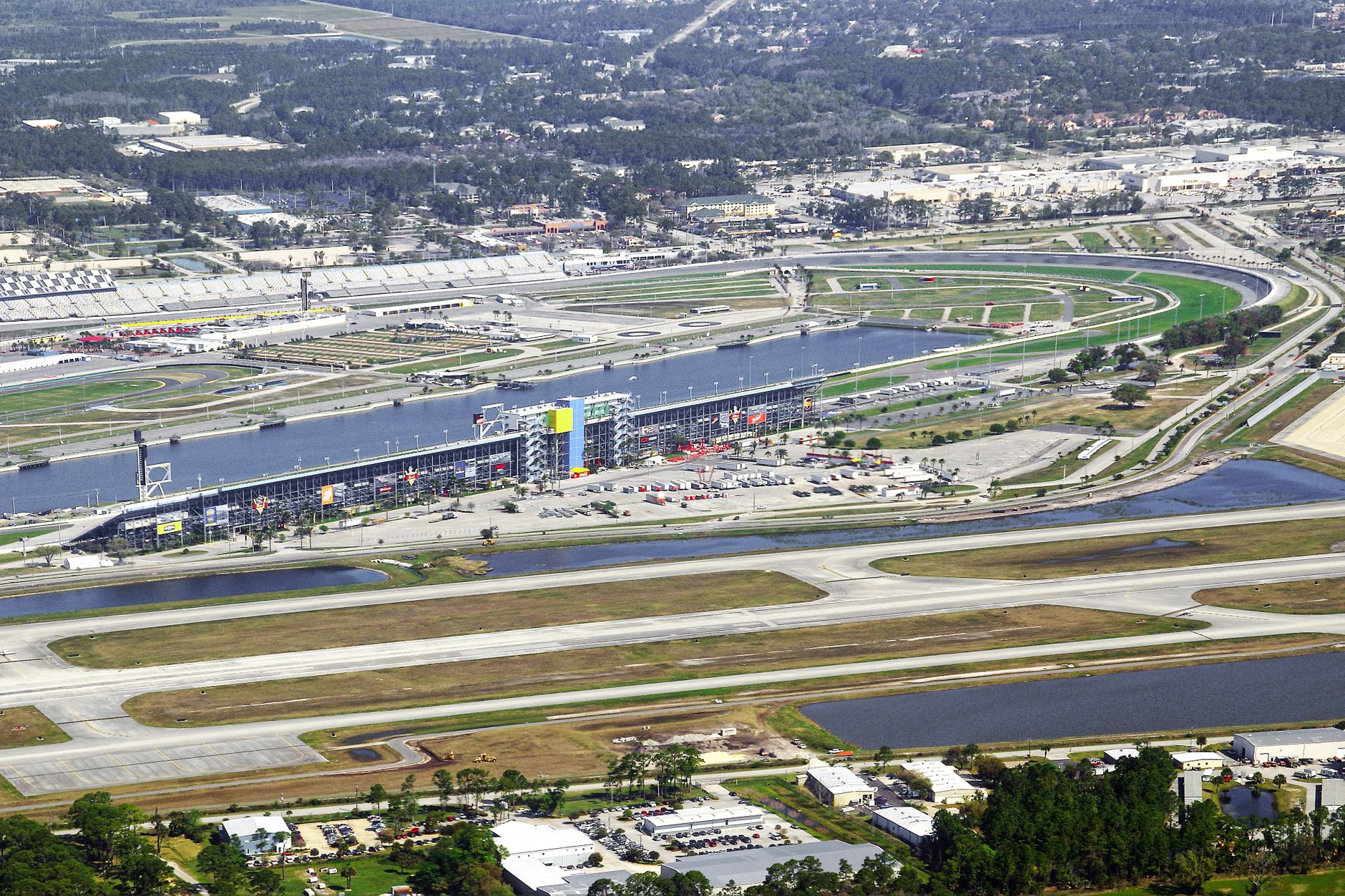
A racetrack is not one lawn. It is a set of separate mowing jobs: the grandstand perimeter, the berms that shape sightlines and drainage, the accessible infield edges, fence lines and the shoulders along access roads. Each area is cut on a schedule set by the race calendar, the weather and the event load, and each one competes with event preparation for the same small crew. The repeatable edges are the part of that list a robotic mower handles well. The rest of the property still needs people and larger equipment.
So the robotic lawn mower ROI for racetracks is a question about hours, not about the machine. What matters is how many crew hours in peak season move from fixed perimeter passes to the robot, and what those hours are worth to the operation. Service Robot Co. measures that during a free site assessment, then provides a lease quote for a fixed robot lease payment. The calculator on this page is pre-filled for this setting, and the savings it shows is a range, not a promise.
How many racetracks are there, and how big are the grounds crews?
No single authoritative count of US racetracks was available for this page, so any total should be treated as an estimate. The best published figures come from the series that run on them. According to NASCAR, it races at 35 tracks across the US and Mexico in its three national series. In its 2022 season, the NASCAR Cup Series had races at 26 US tracks, including six road course races, according to Sportskeeda.
Those figures describe the top of the market. Many tracks are smaller ovals, road courses and short tracks run by local operators, and their grounds crews are smaller still. In the trade and press reports reviewed for this page, track grounds crews ranged from a two-person infield crew to a supervisor's crew of up to 10 at a large oval. A typical crew of about 4 is the planning figure used here.
How much mowing work do racetrack crews actually carry?
Scale drives crew hours more than anything else. In a 2021 report, Bangor Daily News described a grounds supervisor's crew at a large oval of up to 10 people, responsible for 480 acres of turf. At the other end, Turf magazine reported that one speedway's turf manager covers about 20 to 25 acres of high-maintenance turf that is irrigated, fertilized and striped. Those are different jobs, and a site's labor need depends on how much of it is high-maintenance infield and how much is perimeter.
The perimeter work that suits a robot is narrower and more repeatable: the grandstand edge, the berm and the accessible infield margin. These areas tend to get cut on the same route each time, which makes timing predictable. The full infield on a high-speed oval is different, because its size, striping and event schedule call for people and larger equipment. The share of total turf a robot can take is usually a fraction of the whole, and the site assessment is where that fraction is measured.
Seasonality adds another layer. According to the US Bureau of Labor Statistics, about 1.3 million people held grounds maintenance jobs in 2024, and some of those jobs are seasonal, with training typically on the job. The same source projects 4 percent growth from 2024 to 2034 and about 171,600 openings a year. Turnover figures for this occupation were not found for this page, so the hiring plan should come from the track's own records.
Where does the return come from on a racetrack?

The return is the value of crew hours moved to the robot, minus the robot lease payment, minus the hours the crew still spends on supervision, hand trimming and checks. The hours offset is the central input. When the grandstand perimeter and berms are cut on a fixed route, the crew gets back time it can spend on event preparation, litter, irrigation and the infield work that needs a person.
The calculator multiplies the hours offset by the loaded hourly labor cost for the crew, then subtracts the lease payment and an allowance for residual crew time. It applies a realistic share of the work the robot takes instead of assuming all of it, because some edges need hand work and some days need a crew on site anyway. The output is a savings range. The range is wide when inputs are uncertain, and a site assessment narrows it by measuring the actual perimeter, berm and edge lengths.
A useful test is to read the hours offset as a weekly figure during the busiest three weeks of the season, not as an annual average. An annual average hides the weeks when prep work is heaviest, and those are the weeks where the lease has to show its value most clearly.
How do the hours actually shift between the crew and the robot?
The table below shows the task-by-task shift. The hours themselves are not published for track mowing, so each row is measured on the track's own crew log during the site assessment rather than taken from a generic estimate. Look for the rows where the crew is doing fixed-route work that happens before every event, because those rows carry most of the offset.
What changes the number up or down?
The biggest swing factor is how much repeatable perimeter the site has compared with the total turf the crew must cut. A track with long grandstand edges, many berms and clear fence lines gives the robot more work. A track dominated by large infield turf, complex striping and frequent obstacles gives it less.
Race calendar density matters too. A track with many events close together has more prep work competing for the same crew hours, which raises the value of any freed hours. Wet weather also moves the number, because saturated ground limits when any mower can run, and the schedule has to plan around those days. The checklist below covers the inputs to check before reading a savings range.
- Repeatable perimeter passes
Robotic Lawn Mower
Runs the same route on schedule with consistent cut timing
Staff
Consistent when the same crew member repeats the route
- Event-day changes
Robotic Lawn Mower
Needs the route closed or paused when sightlines, fencing or vehicles change
Staff
Adapts on the spot to closures, vehicles and crowd movement
- Night or early morning work
Robotic Lawn Mower
Can run when the grounds are quiet, if the site allows it
Staff
Needs paid shift time and supervision
- Edge detail and obstacles
Robotic Lawn Mower
Handles open edges well but needs help around irregular obstacles
Staff
Trims around signs, posts and fixtures by hand
- Debris and track cleanup
Robotic Lawn Mower
Limited, since a mower is not a litter tool
Staff
Picks up debris, checks surfaces and removes hazards
- Judgment when conditions change
Robotic Lawn Mower
Follows its mapped route and stops for problems it cannot resolve
Staff
Decides what to do when conditions change
How does a robot compare with crew mowing on a track?
Adoption on commercial grounds is harder to measure than consumer adoption. According to NielsenIQ, about 5 percent of lawn mower shoppers have adopted a robotic mower, but that is consumer data, and no reliable survey of commercial track adoption was found. Total Landscape Care describes landscaper adoption as medium to medium-high, based on executive comments rather than a survey.
A robot is consistent on a fixed route and can run when the crew is busy elsewhere. A person handles judgment, debris, event-day changes and anything that does not fit the map. The table below sets the two side by side.
What are the risks to the return, and how do you avoid them?
The first risk is that freed hours go nowhere. If the crew keeps the same schedule after the robot starts, the offset never shows up in the labor line. Write the new task list before go live and assign the freed hours to named jobs.
The second risk is downtime. A lease only pays back if the robot runs through the season, so service response and a spare unit plan matter as much as the machine itself. The third is mapping and boundary error, which can send the robot onto areas it should avoid. The fix is a careful site map and supervised first passes.
Safety belongs in the math too. According to the BLS injury and illness snapshot for landscaping and groundskeeping workers, the incidence rate was 185 per 10,000 full-time equivalent workers in 2019, with 1,070 machinery-related cases and 2,040 handtool-related cases that year. The same snapshot reports 124 fatal work injuries in 2019, down from 142 in 2018. Moving repeatable edge work to a robot can reduce hand and machinery exposure, but the crew still works around the route, so access rules and training still apply.
Insurance and closure procedures belong in the plan as well. A robot working near spectators or vehicles needs a clear closure routine and a named person who can stop it quickly from a phone or radio. The operator should confirm those steps with the track's own safety staff before go live.
Where on the property does the robot actually work?
The robot's work sits in the margins of the property, not the center. Grandstand perimeters, berms, the accessible edges of the infield, fence lines and the shoulders along access roads are the usual candidates. Lawns near hospitality areas and in parking areas can also fit when they are open and mapped.
Some areas stay with the crew. Active pit lane margins, areas near live traffic, and surfaces that need careful handling around race operations are not places to run an unattended mower without a site plan. The map and assessment decide which zones go on the route.

What is a realistic timeline from assessment to payback, and how do you get a precise figure?
The sequence is predictable. The free site assessment maps the perimeter, berms, edges and fence lines, and it measures the crew's peak season perimeter hours from the track's own log. From there, Service Robot Co. issues a lease quote with a fixed robot lease payment, and the savings range narrows to the measured inputs.
After a signed lease, deployment and integration come next. Service Robot Co. installs the mapped route, trains staff, supports go live and services the unit nationwide. A supervised first period is typical before the full schedule starts. Payback is measured over a full season, not the first few weeks, because setup time comes first and the freed hours take a while to find their new jobs.
The first full season also produces the data needed to refine the next year's schedule, including which edges grew fastest and which wet days cost the most passes.
To get a precise figure, bring the crew's perimeter hours for a recent peak season, the list of event dates, the perimeter and berm lengths, and any known wet-ground days. Those inputs drive the calculator more than any others, and the assessment checks each one on site.
Frequently asked questions
Want a robotic mower at your racetrack?
Tell us about your site. We will recommend the robot, quote the lease, and keep it serviced.
Sources
- NASCAR, Tracks
- Sportskeeda, 2022 road course count in the NASCAR Cup Series
- U.S. Bureau of Labor Statistics, Occupational Outlook Handbook: Grounds Maintenance Workers
- U.S. Bureau of Labor Statistics, Landscaping and Groundskeeping Workers injury snapshot 2015 to 2019
- Bangor Daily News, Daytona International Speedway head groundskeeper profile
- Turf magazine, On the Fast Track
- NielsenIQ, Is the grass always greener on the robotic side
- Total Landscape Care, How perceptions are changing about robotic lawn mowers