


Wire-Free and GPS Robot Lawn Mowers Explained
RTK, EPOS and RTKn in plain words, where satellite guidance works, and when a perimeter wire still wins.
- All 50
- US states served
- 10 min
- 24/7 triage
- 24/7
- emergency response
Updated November 2026
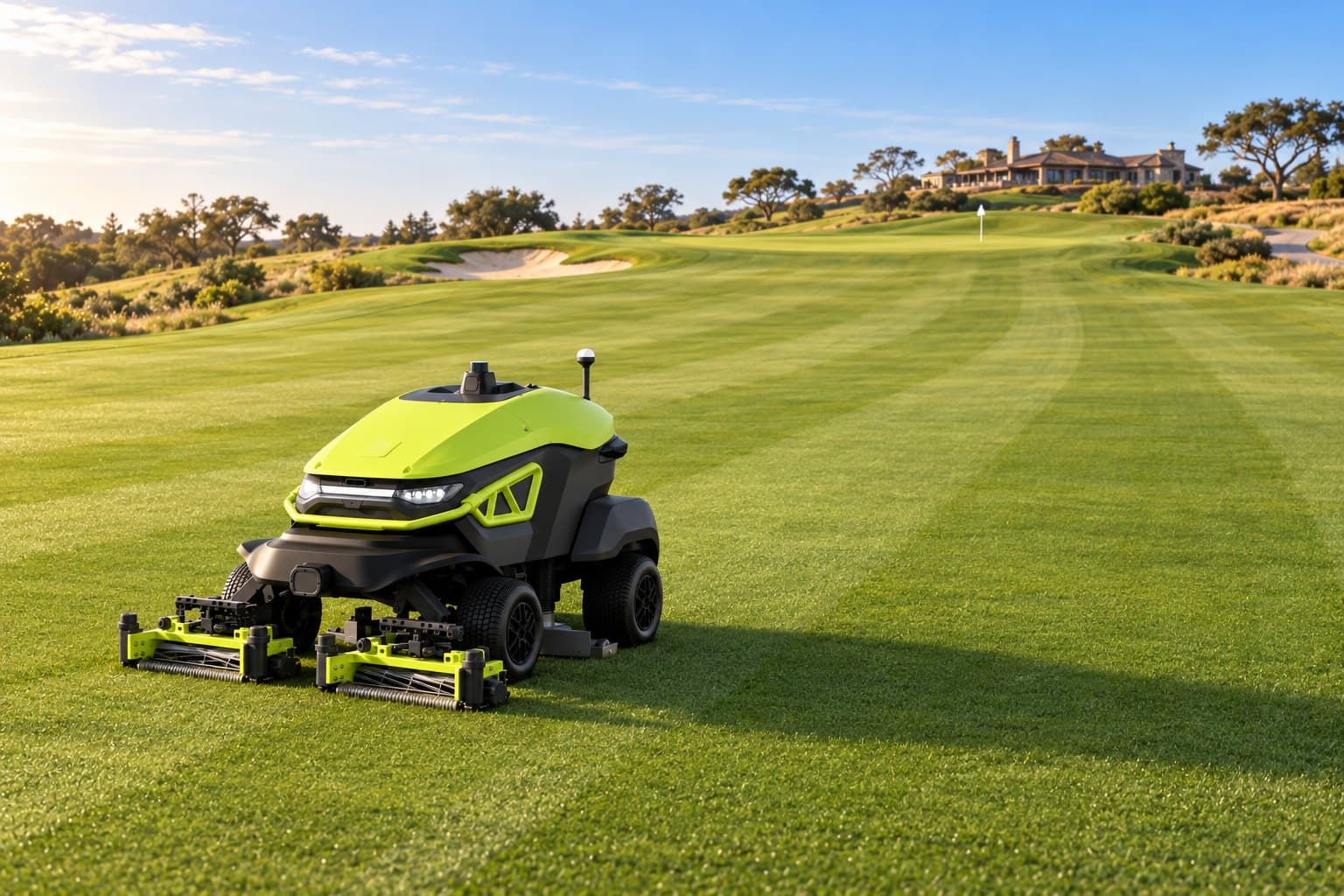
A wire-free robot lawn mower navigates with RTK GPS: it corrects its satellite position against a fixed reference station to about 2 cm, so it can hold a mapped boundary with no perimeter wire in the ground. Service Robot Co. installs both wire-free and wired commercial mowers, picking by the site’s sky view, and leases them on a 3-year lease with a $1 buyout.
Robot lawn mowers at a glance
- positioning accuracy ECHO Robotics publishes for the GPS-RTK TM-2050 (ECHO Robotics, TM-2050 product page (read November 2026))
- 2 cm
- approximate positioning accuracy of Husqvarna’s EPOS satellite system, per its spec page (Husqvarna, CEORA 544 EPOS / RZ 43M / CS4 product page (UK))
- 2 cm
- ECHO says the TM-2050 mows perfect trajectories without boundary wires (ECHO Robotics, TM-2050 product page (read November 2026))
- 0 wires
- wired My Goat mowers one groundskeeper can oversee, company-reported (Robotics 24/7: My Goat educates the lawn care industry on the benefits of robots (February 2022))
- 70


How a robot mower knows where the edge is
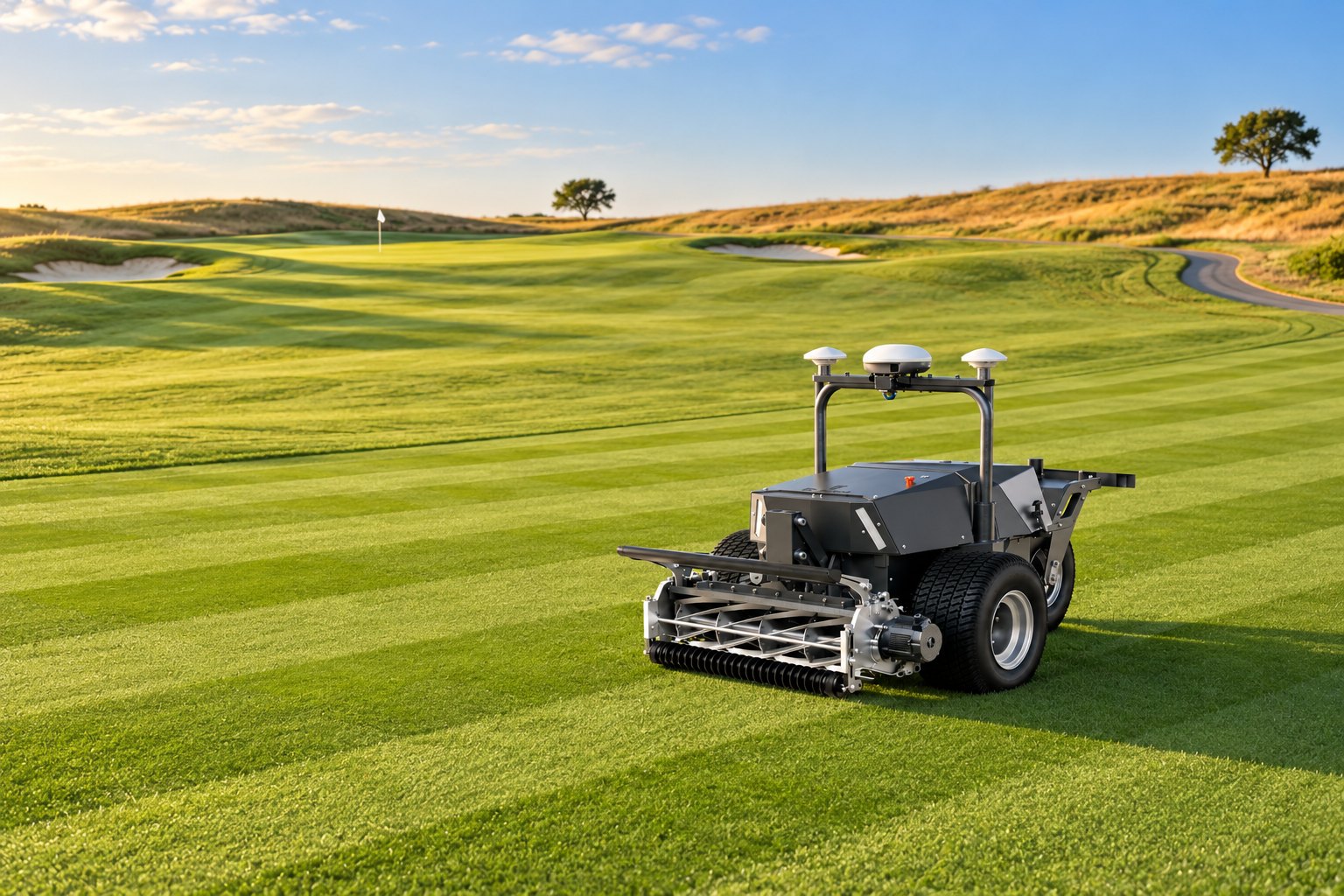
Every robot mower needs a boundary. The first generation got it from a perimeter wire buried around the lawn: the mower senses the wire’s signal and turns back. Wire-free mowers get it from a map instead. The mower knows its own position precisely enough to follow a boundary drawn on a tablet, and that precision comes from RTK, real-time kinematic correction of a satellite position.
Plain GPS is accurate to a few metres, which is useless at a bed edge. RTK fixes that by comparing the mower’s satellite signal with the signal at a reference station whose position is known exactly, and correcting the difference in real time. Husqvarna calls its system EPOS and lists an EPOS reference station in the CEORA kit; ECHO calls the TM-2050 a GPS-RTK mower; Kress calls its line RTKn and, per Mowing Magic, uses a Kress RTK network with no perimeter wire. All three publish accuracy of about 2 cm. Source
Wire versus RTK on a commercial site
Neither is better everywhere. The table sets out the trade-offs we check on every site assessment.
| Question | Perimeter wire | RTK satellite guidance (EPOS, RTKn, GPS-RTK) |
|---|---|---|
| How the boundary is set | A wire is trenched around each zone and around islands such as beds and trees. | Zones and no-go areas are drawn on a map; nothing goes in the ground except a reference station. |
| Changing the layout | Re-trench the wire where the bed, path or fence moved. | Redraw the map. Contractors still report mapping a property several times before the workflow settles, per NALP. Source |
| Where it struggles | Wire breaks from aeration, digging or rodents stop the mower until found and spliced. | Heavy tree canopy and tall building shadow degrade the RTK fix, per MowScout. Source |
| Coverage of the signal | Only as far as the wire runs. | Only where the reference station or network reaches: MowerRanker says Kress RTKn works only where a dealer antenna covers the address. Source |
| Stripes and patterns | Random or semi-random paths inside the wire. | Straight, repeatable lines; ECHO says the TM-2050 mows perfect trajectories without boundary wires. Source |
| Typical use | Fenced pens of small mowers: My Goat buries a boundary wire at installation, then supports the fleet remotely. | Large open turf: fairways, rough, campuses, parks, solar sites. Source |
Where wire-free mowers fail, and what to check
RTK needs sky. MowScout’s review of a satellite-guided commercial mower says heavy tree canopy and tall building shadow degrade the RTK fix, and a mower without a fix stops. On a site assessment we walk every zone and look up: a lawn between two tall buildings, a park under mature oaks or a cemetery with dense tree cover may need a wire, a mix of guidance types or a crew. Source
RTK also needs its reference. Some makers run a network of correction antennas, and the mower works only within range of one; MowerRanker says that is the case for Kress RTKn, and Mowing Magic notes that a dealer installs each mower. Others ship a reference station with the machine, as Husqvarna does with the CEORA kit, so the site carries its own. A Kansas club checked its cell signal and the distance to a GPS base station before committing, according to Golf Course Industry. Do the same. Source
Finally, RTK tells the mower where it is, not what is in front of it. Obstacle handling is a separate system: ECHO says the TM-2050 uses sonar units to detect obstacles even on slopes of up to 45%, and USGA reports that robot mowers are programmed to move around obstacles, including golf balls. The USGA also notes that reel robots can get stuck or throw faults that need a reset, so plan for a person who answers those. Source
“Heavy tree canopy, tall building shadow ... degrade the RTK fix”
When a wire still makes sense
A wire is cheap to run and does not care about trees. For fenced, shaded or small zones mowed by fleets of small machines all day, it remains the simpler choice, which is why fleet operators such as My Goat bury one at installation and report a single groundskeeper overseeing up to 70 mowers. A wire is the wrong choice where the layout changes often, where you want straight stripes or where the turf is measured in tens of acres. Source
How Service Robot Co. picks the guidance for your site
We are not tied to one navigation system or one maker. At the free site assessment we map the sky view of every zone, check where a reference station or antenna would sit, note the zones that need a wire or a crew, and pick the machine that fits. Then we lease it on a 3-year lease with a $1 buyout, set the boundaries, train the crew to redraw them when the site changes and service it.
RoboCare™
Service nationwide.
- 24/7 support.
- 10-minute technical-specialist triage.
- Regional service engineers in every state we service.
- 3 check visits a year.
- 12-month warranty.
Common questions
Go deeper
Robot lawn mower guides
- Commercial robot lawn mowers: leased, installed and serviced
- How Much Does a Robot Lawn Mower Cost?
- Best Robot Lawn Mowers for Commercial Properties in 2026
- Robot Lawn Mowers for Large Properties: 1, 2, 5 and 20+ Acres
- Does a Robot Lawn Mower Actually Work?
- Robotic lawn mower cost for golf courses
- Robotic mowers for landscapers
- Robots for golf courses
Sources
- ECHO Robotics, TM-2050 product page (read November 2026)
- Husqvarna, CEORA 544 EPOS / RZ 43M / CS4 product page (UK)
- Husqvarna US, CEORA commercial robotic mower (read November 2026)
- Mowing Magic: review of the Kress RTKn line of robot mowers (November 2023)
- MowerRanker: Kress Mission RTKn KR161 review
- MowScout: review of a satellite-guided commercial mower (updated July 2026)
- NALP, The Edge: what contractors need to know before going all-in on robotics (May 2026)
- Automated Warehouse: My Goat is a robotic service provider offering autonomous lawn care
- Robotics 24/7: My Goat educates the lawn care industry on the benefits of robots (February 2022)
- Golf Course Industry, implementation at a Kansas club
- USGA Green Section Record, how do robot mowers affect turf management and the golfer experience? (April 2025)
- USGA Green Section Record, AI for autonomous mowers (2026)
Start with a free site assessment.
Send us the acres you want mowed first. We walk the site, tell you honestly whether a robot lawn mower fits and quote the lease before you commit.
Find the robot that fits your site.
Free site assessment. We tell you what actually works before you spend a dollar.