

The short answer
Robotic lawn mower ROI for motels comes from taking scheduled mowing of frontage, sign areas and lot edges off staff or contractor hours, and the savings range depends on lot area, obstacles, season length and what mowing costs today. The calculator on this page shows a range, not a promise, and a free site assessment measures those inputs before any fixed robot lease payment is quoted.
Read the commercial robot lawn mower guideSee what a robotic mower costsRun the numbers in the ROI calculator
Key takeaways
- A motel's mowing return comes from hours moved off staff or contractors, measured on your own lot.
- Obstacles, slopes and lot shape change the number more than lawn size alone.
- Labor is hard to fill in landscaping, so a fixed mowing schedule carries less staffing risk.
- Treat every figure as a range until a site assessment measures your hours and lease terms.
- Pilot the largest mowing zone first and measure a full growing cycle before committing the property.
How does robotic lawn mower ROI for motels work?
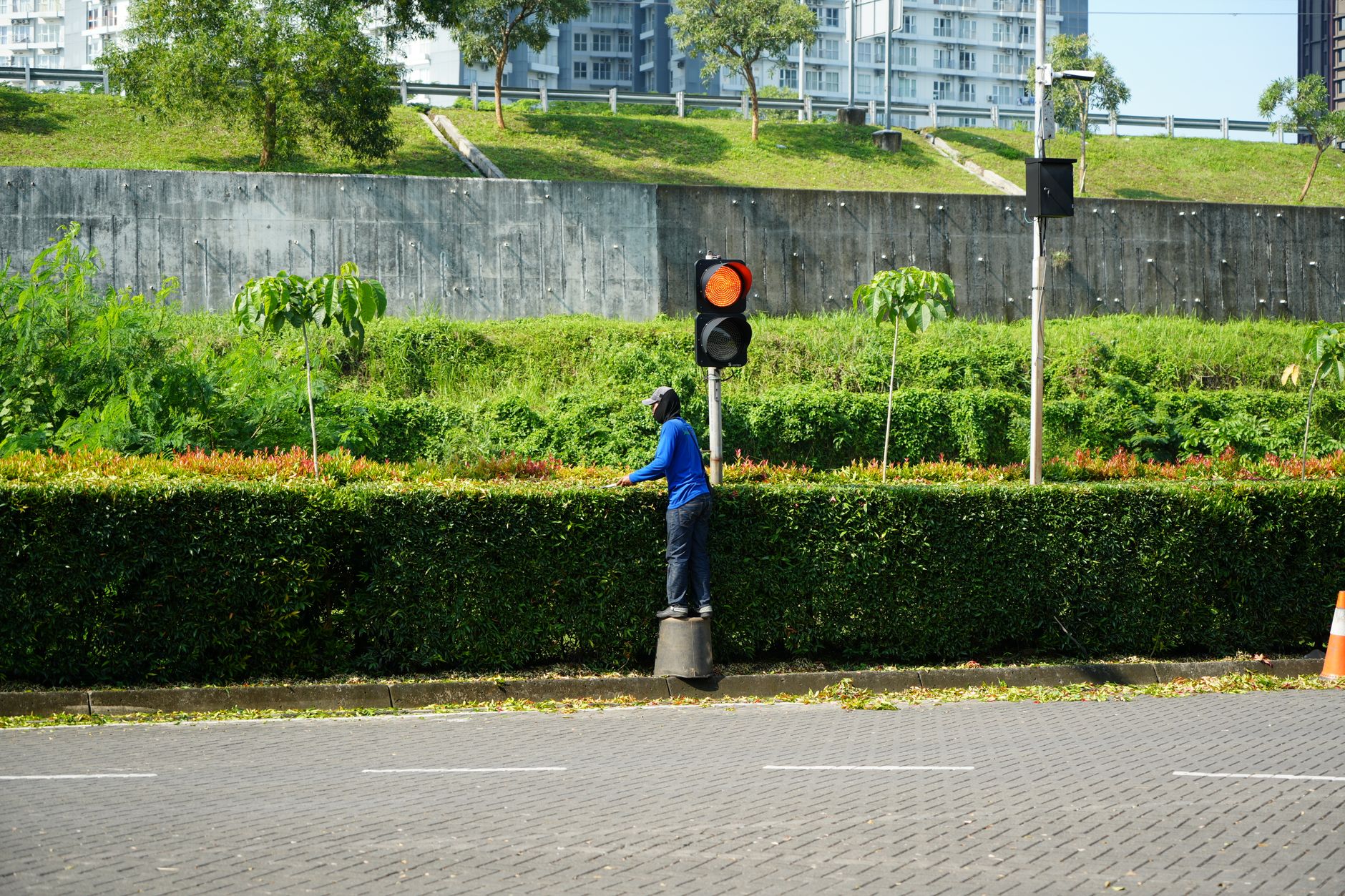
Robotic lawn mower ROI for motels comes from one place: scheduled mowing that stops taking staff hours or contractor visits away from other work. A motel has the grounds pattern that suits this well. Frontage strips, sign beds, lot edges, side yards and a rear property line all need cutting on a regular cycle, and most of that work is repetitive, open and predictable.
We are a US commercial robot integrator. We pick the robot for the site, lease it through financing, deploy and integrate it, train the staff who will check it, and service it nationwide. The calculator on this page is pre-filled for motels and produces a savings range from your inputs. Read this page as the method behind that range, and treat the result as an estimate until a site assessment measures your lot.
Two inputs carry most of the math: the hours your property spends on mowing now, and the share of that mowing a robot can realistically take. A robot does not take every task. Hand edging, trimming around fixtures and clearing debris stay with people, so the offset is the share of routine cutting, not the full grounds budget.
How many motels could use a robotic lawn mower?
According to a directory count of verified business listings, there were 32,199 motels in the United States as of August 2025. That is a listing count, not an official census, so treat it as the scale of the market rather than an exact base. The number still shows how many lots share the same pattern of wide frontage, sign areas and long edges.
No official government count of motels alone was found in this research. Broader categories combine hotels and motels, so they overstate the motel-only base. The more useful planning point is that motel grounds vary widely. A roadside property with a narrow strip of lawn and an interstate property with a large sign field and a rear easement are very different jobs, so size the work from the lot, not from the property type.
Where does the labor offset come from?
The labor offset is the mowing time that moves off staff or a contractor. The US grounds workforce is large and seasonal. The Bureau of Labor Statistics Occupational Outlook Handbook reports about 1.3 million grounds maintenance workers in 2024 data, with about 1.19 million in landscaping and groundskeeping, and projects 4 percent growth from 2024 to 2034, which it describes as about average. The same handbook notes the work is seasonal, so a motel that depends on a crew for peak weeks faces the sharpest scheduling strain.
The lodging workforce is also large. A lodging trade publication, reporting American Hotel and Lodging Association projections, says US hotels are expected to add more than 14,000 direct jobs in 2025, reaching about 2.17 million. Those are projections, not Bureau of Labor Statistics counts, and they cover hotels rather than motels alone.
Hiring is the harder problem. A 2025 survey of commercial landscape contractors, covering 1,015 contractors, found 70 percent planned wage increases that year. The 2025 State of the Green Industry report, from 424 respondents, found 29 percent named labor as their most pressing concern. No published motel-specific headcount was found, so this page uses one person as a planning assumption for grounds work at a typical site. Replace that with the property's own count at assessment.
Work is divided across zones, and each zone offsets hours differently.
How is the savings range calculated?
The calculation has four steps. First, measure current mowing hours for the property, including crew time, contractor visits, equipment handling and the time spent re-cutting missed strips. Second, apply the share of that work a robot can realistically take, which is less than the total because hand work stays with people. Third, subtract the fixed robot lease payment, which is quoted after the site assessment. Fourth, express the result as a range, because every input carries some uncertainty.
The hours offset and the lease payment together produce a net figure. If the robot takes a larger share of the hours and the lease is small relative to those hours, the return rises. The reverse also holds. The calculator on this page shows the range from the inputs you enter, not a guaranteed result. Ask the assessment team to show each input and its source, so the number can be checked after go live.

What changes the number up or down?
Obstacles are the largest single variable on a lawn. A robot mower maker's guide to large lawns says that a one-acre yard with mature trees and complex landscaping loses 20 to 30 percent of rated coverage to obstacle navigation, and that no single residential model handles a one-and-a-half to two-acre lawn in one cycle. That guide is written for home yards, so treat it as a direction, not a commercial benchmark. Motel lots have their own obstacles: light poles, signs, curbs, landscape islands, parking blocks and drainage structures.
Rated coverage also depends on the mode the mower runs in. The same guide gives a rated 2,500 square meters, about 0.62 acres, per day in its standard mode, with higher ratings in faster modes. Ratings describe ideal conditions. A single product review, which was not a controlled study, found users typically reach about 60 percent of advertised coverage, with one model averaging about 0.75 acres per charge against a rated 1.25 acres. Plan around the realistic daily area on your lot. Slope, grass type and rainfall push the number up or down as well.
Season length matters. Grounds work is seasonal, so a property in a region with a short growing season gets fewer months of offset than one in a long season. Existing contracts also shape the number. A contract priced per visit produces a different offset than a crew paid for hours worked.
What are the risks to the return, and how do you avoid them?
The biggest risk is planning around the rated area instead of the real one. Map the lot, mark obstacles and boundaries, and run a pilot on the largest mowing zone first. A pilot that measures actual hours across a full growing period is worth more than a forecast built from a brochure.
The second risk is guest and safety conflict. Landscaping is a high-injury occupation. A safety records site citing Bureau of Labor Statistics survey data reports 3.0 injuries and illnesses per 100 full-time workers for landscaping services in 2024. A news report on an analysis of federal data found a grounds maintenance fatal rate of 20.9 per 100,000 workers in 2024, with 239 deaths. A scheduled machine may reduce how often people work near moving equipment on routine cuts, but it does not remove the need for supervision. Set rules for guests and pedestrians, keep pool and play areas on a separate schedule, and train staff on stop procedures.
The third risk is downtime. A mower that sits idle through a peak week returns nothing for that period. Service coverage, a spare unit plan and remote triage reduce that exposure, and the lease quote should state the service response expectation in writing.
How long does payback take, from assessment to first savings?

The path runs in steps. Assessment maps the lot, measures current hours, and identifies obstacles and boundaries. The quote then sets the fixed robot lease payment and the lease terms, including what maintenance is included. Deployment installs boundaries, sets zones and connects the schedule to staff. Go live support covers the first growing weeks, when schedules and boundaries get tuned. Payback is measured against the baseline hours recorded at assessment, not against an estimate.
Expect the first season to be a tuning period. Early weeks often show coverage gaps, obstacle problems and schedule conflicts with events or irrigation runs. Starting deployment ahead of the peak mowing months lets zones settle before guests and events arrive. Payback is clearest once a full cycle of normal mowing has run, because seasonal peaks and quiet periods distort a short sample.
Where does a grounds crew still beat a robot?
A robot does not replace a grounds crew entirely. People win on hand edging around sign bases, trimming near fixtures, clearing debris after storms, responding to irrigation breaks, and handling irregular areas that were not on the map. Staff also notice what a machine will miss, such as a bare patch, a fallen branch or a damaged sprinkler head. The sensible setup keeps one person responsible for grounds checks while the robot handles the routine cut on schedule.
Where the lot is simple and the schedule is steady, the robot takes most of the routine work. Where the lot is full of obstacles or the season is short, the offset is smaller, and the case rests on specific zones rather than the whole property.
How do I get a precise figure from a free site assessment?
Ask for a free site assessment. We map the property, record zones and obstacles, measure current hours with the staff or contractor who does the work, and check boundaries and charging access. We then choose the robot that fits the site and quote a fixed robot lease payment, with the lease financing options and a clear list of what the service plan covers. Each input gets a source, so the savings range can be checked after go live.
Bring your current mowing hours, your contract terms, your lot plan and a list of known problem areas. A site with clear records produces a tighter range than one built on estimates. We deploy and integrate the robot, train the staff who check it, and service it nationwide, with on-site dispatch when a fault needs hands and remote triage for everything else.
Frequently asked questions
Upcoming hotels & hospitality events
- MeetupMPI Virginia Morning Brew Meet-Up, November 2026Nov 10, 2026Hampton, VA
- SummitVA1 Governor's Tourism Summit 2026Nov 18 to 20, 2026Kalahari Resorts & Conventions, Spotsylvania, VA
- ConferenceVirginia Association of Fairs ConventionJan 14 to 17, 2027Williamsburg Lodge, Autograph Collection, Williamsburg, VA
- ConferenceIHLA Convention and Exposition, 2027Feb 8 to 10, 2027Indianapolis, IN
Want a robotic mower at your motel?
Tell us about your site. We will recommend the robot, quote the lease, and keep it serviced.
Sources
- Motel directory count, August 2025
- Lodging trade press report on AHLA projections
- Bureau of Labor Statistics Occupational Outlook Handbook, grounds maintenance workers
- News report on federal data analysis, grounds maintenance fatalities
- Safety records site citing BLS SOII data
- 2025 survey of commercial landscape contractors
- 2025 State of the Green Industry report
- Robot mower maker guide to large lawns (vendor-reported)