
The short answer
A cleaning robot vs janitor in Denver is rarely an either-or choice. A leased floor robot makes sense when large, open, repeatable floors can be cleaned while the building is empty, and it does not make sense when most of the work is spot cleaning, restrooms, or moving furniture. Keep staff for the work a robot cannot do, and confirm the fit with a free site assessment before any lease is quoted.
Key takeaways
- A floor robot fits large, open, repeatable floors that can be cleaned while the building is empty.
- A janitor is still needed for restrooms, spills, corners, trash, restocking and judgment calls.
- BLS projects about 351,300 openings a year for janitors and building cleaners, mostly replacement hiring.
- The 2020 BLS injury rate for janitors and cleaners was 191.6 per 10,000 full-time equivalent workers, so track your own incident records.
- Plan a robot plus fewer staff, never zero staff, and check the fit in a site assessment first.
Cleaning robot or janitor for a business in Denver: which makes sense?
A floor cleaning robot makes sense in Denver when your floor work is large, open and repeatable, and when much of it can run while the building is empty. A janitor still makes sense for work that depends on people: restrooms, spills, tight corners, furniture, trash and anything that needs a judgment call. Most sites end up with a mix, where the robot takes the routine floor passes and staff handle everything else.
The robot does not fit well when floors are mostly small rooms, heavy with clutter or broken up by stairs, or when the cleaning is mainly spot work scattered across the day. It also struggles when the route cannot be mapped cleanly or when traffic is too unpredictable for a machine to pass safely.
The decision is about coverage hours, not about replacing a worker. The sections below cover the job itself, what the government data says about labor and injuries, and how a site assessment tests the fit before any lease is quoted.
What does a janitor actually do during a shift in Denver?
Janitors and building cleaners are a large occupation. The BLS Occupational Outlook Handbook reports about 2,447,700 of them in the US in 2024, so the job is common in offices, schools, hospitals and retail. The government wage data on this page shows the local wage for this job, which is the right reference for any labor comparison in Denver.
A shift usually mixes several kinds of work: emptying trash and recycling, restocking paper and soap, cleaning restrooms, wiping high-touch surfaces, responding to spills, sweeping or mopping hard floors, and vacuuming where needed. The order depends on the building, the schedule and what people report during the day.
That mix is why the job is hard to automate in one step. The floor passes are repeatable and suit a machine. The rest changes from room to room and hour to hour, and it often needs someone to notice a problem and act on it.
Median hourly wage, Janitors and Building Cleaners
$4,200
Monthly cost of one full-time worker in Denver, CO, at the median wage plus payroll costs (an estimate, not a quote).
Which parts of the cleaning can a robot take over, and which can it not?
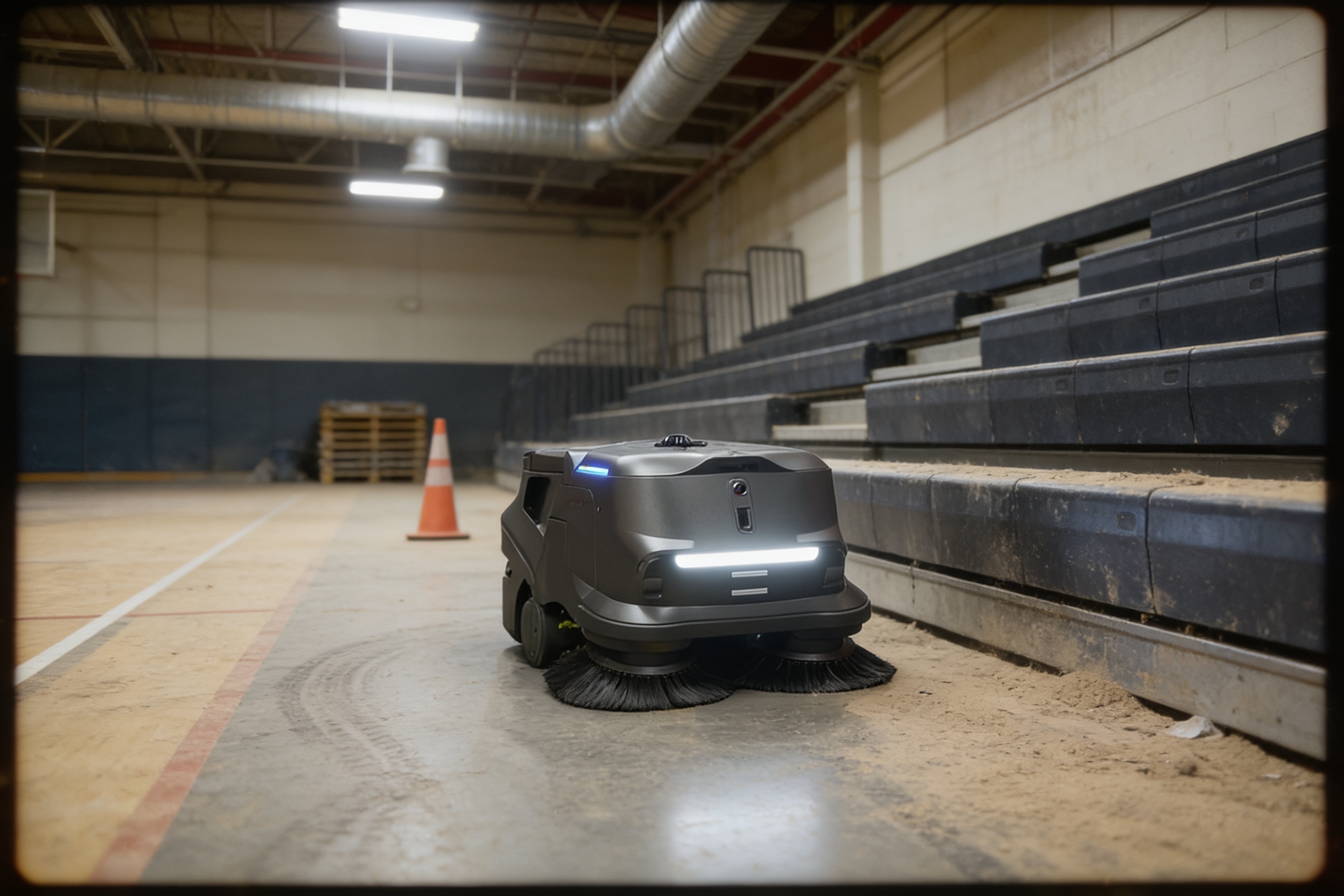
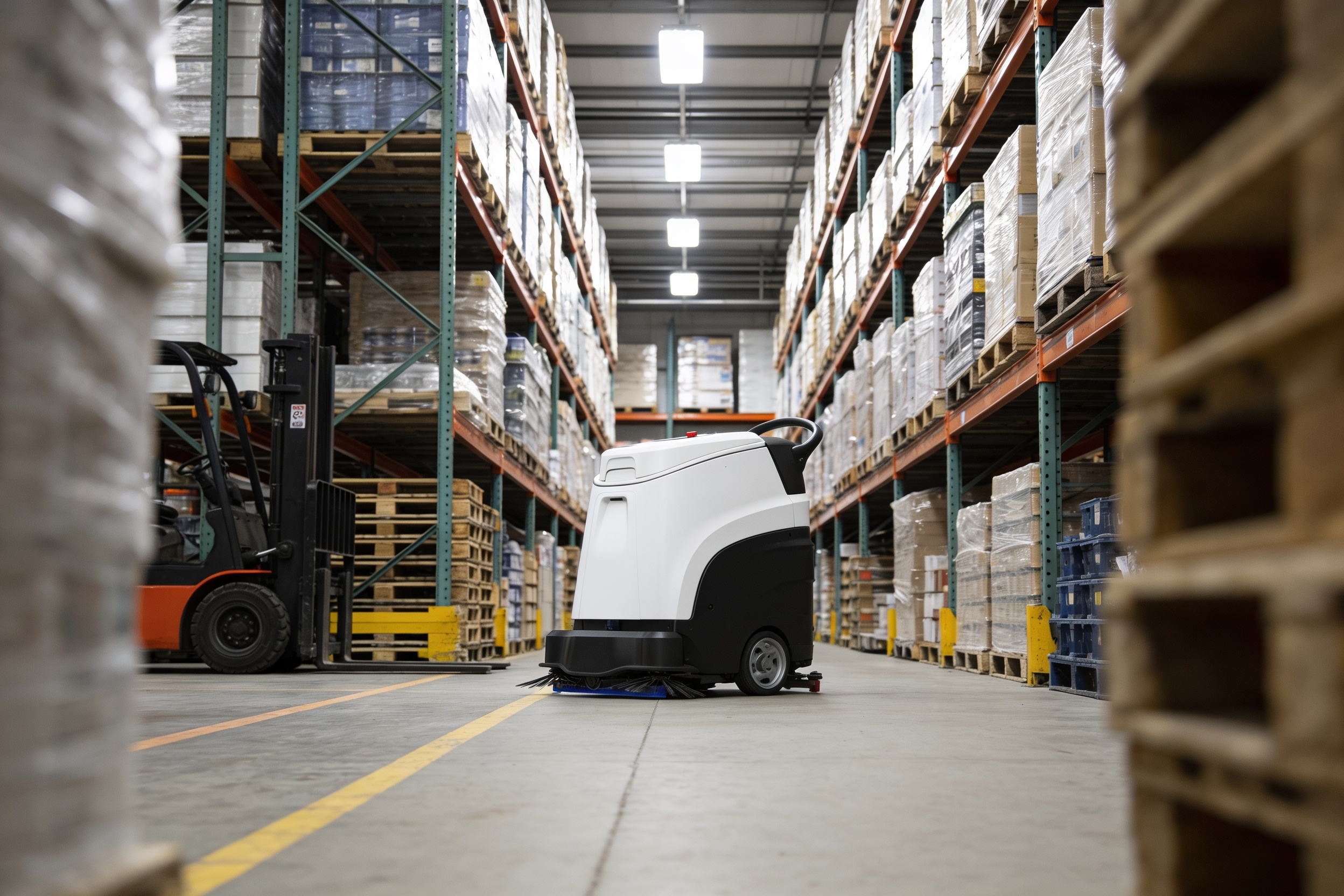
A floor cleaning robot takes over the repeatable floor passes: scrubbing or sweeping open corridors, lobbies, open office floors and large clear areas. It follows a route mapped during the site assessment, runs on a schedule, often overnight or between shifts, and repeats the same path each time. The value is floor coverage that would otherwise take a person's shift time.
It cannot take over restrooms, which need hands, supplies and inspection. It does not handle trash pickup, restocking, furniture, unknown spills or fixing what it finds. Corners and edges are usually left for a person with a hand tool, and a robot will not notice a broken fixture or a leak unless its sensors happen to see it.
In practice the split is clean. Anything repeatable on open floor is a candidate, and anything that needs hands, supplies or a decision stays with staff.
- Night coverage
Cleaning Robot
Runs on a schedule when the building is empty, with no shift to staff.
Janitor
Can work nights, but needs scheduling, supervision and off-hours pay.
- Repeatable floor passes
Cleaning Robot
Same route each run, with no drift in coverage.
Janitor
Consistent when well trained, but tires and varies between shifts.
- Restrooms and spills
Cleaning Robot
Not suited. Cannot clean restrooms or handle unknown spills.
Janitor
Clear winner. Hands, supplies and judgment handle these.
- Corners and edges
Cleaning Robot
Limited. Edges and tight spaces are usually left for hand work.
Janitor
Wins. A person reaches corners and edges with a hand tool.
- Unplanned problems
Cleaning Robot
Stops and alerts when its path is blocked, but cannot fix or decide.
Janitor
Notices a leak, a broken fixture or a hazard and acts on it.
- Absence and sick days
Cleaning Robot
Does not call in sick, though a failed unit needs a backup plan.
Janitor
Can call in sick, so the team must plan coverage for the shift.
- Trash and restocking
Cleaning Robot
Not part of the robot's work.
Janitor
Done by staff during the shift.
What do the hours and labor data show for janitors?
According to the BLS Occupational Outlook Handbook, janitors and building cleaners will see about 351,300 openings a year, mostly from workers leaving the occupation and being replaced. The same source projects about 47,800 new jobs and 2% growth from 2024 to 2034, which it describes as slower than average. Most hiring for this job is replacement hiring, not expansion.
BLS does not publish an official turnover rate for this occupation, so the openings figure is the closest official measure. An industry trade blog says only leisure and hospitality has a higher turnover rate than janitorial work, without giving an exact figure. For a Denver manager, recruiting is a constant task, and an unfilled night shift lands on the staff who remain.
For the Denver metro, the BLS OEWS table for May 2023 lists 350 jobs in Building Cleaning Workers, All Other, down from 510 in May 2021 and 450 in May 2022. That is an adjacent category, not the same count as janitors and building cleaners, and the metro is now named Denver-Aurora-Centennial. The May 2024 Denver count for the janitor category was not retrieved for this page, so use the government wage data panel as the local reference for the job.
Overtime, sick-day and night-shift figures for this occupation were not verified for this page. Check your own timekeeping records for those, because they change the case for a robot more than any national average would.
| Task | Today | With a robot |
|---|---|---|
| Scrub open corridors and lobby floors | The largest share of routine floor time | A scheduled run, with staff checking the result |
| Sweep or scrub large open office floors | Steady recurring work across the shift | Runs while the floor is empty |
| Restroom cleaning | A fixed, hands-on share of each shift | Stays with staff, no change |
| Spot cleaning and spills | Unplanned work spread through the day | Stays with staff, the robot does not replace it |
| Trash, restocking and walking between rooms | Much of the remaining shift | Stays with staff |
No hour figures for this occupation were verified for this run, so the table uses relative terms. Replace them with your own timekeeping figures from the site assessment.
What do injury rates mean for the janitor side of the decision?
BLS publishes injury data for this group as a whole. For 2020, the BLS snapshot for janitors and cleaners, excluding maids and housekeeping cleaners, reports 21,100 nonfatal injury and illness cases with days away from work in private industry, at a rate of 191.6 per 10,000 full-time equivalent workers. For 2019, the janitor series reports 18,680 cases at a rate of 157.4.
Fatal work injuries for the occupation were 45 in 2019 and 42 in 2020, according to the same BLS series. Those counts are small, so the per-worker rate is the fairer way to compare this job with others.
The verified national rate runs only to 2020, and no 2021 to 2024 rate for this occupation was found for this page. Manual scrubbing and pushing equipment are the tasks a floor robot would take off a person's hands, so your own incident log should show whether those tasks drive your claims before you decide what the robot is meant to reduce.
How does a team work with a robot in place?
The robot is never the only worker on the floor. A workable model keeps the janitors you have, moves them from floor passes to restrooms, spills, restocking and checks, and adds the robot to cover open floor on a schedule. Headcount can drop through attrition over time, but the first step is a robot plus the same or fewer staff, not zero staff.
Training matters as much as the machine. Staff need to know how to clear the route, what the robot's stop signals mean, how to mark an obstacle and who to call when it stops. We train the staff on site during deployment, so the people who sign off on the decision also know what they are supervising.
The real risk is a coverage gap. If the robot is down on a given night, the floor still has to be done, so lease planning should cover what happens on a failed night and who responds when the unit needs service.

What can a cleaning robot not do?
A floor robot is not a complete janitor. It does not clean restrooms, empty trash, restock supplies, move furniture or handle biohazards. It also cannot judge a wet floor sign placed in the wrong spot or decide that a chair in a doorway should be moved.
Floor conditions set the limit more than the model does. The list below shows the conditions that most often stop a route or leave a poor finish, and each one should be checked before a lease is quoted.
The honest answer for many Denver sites is a mixed plan: the robot covers open floor at night and staff handle the rest. If the building is mostly restrooms and spot cleaning, a janitor is the right first hire, and a robot may not fit at all.
- Deep-pile or thick carpet the route cannot cross
- Stairs, ramps and level changes
- Loose cords, cables and cluttered floors
- Heavily damaged floors or uneven seams
- Crowded event floors with unpredictable traffic
Are other facilities adopting autonomous cleaning equipment?
According to ISSA Today, reporting on the CMM In-House/Facility Management Benchmarking Survey, 43 percent of respondents plan to adopt autonomous cleaning equipment. That figure comes from the survey itself, not from a vendor, but it measures plans, not completed installations.
The main AACEM and ISSA autonomous cleaning survey dates from 2019, and its full report is limited to ISSA members. The newer benchmarking figure is the more useful signal, though plans are a starting point and not proof that a robot will fit a particular building.
How do you get started with a robot for a Denver site?
Start with a site assessment. We map the floor, check the route, review doors, elevators, floor types and the hours the building is empty, then recommend the robot that fits the site. The assessment is free, and the lease is quoted after it.
We lease the robot through financing, then deploy and integrate it, train the staff and service it nationwide with on-site dispatch and remote triage. A common first step is one leased unit on the highest-value floor, with a second unit only if the first one earns its place. Confirm the backup plan and the service response in writing before you sign.
Bring your cleaning records, the list of areas you want covered and the hours the building is empty. Those three items are enough to show whether a robot plus fewer staff makes sense, or whether a janitor is the better first hire.
Frequently asked questions
Put a robot to work in Denver.
We walk your site, learn the job, and recommend the unit that fits. Then we quote the lease, deploy it, and keep it serviced.
Sources
- US Bureau of Labor Statistics, Occupational Employment and Wage Statistics (OEWS May 2024)
- BLS Occupational Outlook Handbook, Janitors and Building Cleaners
- BLS Occupational Employment and Wage Statistics, May 2023, SOC 37-2019 Denver metro
- BLS Injuries, Illnesses and Fatalities snapshot, Janitors and Cleaners (except Maids and Housekeeping Cleaners), 2016 to 2020
- BLS Injuries, Illnesses and Fatalities snapshot, Janitors, 2015 to 2019
- ISSA Today, September to October 2025, CMM In-House/Facility Management Benchmarking Survey
- AACEM/ISSA Autonomous Cleaning Survey Report
- Janitorial Manager blog, ways the janitorial industry turnover rate has changed