
The short answer
A cleaning robot makes sense in Columbus, OH when the floor work is large, mostly open and repeated on a set route, especially overnight, and when those night hours are hard to staff. It does not replace a janitor, because restrooms, trash, spills and judgment calls still need a person on site. The cleaning robot vs janitor in Columbus decision comes down to whether the lease quote, set after a free site assessment, is lower than the night labor it would cover.
Key takeaways
- A cleaning robot fits large, open, repeated floor routes, not whole janitorial jobs.
- Restrooms, trash, spills and judgment calls stay with a person.
- Measure your own floor pass time, because vendor listed rates overstate practical output.
- The lease quote comes after a free site assessment and should be compared with your night hours.
- Every robot route needs a named person on each shift and a backup for that person.
Cleaning robot vs janitor in Columbus: does it make sense?
A cleaning robot makes sense for a Columbus site when the floor work is large, mostly open and repeated on the same route, and when those hours are hard to staff at night. Wide corridors, sales floors and warehouse aisles that get the same pass every night are the strongest fit. The robot earns its place by taking that routine pass off the crew's list.
It does not make sense as a full replacement for a janitor. Restrooms, trash, spills, glass, detail work and any task that needs a judgment call still need a person on site. A building with many small rooms, constant furniture moves or the same spots blocked every shift usually gets less from a robot than a building with long, clear floors.
Adoption is growing, though the figures are global and sample-based. According to the International Federation of Robotics, professional cleaning robots ranked third by units in 2024, up 34%, with more than 25,000 units sold, mostly for floor cleaning in airports, supermarkets and shopping centers. The same source says its figures come from a sample of 294 companies and are not projected to the whole industry.
The fair test is simple. If a robot can run the routine floor pass unattended and a person covers the rest, the lease case is worth checking. If the pass is short or broken up by obstacles, a janitor with a good cart often remains the better tool.
What does a janitor actually do in a shift in Columbus?
A janitorial shift in a commercial building is rarely one task. Workers empty bins, restock paper and soap, clean restrooms, dust surfaces, scrub hard floors, vacuum carpets and answer spills as they come up. Most of that work is done on foot with carts and hand tools, moving between zones along a route.
The occupation is large. According to the U.S. Bureau of Labor Statistics, janitors and building cleaners held about 2.4 million jobs in 2024. A city statistics site reports about 14,130 janitors and cleaners employed in the Columbus metro. That is a secondary estimate, not an official OEWS table figure, so treat it as a rough local reference.
A wage aggregator reports that Ohio's statewide median for this job in May 2024 sat about 3% below the national median. The local wage for this job appears in the government wage data panel on this page. Compare that panel to your own staffing costs, not to a national average.
The robot competes only with the part of the shift that repeats. List the tasks by minutes, not by job title, and the split will usually show where a robot can help and where it cannot.
Median hourly wage, Janitors and Building Cleaners
$3,948
Monthly cost of one full-time worker in Columbus, OH, at the median wage plus payroll costs (an estimate, not a quote).
Which parts of the cleaning can a robot take, and which can it not take?
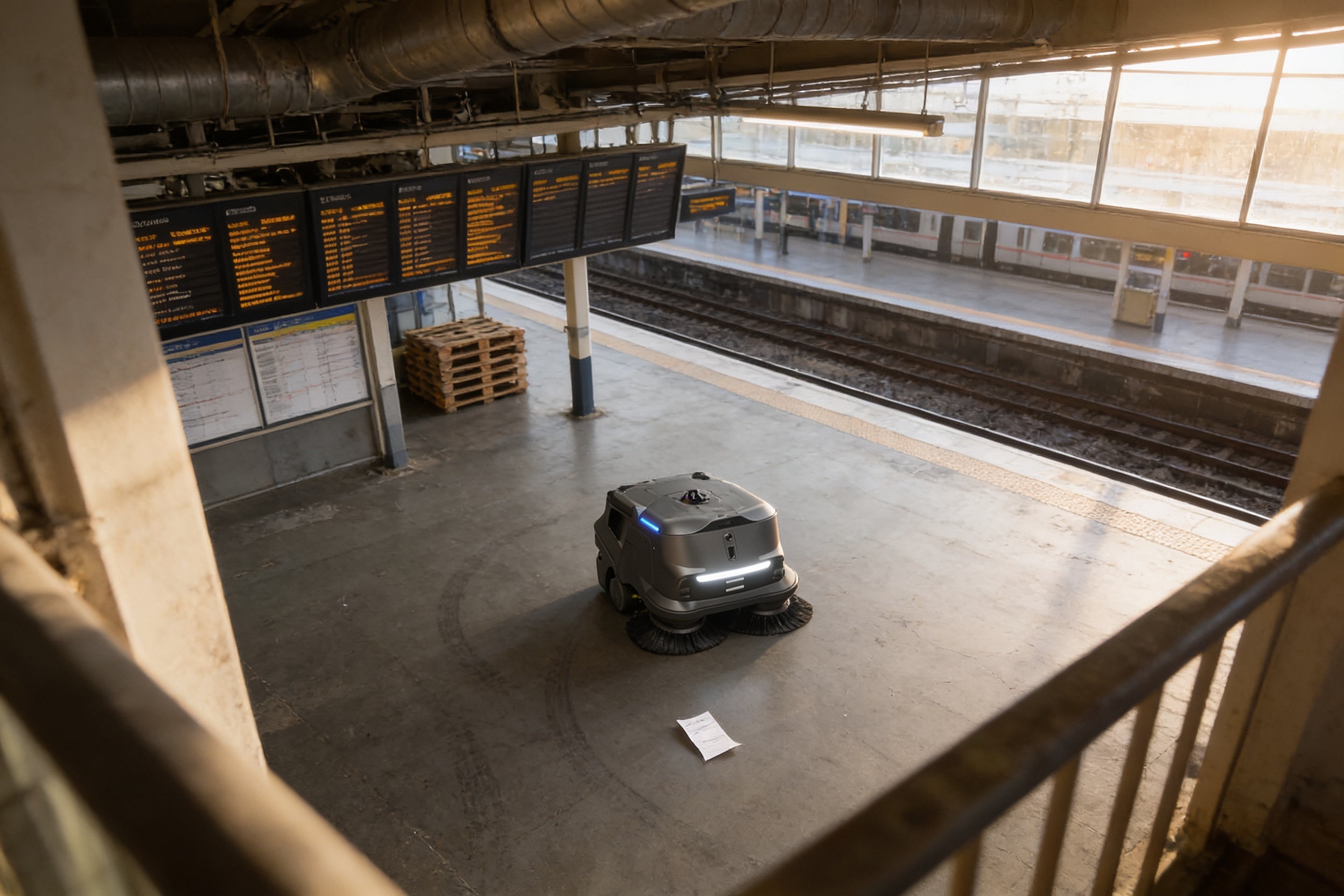
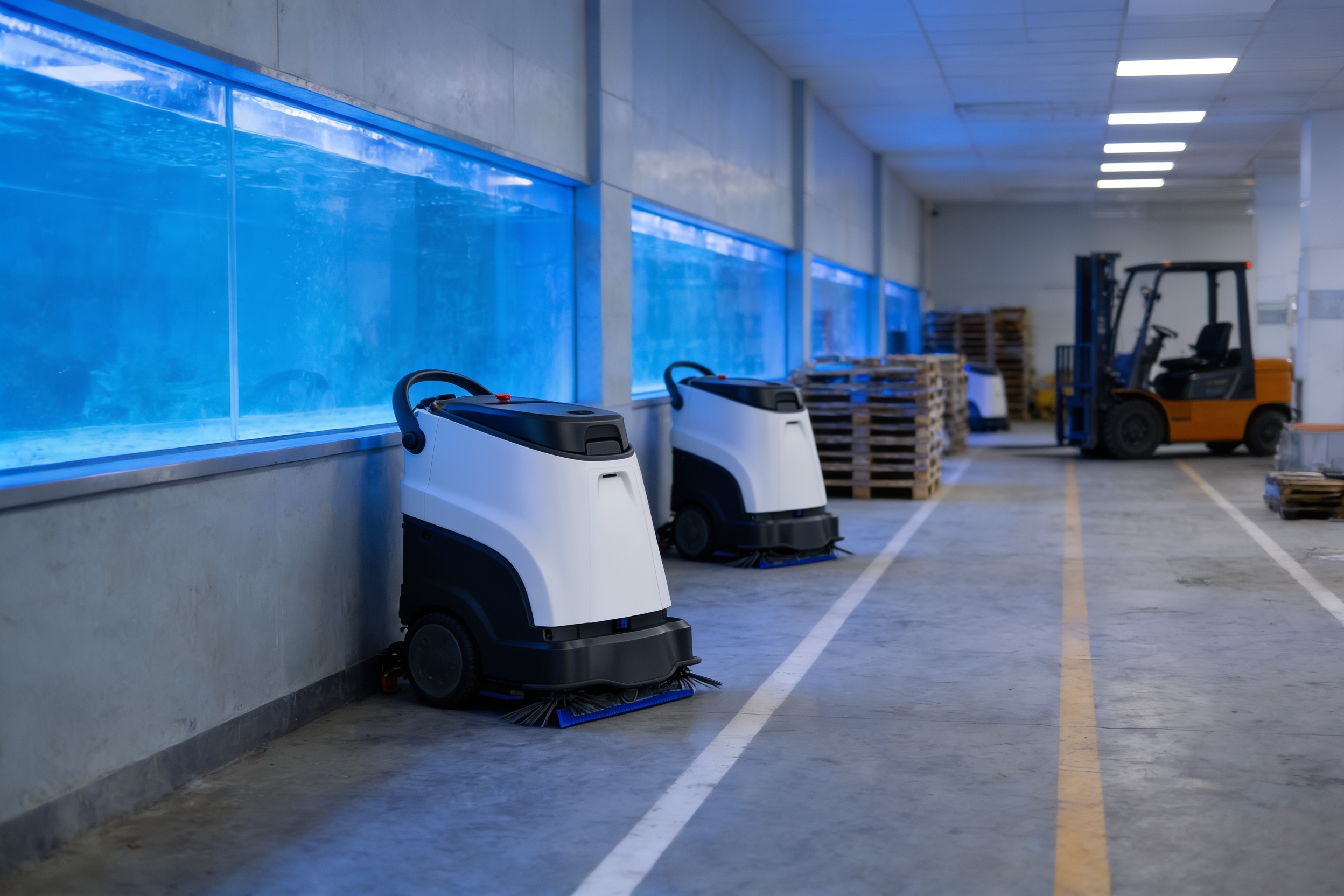
A floor scrubbing robot takes the open-floor pass: wide corridors, sales floors, warehouse aisles, lobbies and hallways with clear paths. During setup it maps the room, runs a set route on a schedule, and returns to its dock to charge. The work is only as good as the map, so the route has to match the layout the crew actually works in.
It cannot take restrooms, trash removal, dusting, glass, spill response, or any task that needs a person to open doors, move furniture or decide what counts as clean. Carpets, thresholds and loose cords all need checking before a route is set. Sites that give the robot a clear path tend to get the most from it.
- Open hard floor pass
Cleaning Robot
Runs a mapped route on a set schedule
Janitor
Works the route by sight and adjusts around people and carts
- Restrooms
Cleaning Robot
Cannot do this task
Janitor
Cleans fixtures, restocks supplies and checks for damage
- Trash and bins
Cleaning Robot
Cannot do this task
Janitor
Empties, bags and carries it to the dumpster
- Spills and new messes
Cleaning Robot
Stops and waits for a person
Janitor
Responds when called and decides how to clean it
- Night coverage
Cleaning Robot
Runs unattended after close on a set route
Janitor
Needs a shift, a break and a supervisor
- Unusual conditions
Cleaning Robot
Limited to what its sensors and map detect
Janitor
Reads context and catches what the route did not expect
How many hours does a cleaning robot actually take over?

The honest answer depends on how long the floor pass takes today. One floor scrubber vendor's specification page lists up to 20,800 square feet per hour for its robotic scrubbers. That is a vendor-reported rate, not an independent time study, and it does not account for turns, obstacles, refills or charging.
A janitorial supply guide makes the same point from the other side. It distinguishes theoretical productivity from practical productivity, and notes that practical rates are usually well below listed rates once those interruptions are counted. No independent study of scrubber hours per shift in commercial janitorial work turned up in our search.
That is why the number to trust is your own measurement. Time the current floor pass, count the rooms and square footage, and note how often the crew stops. A site assessment turns those measurements into a route plan and a lease quote you can compare against the night hours it would cover.
What do turnover, overtime and night shifts look like for this job?
The BLS Occupational Outlook Handbook projects 2% growth for janitors and building cleaners from 2024 to 2034, which it describes as slower than average, a net change of 47,800 jobs. The bigger driver of openings is replacement: about 351,300 openings a year on average, most of them coming from workers who leave.
The Handbook does not publish a turnover rate for this occupation, and turnover figures from job blogs and staffing pages could not be verified, so leave them out of your decision. What you can measure is your own history: how many night shifts sat unfilled, how many hours went to overtime, and how often sick-day calls left one crew short.
A robot does not remove the staffing problem. It reduces the number of hours that depend on a person being present at night for the floor pass. For a site with frequent open shifts, that reduction is often the real reason a lease case gets approved, more than the robot's speed.

What do injury and incident rates say about this work?
A third-party summary of Bureau of Labor Statistics injury data reports that janitorial services recorded about 2.5 total recordable cases per 100 full-time workers in 2024, against about 2.3 for all private industry. The gap is small, so injury rates alone do not justify a lease, but they confirm that the work carries real physical risk.
A BLS chart for 2024 lists administrative and support and waste management services at a rate of 1.8. That is a broader group, not janitorial services, so use the janitorial figure as the working reference. Check the official BLS table before you cite it in an insurance or board document.
A floor robot can reduce how many people walk and work around equipment on open floors after close. Treat that as a hypothesis to test against your own incident log, not as a promised result.
How does a team work with a robot?
The team does not disappear. In most buildings a cleaning robot runs the scheduled floor pass, the same people do the rest, and the crew can often be sized somewhat smaller, though not to zero. The split works best when the robot owns the route and the person owns restrooms, trash, spills and a check of the robot's work.
Setup is where many sites go wrong. Someone has to own the route map, the charging dock, the schedule, the daily log and the call to clear a stuck robot. Name a person for each shift and train at least one backup, so a single absence does not stop the route.
A typical overnight rhythm looks like this, and the timeline below shows where staff work and robot work overlap.
What can a cleaning robot not do?
It cannot handle restrooms, trash, glass, detailed cleaning or unexpected mess. It cannot finish a route blocked by a pallet or a propped door without a person clearing it. It needs a charged dock, an accurate map, a stable network connection and someone who knows what to do when it stops.
It also often struggles with thresholds, rugs, tight gaps, heavy carpeting and floors with frequent level changes. A building that changes layout often, such as an event venue, needs remapping or a different plan, or the route drifts away from the floor it is meant to clean.
A robot does not reduce supervision to zero. It moves supervision to the route log, the morning check and the call list. A site that expects no staff at all will be disappointed, while a site that plans for a robot plus fewer staff usually gets steady results.
How do you get started with a cleaning robot lease in Columbus?
Start with a free site assessment. We pick the right robot for the site, map the floor, measure the route and check for obstructions. The lease quote comes after that assessment, so it reflects your actual layout, hours and service needs, and you can compare it directly to your current night labor.
We lease the robot through financing, deploy and integrate it, train your staff and service it nationwide. A common first step is a pilot on one floor or one building, with a spare unit or loaner plan so a downtime event does not stop the route.
Use the checklist below before you request an assessment. It will help the first visit answer the questions that decide whether the lease makes sense.
Frequently asked questions
Put a robot to work in Columbus.
We walk your site, learn the job, and recommend the unit that fits. Then we quote the lease, deploy it, and keep it serviced.
Sources
- US Bureau of Labor Statistics, Occupational Employment and Wage Statistics (OEWS May 2024)
- U.S. Bureau of Labor Statistics, Occupational Outlook Handbook: Janitors and Building Cleaners
- International Federation of Robotics, World Robotics 2025 service robots press release
- U.S. Bureau of Labor Statistics, nonfatal injuries and illnesses by industry chart
- Third-party summary of BLS injury data for janitorial services
- Floor scrubber vendor specification page
- Janitorial supply guide on floor scrubber productivity
- City statistics site, Columbus metro janitors and cleaners
- Wage aggregator, Ohio janitors and cleaners