

The question, in the buyer's words
I run a 12-acre wedding venue outside Austin, Texas, and caterers walk 400 feet of gravel path from the kitchen to the tent during every dinner service; could a delivery robot carry plated courses over that gravel without spilling sauce on the guests?
Key takeaways
- Gravel is the failing leg: no food runner robot we found has a published gravel rating.
- Indoor-rated vendor datasheets list flat ground, a slope limit of about 5 degrees and 3 to 4 trays (vendor-reported).
- Heat is a real factor near Austin, with about 29 days a year at 100 F or higher according to LCRA normals.
- Shortening the gravel carry also cuts caterer exposure to slips and burns, a real risk in food service.
- Start with a free site assessment and a loaded route test before any lease payment is quoted.
Can a delivery robot carry plated courses over Austin wedding venue gravel?
A delivery robot can carry plated courses from the kitchen to the tent, but only on a route it can cross predictably. The indoor-rated vendor datasheet we reviewed for one food runner model lists flat-ground operation, a slope limit of about 5 degrees, 3 to 4 trays and a maximum surmountable height of 10 mm (vendor-reported). Those are the figures to hold against your gravel path, not the marketing language around them. At an Austin wedding venue, the gravel leg sits outside those figures.
A second food runner is marketed as semi-outdoor, with 10 kg per tray and a 13 kg maximum load (vendor-reported). The terrain claim on that page is vague and does not say whether gravel is covered, so it cannot settle the question. We did not find a published gravel rating for any food runner robot, which means gravel performance is unknown rather than proven good or bad.
The honest fit is partial. A robot may take plated courses along a firm, level route such as a paved drive, a hard walkway or the indoor corridors of the venue building. The 400 foot gravel walk you run every dinner service is the stretch that needs a different answer, or a route change, before a robot is worth testing on it. Plating a course nearer the tent may remove more of the problem than any robot would.
How do delivery robots handle uneven ground like gravel?
Gravel is loose stone that shifts under each wheel. A tray crossing loose stone tilts and rocks in a way a flat floor never produces, and that motion is what carries sauce to the rim. The food runner datasheets we reviewed are rated for flat indoor floors, and the slope limit on one of them is about 5 degrees (vendor-reported). A path that rises gently toward the tent may be a problem even before the gravel is considered.
Obstacle height matters too. The datasheet lists a maximum surmountable height of 10 mm (vendor-reported), and gravel stones can be larger than that, so a wheel that meets a stone may slip, stop or lurch the tray. Wheel type, ground clearance and suspension decide how a robot handles loose surfaces, and none of the food runner specifications we reviewed reports those for gravel.
Speed is the other lever. A robot that is steady at a walking pace on a flat floor may need to crawl on a bumpy path, which lengthens each trip and adds staff time at the far end. Any robot route on gravel has to be timed with loaded trays, not assumed from a floor demonstration.
- Loose gravel and uneven stone
Delivery Robot
Rated for flat indoor floors in the datasheet reviewed, with no published gravel rating
Staff
Adjusts step by step, sees stones and watches footing
- Path that slopes toward the tent
Delivery Robot
Slope limit of about 5 degrees (vendor-reported)
Staff
Walks any grade with a tray, but slowly and with more risk
- Sauce control
Delivery Robot
Steady on flat ground, with tilt risk rising on bumps
Staff
Can slow, rebalance and carry a covered plate with care
- Heat during dinner
Delivery Robot
Operating temperature range must be confirmed in writing with the vendor
Staff
Works in heat with breaks and water, though fatigue builds
- Timing for each course
Delivery Robot
Same route and speed on every run
Staff
Varies with crew, fatigue and crowds
- Judgment near guests
Delivery Robot
Depends on its sensors and the rules set around guests
Staff
Reads the room, moves guests aside and changes the plan
How hot does Austin get during an outdoor wedding dinner?
Heat matters because the robot is only one part of an outdoor dinner. According to LCRA, using Camp Mabry 1991 to 2020 normals, Austin averages about 29 days a year at 100 F or higher, and Bergstrom airport averages about 24. The National Weather Service Austin climate summary reports that 2011 had 90 days at or above 100 F, which the summary identifies as the hottest summer on record for the city.
For a venue owner, that means the dinner window can fall in the hottest part of the day. Dry gravel loosens and dust builds, the ground along the route changes with the season, and the caterers walking that path are working in the heat. Plan service timing around shade and cooler hours where you can, and get the robot's operating temperature range in writing before counting on it in July or August.
Heat also raises the stakes of a stalled robot. A tray left mid-route in full sun holds hot food for longer than planned, so any robot plan needs a rule for clearing a stalled tray quickly. Food left out too long is a food safety problem whether or not a robot was involved.

How many people staff a wedding dinner, and what are their risks?
A national wedding guest list study, 2026 edition, covering couples married in 2025 and 10,474 respondents, reports an average guest count of 117 and an average of 13 wedding professionals used per wedding. At that scale a plated course is not a few plates, and the caterers carrying it are the people walking the gravel course after course.
Staffing is the pressure point. According to the Bureau of Labor Statistics, the accommodation and food services quits rate was 3.5 percent in August 2026, against 2.1 percent for private industry and 1.9 percent for total nonfarm. A higher quits rate means each new server or runner learns the path from scratch, and that learning curve repeats every season.
The Austin labor pool is large, but it does not replace training. A wage aggregator that derives its figures from BLS OEWS data estimates about 19,170 waiters and waitresses in the Austin-Round Rock-San Marcos metro for May 2025. That figure is not a direct BLS table and should be confirmed on BLS OEWS before it is cited. A large pool helps with hiring, but it does not teach a new caterer where the soft spots on the gravel are.
Safety adds a second reason to cut time on the gravel. According to BLS, full-service restaurants recorded 88.3 days-away-from-work cases per 10,000 full-time workers in 2019, against 86.9 for all private industry. Hot plates on uneven ground are the kind of task where a fall or a burn can happen, so less time on the gravel has value beyond speed.
Will sauce spill when a robot takes a tray over a bumpy path?
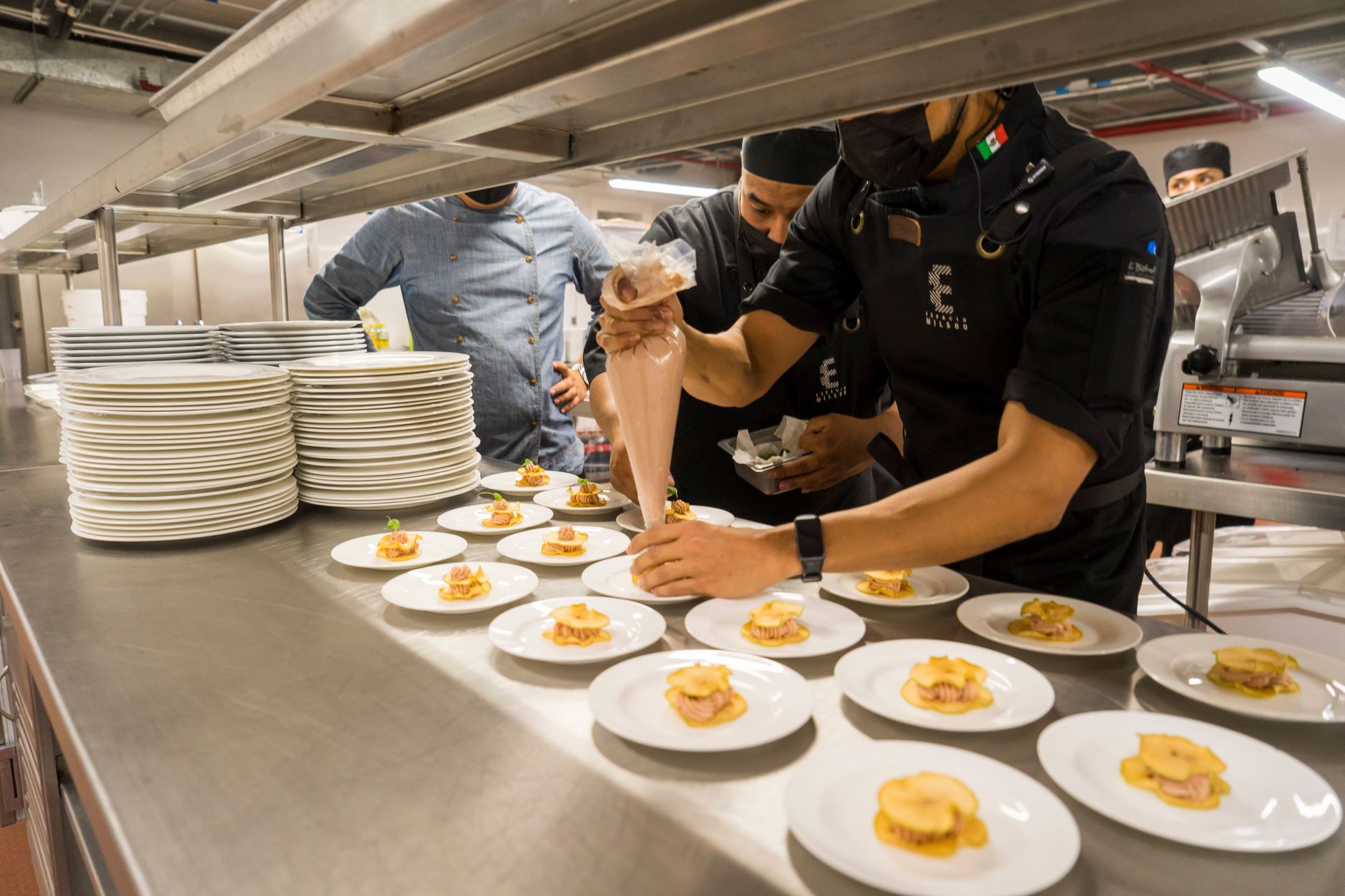
A plate does not spill because a robot carried it. It spills because of tilt, acceleration at each start and stop, and the shape of the plate and the sauce. A robot that is steady on a flat floor can still push sauce over the rim on a bumpy path, and none of the vendor pages we reviewed published a spill test for gravel.
Sauce control depends on choices made before the robot leaves the kitchen. Use plates with a well for sauce, cover courses that will travel, and hold the sauce in a separate cup or add it at the table for the longest runs. Each choice lowers the risk. None of them makes gravel safe on its own.
Test with what you will actually serve. Load full trays with the real plates and a stand-in for sauce, run the entire route at the speed you plan to use, and watch where the tray tilts. A demonstration on a smooth sidewalk tells you about the sidewalk, not about your gravel.
What would a gravel route need before a robot can run it?
A robot needs a route it can cross predictably, and that has to be checked on the real path. The checks below belong in a route survey and test runs before any lease is discussed.
- Measured surface: firm, level and free of loose stone along the full robot path
- Grade: a slope within the rated limit, which is about 5 degrees on the datasheet we reviewed (vendor-reported)
- Edges and obstacles: no stone, root or lip taller than the rated surmountable height of 10 mm (vendor-reported)
- Weather: a dry, shaded route during the dinner window
- Loaded test: full trays of the actual plates run the whole route, with a stand-in for sauce
What works now if the robot cannot take the gravel?
Several options may handle loose gravel more predictably than a robot can today. Caterers can use carts with wide pneumatic tires on a firmed lane, stage the plating station nearer the tent so the longest carry shrinks, or run two plating stations at either end of the route. A second station adds staff, but it cuts the time plates spend in transit, which is where sauce and temperature are most at risk.
Walk the route with the caterers before the event. A practiced path reduces missteps and gives the lead caterer a plan for stones, puddles and slopes. Flag the steepest stretch and any soft patches on each service, so the crew knows where to slow down.
The robot still has a role on paved service paths. A hard drive or walkway from the kitchen to the tent, or the indoor corridors of a venue building, can use the same route checks. Treat it as a pilot on one leg. Measure how many carries it removes and how many trays it stalls, then add legs only if those numbers hold.
How does a free site assessment and lease work for a venue?
We start with a free site assessment, not with a robot. We map the route, measure the surface and grade, test the path with loaded trays and check your dinner timing and heat exposure. A lease payment is quoted only after that assessment, through lease financing, so the numbers reflect the path you actually have.
If the route passes, the lease through financing covers deployment and integration, staff training and service under our service plan, backed by regional service engineers in every state we service. Training covers loading, the stop rule and the walk back to the kitchen. If the route fails, we say so and recommend the non-robot options above, so you do not end up with a unit idle on the gravel.
We are not promising a sauce-free gravel run. The assessment exists to find out whether your specific path can run a robot safely, and to tell you plainly when it cannot.
Frequently asked questions
Upcoming event venues & stadiums events
- Trade showBrats & RobotsNov 10, 2026Alliant Energy Center Exhibition Hall, Madison, WI
- MeetupMPI Virginia Morning Brew Meet-Up, November 2026Nov 10, 2026Hampton, VA
- SummitVA1 Governor's Tourism Summit 2026Nov 18 to 20, 2026Kalahari Resorts & Conventions, Spotsylvania, VA
- ConferenceVirginia Association of Fairs ConventionJan 14 to 17, 2027Williamsburg Lodge, Autograph Collection, Williamsburg, VA
Put a robot to work in Austin.
We walk your site, learn the job, and recommend the unit that fits. Then we quote the lease, deploy it, and keep it serviced.
Sources
- Bureau of Labor Statistics, The Economics Daily, accommodation and food services quits rate, August 2026
- Bureau of Labor Statistics, The Economics Daily, nonfatal injuries and illnesses in full-service restaurants, 2019
- Lower Colorado River Authority, Austin temperature normals (Camp Mabry and Bergstrom)
- National Weather Service, Austin climate summary