
The short answer
Cleaning robot ROI in Orlando, FL comes from floor cleaning hours that move from staff to an autonomous machine, priced at the local wage for this job and reduced by the realistic share of the floor the robot covers and by the fixed lease cost. For a typical site, the savings range is set by overnight access, how much floor is clear on the route, and how many staff hours are really redirected, not by a headline productivity rate. A free site assessment turns the range into a precise figure and a lease quote.
See what a cleaning robot costsRun the numbers in the ROI calculator
Key takeaways
- The return comes from floor hours returned to staff, not from a headcount cut.
- Plan on the share of floor the robot can really cover, not the vendor maximum.
- The lease quote comes after a free site assessment, so the range firms up at that step.
- Start with one leased unit to measure the hours before any wider rollout.
Run the numbers for your site
Auto-detected from your location - we use the real BLS wage here. Not right? Pick your city or state above.
What do you want to automate?
The robot runs the open floor overnight; your crew keeps detail and edges.
What is the cleaning robot ROI in Orlando, FL?
The return on a cleaning robot in Orlando, FL is the value of floor cleaning hours that move from people to a machine, minus the lease cost and the time staff still spend on setup, checks and exceptions. Most sites see that value as hours returned to the existing team, floors that are ready at opening, and fewer gaps when someone calls out. Headcount reduction is a weak basis for the decision, because the work does not disappear when a robot arrives.
The Orlando number is driven by local labor. The government wage data on this page gives the local wage for this job, and the calculator applies that wage only to the hours the robot realistically takes over. Treat the result as a savings range, not a promise, since the outcome depends on floor layout, run window and how the freed time is used.
How does the cleaning robot ROI math work?
The calculation has four inputs. The first is the janitor and building cleaner hours the robot takes off the schedule each week. The second is the local wage for this job from the panel, which prices those hours. The third is the share of the work the robot can realistically take, since not every task on the route suits an autonomous scrubber. The fourth is the fixed lease payment, quoted after a site assessment and subtracted from the labor value.
The share of work is where most estimates go wrong. Vendor case studies report large hour totals, but they are vendor-reported and not independent. According to one grocery retailer's case study, a grocery operator using an autonomous scrubber reported 33,649 hours reallocated across its stores in 2024, up 11 percent from the prior year. That count reflects a multi-store operation and a schedule built around it, so it does not carry over to a single building.
A 2023 vendor case study from a US hospital network describes two overnight autonomous scrubbers that cut floor care labor from 16 to 5 person-hours per night, with about 8 hours reallocated. Read the remaining 5 hours as the labor still needed for supervision, loading and exceptions, which the calculator counts as well.
Median hourly wage, Janitors and Building Cleaners
$3,550
Monthly cost of one full-time worker in Orlando, FL, at the median wage plus payroll costs (an estimate, not a quote).
How many janitor hours can a cleaning robot take over?
Coverage is the first limit. A floor scrubber datasheet from a manufacturer gives a theoretical maximum of about 49,406 square feet per hour with a roller brush and about 52,313 square feet per hour with a disc brush, on a 4-hour battery runtime. Treat those as ceilings. Aisles blocked by stock, carts and furniture, plus charging trips, take time away from the maximum, so the calculator uses a realistic share of the floor instead.
Runtime is rarely the limit on its own. A vendor case study from a US building cleaning contractor reports more than 2.5 hours a day of autonomous cleaning on average, with 99.2 percent of runtime in autonomous mode. The gap that matters is between the machine running and the machine finishing the full route on schedule, which depends on the route plan and on clear floors.
A logistics operator in Canada reported more than 300 labor hours saved from summer 2020 to April 2021 with fully autonomous scrubbers compared with conventional cleaning, as described in a materials handling trade magazine. The figure is company-reported and comes from a warehouse setting, so use it for scale, not as a forecast for an office.
Who does this work and how much turnover is there?
The occupation is large and steady. According to the Bureau of Labor Statistics, janitors and building cleaners held 2,447,700 jobs in 2024, and the agency projects 2 percent growth from 2024 to 2034, slower than the average for all occupations. It also projects about 351,300 openings a year on average, so filling vacancies is a continuing task for most sites.
Turnover is the operational pressure. A janitorial industry blog that cites Bureau of Labor Statistics data says janitorial turnover is higher than in construction, education services and retail trades, with only leisure and hospitality higher. The blog gives no verified numeric rate, so use it as direction, not as a number to plug in. Each unfilled shift is labor the robot can cover while you hire.
Injury exposure belongs in the calculation too. According to the Bureau of Labor Statistics, janitors and cleaners, except maids and housekeeping cleaners, had 21,100 days-away-from-work cases in private industry in 2020, a rate of 191.6 per 10,000 full-time equivalent workers. A robot does not remove staff from the building, but it takes over repetitive pushing and scrubbing work, which reduces the hours people spend on the tasks behind those cases.
The Orlando metro survey base is large. The May 2024 Orlando release from the Bureau of Labor Statistics covered 5,627 establishments with a 66 percent response rate. The same release adopted new metro definitions, so compare it with earlier years with care.
The typical headcount on this page is three people doing this kind of work at one site. That is our working assumption for the calculator, since we did not find a sourced count for a site of this type. The site assessment replaces it with your actual crew size, which is one of the inputs that moves the range.
What changes the cleaning robot ROI up or down?
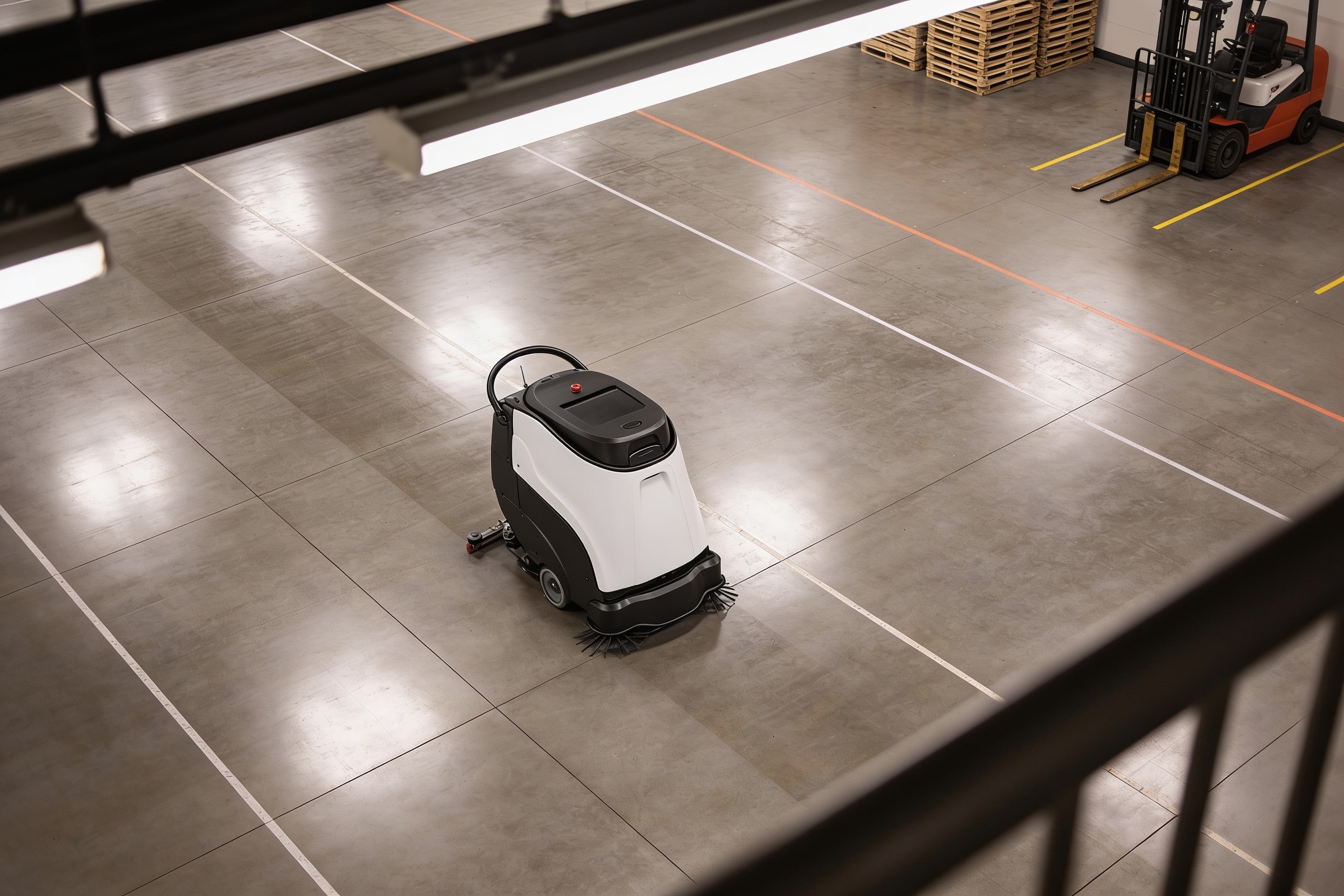
Four things move the number most: how much clear floor the robot can reach, when it runs, how many staff hours it really frees, and the lease term. Floor area matters less than the share of it that is open at run time. A large building with blocked aisles can return less than a smaller building that stays clear.
Run window is the second lever. An empty building lets the robot run the whole route, while a daytime run around customers or diners limits the route and adds handling. Freed hours also depend on whether the crew moves that time to other work or leaves it unused, and that is a management decision made before go live.
Where does the robot work in an Orlando facility?
A cleaning robot works best on hard, open floors that follow a repeatable route. It is not a whole-building service, so the zones below show where the machine usually fits and where staff keep the work. Each zone has its own limits, and the site assessment maps which ones apply to your floor plan.
Zones with heavy furniture, rugs, loose cords or constant traffic at all hours usually return less than the zones listed here. Those areas are still worth mapping, because a partial route can still take real hours off the crew.
What are the risks to the return, and how do you avoid them?
The biggest risk is an overstated coverage assumption. If the plan uses the vendor maximum rate instead of the share of floor that is open on the actual route, the savings range will fall short. Build the plan on a short measured pilot on your own floors, not on a datasheet.
The second risk is downtime. A unit that stops leaves a route uncleaned, and the hours you counted come back to the crew. Plan for spare coverage, on-site dispatch and remote triage from day one, so a single fault does not erase the hours in the calculation.
The third risk is hours that are freed on paper but never used. Agree in advance what the crew does with the redirected time, and track it through the first months after go live. We usually start with one leased unit in a phased deployment, so the layout, schedule and staff routines can be checked before a second unit goes in. We handle site mapping, deployment, integration, training and nationwide service, so the crew is not left to solve those problems alone.
What does a night shift with a cleaning robot look like?
A typical overnight run starts after the building empties and finishes before the first staff arrive. The crew's role shifts from pushing the machine to checking the route, clearing exceptions and reading the run log.
The schedule works only when the route is clear at the start of the run. Put route clearing on the closing checklist, and log any run that finishes short, so the gap shows up at the next review instead of being missed.
How long until payback, and how do you get a precise figure from a free site assessment?
Payback can only be measured after the robot has run a full cycle on your floors. The sequence is a free site assessment, floor mapping, deployment and integration, go live support, and then a review of the hours actually returned against the lease. Each step narrows the savings range, and the lease quote comes after the assessment.
To get a precise figure, bring the floor plan or square footage, the cleaning schedule, the hours your crew logs for that route, the run windows you can offer, and the lease term you want to compare. We measure the open route on site, set a realistic coverage share, and apply the government wage data for this job to the hours freed. The output is a savings range and a fixed lease payment quote, with the assumptions written beside each number.
Frequently asked questions
Put a robot to work in Orlando.
We walk your site, learn the job, and recommend the unit that fits. Then we quote the lease, deploy it, and keep it serviced.
Sources
- US Bureau of Labor Statistics, Occupational Employment and Wage Statistics (OEWS May 2024)
- Bureau of Labor Statistics, Occupational Outlook Handbook: Janitors and Building Cleaners
- Bureau of Labor Statistics, Orlando metro occupational employment and wages release, May 2024
- Bureau of Labor Statistics, Survey of Occupational Injuries and Illnesses snapshot for janitors and cleaners, 2016 to 2020
- Grocery retailer autonomous floor scrubber case study (vendor-reported)
- US hospital network overnight autonomous scrubber case study, 2023 (vendor-reported)
- Building cleaning contractor autonomous scrubber case study (vendor-reported)
- Materials handling trade magazine: fully autonomous floor scrubbing case (company-reported)
- Janitorial industry blog on turnover, citing Bureau of Labor Statistics data