
The short answer
Cleaning robot ROI in New York comes from the night-shift floor hours a robot takes over, measured against the lease cost of the machine and the staffing it offsets. The return depends on how much of the floor is hard and unobstructed, how many hours the crew spends on that work, and how the local wage for the job compares with the lease quote. We measure all three in a free site assessment before any savings range is shown.
See what a cleaning robot costsRun the numbers in the ROI calculator
Key takeaways
- The return comes from floor hours moved off the crew, not from the machine itself.
- Hard, level, unobstructed floor sets the ceiling on what a robot can take over.
- Savings are shown as a range built from your site measurements, never a single promise.
- The labor side is priced on the local wage for this job from government data.
- Payback depends on how fast the pilot reaches its hours, so review run reports from day one.
Run the numbers for your site
Auto-detected from your location - we use the real BLS wage here. Not right? Pick your city or state above.
What do you want to automate?
The robot runs the open floor overnight; your crew keeps detail and edges.
What is cleaning robot ROI in New York, and where does it come from?
Cleaning robot ROI in New York is the labor a building saves when an autonomous floor scrubber takes over repetitive floor work, measured against the lease cost of the machine. For most buildings that work is scheduled and predictable: scrubbing hard corridors, lobbies and open office floors, usually overnight when the space is empty. The return is not a fixed figure. It moves with how much of the floor suits a machine, how many hours the crew spends on that work, and how the lease quote compares with the labor it offsets.
This page explains that math for New York, NY. Our ROI calculator is pre-filled for the city and shows a savings range built from site inputs, never a promise. The government wage data for the job sits in the panel beside this text, so you can check the labor side against an official source.
We are a commercial robot integrator. We pick the machine for the site, lease it through financing, deploy and integrate it, train the staff and service it nationwide. The lease payment is quoted after a free site assessment, because the right machine and the right payment both depend on the floor it will work on.
How many janitorial jobs and businesses are there in New York?
The labor pool behind this work is large. The Bureau of Labor Statistics, in its Occupational Outlook Handbook, counted 2,447,700 janitors and building cleaners nationally in 2024 and projects growth of 2% for 2024 to 2034. Growth that slow means the hours still need covering through the decade, whoever ends up covering them.
New York has a large base of its own. According to a business density dataset for janitorial services, New York had 5,024 establishments employing 73,193 people in 2024. That source is an aggregator and has not been checked against Census counts, so read it as an indicator. Dividing employees by establishments gives about 14.6 workers per business, but that average spans firms of every size and does not tell you how many people clean one building.
The useful takeaway is scale. A large regional pool means staffing is a shared problem, and the buildings that handle it best are the ones that measure their own hours instead of relying on industry averages.
Median hourly wage, Janitors and Building Cleaners
$4,540
Monthly cost of one full-time worker in New York, NY, at the median wage plus payroll costs (an estimate, not a quote).
Where does the labor return come from in a New York building?
The return comes from hours. A robot runs a fixed route on a schedule and logs each completed pass, so the hours that used to go to that route become available for other work or for fewer overtime hours. The saving is largest where the route is long, the floor is clear, and the work falls on nights or weekends when the building is empty and hard to staff.
Timing matters as much as volume. A route that runs while the building is empty protects the day crew from disruption and keeps the machine clear of foot traffic. Many buildings find that the hours with the highest labor cost are the same hours that are hardest to staff, so a route that covers them carries more weight in the math than its raw length suggests.
Staffing is the pressure behind that. The BLS figures above describe a large workforce growing slowly, which means a building cannot count on a full night crew every shift. According to a staffing vendor's research on janitorial staffing costs, multi-site cleaning operators report 150 to 200% annual frontline turnover. That figure is vendor-reported and untraced, so treat it as a question to test against your own records, not as a benchmark.
Headcount is the number we most need to confirm. No sourced figure for people per site was found. The typical headcount on this page, three people on a night crew for a mid-sized building, is a planning assumption. Your site assessment replaces it with your actual count, and the hours table below shows the task-by-task breakdown we build from that count.
| Task | Today | With a robot |
|---|---|---|
| Scrub the main corridors | Logged by the crew at the site walk | Scheduled run with the route set once |
| Scrub the main lobby | Crew time set by the morning schedule | Scheduled run, staff review the log |
| Sweep open office floor plates | Measured during the site assessment | Autonomous run around clear aisles |
| Clear the route before each run | Staff move chairs and bins by hand | Staff still clear the route, then the machine runs |
| Carpet, stairs and tight spaces | Crew time, unchanged | Stays with the crew |
| Check the run record | Supervisor walk and manual checks | Run report reviewed each morning |
Hour figures are measured at your site during the assessment. We did not verify a published hours benchmark for these tasks, so none is shown.
Which areas of the building can the robot clean?
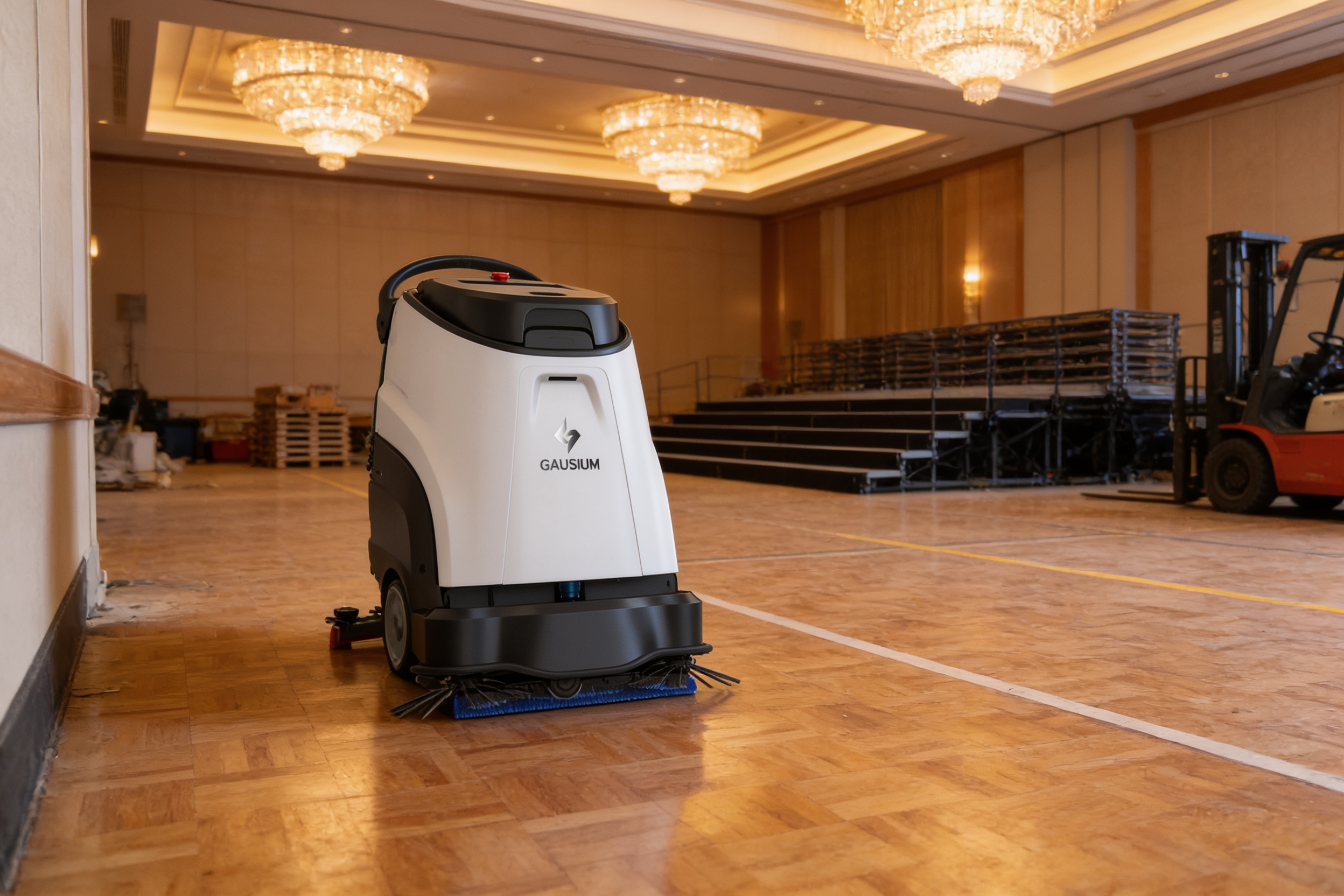
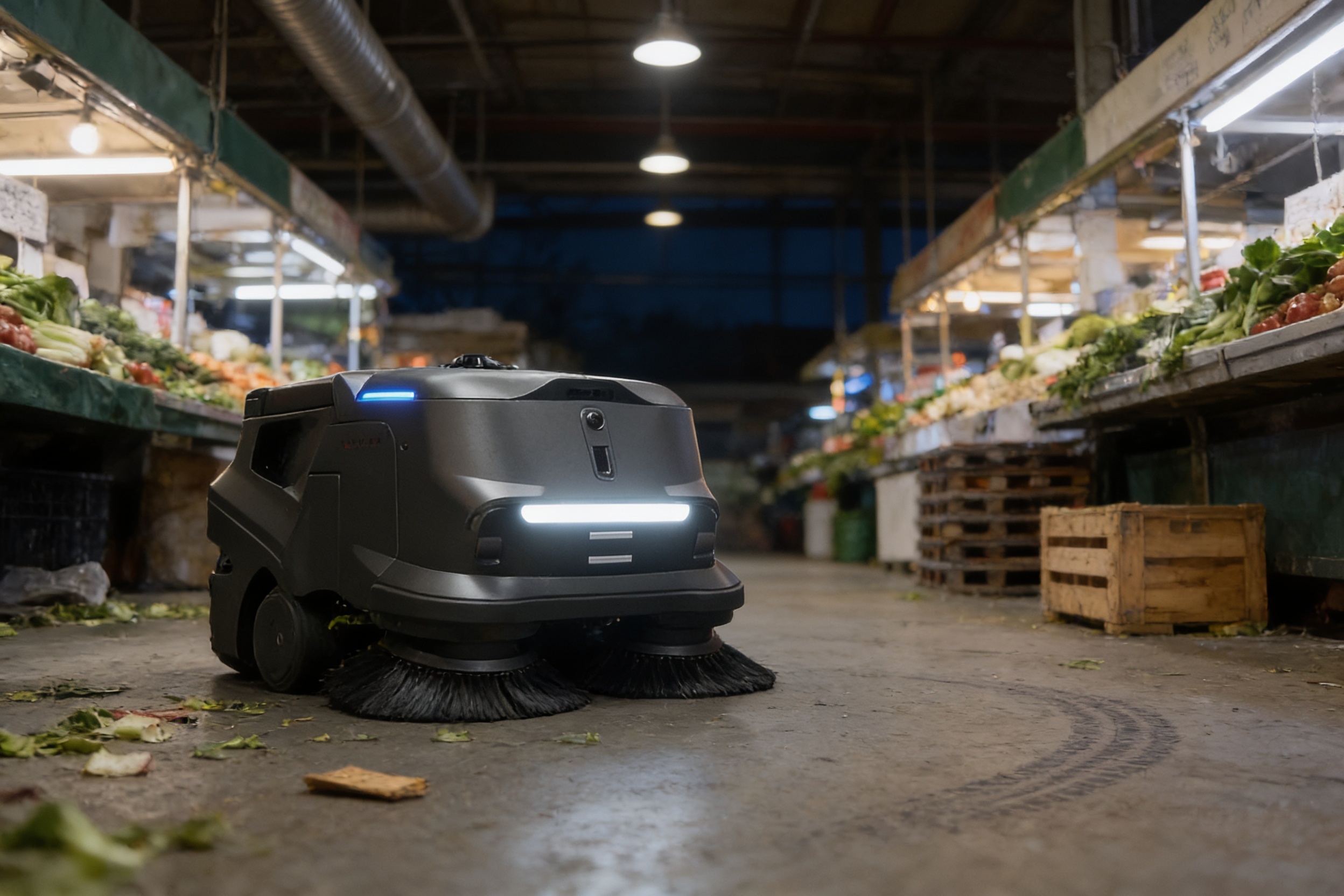
A floor scrubber works best on hard, level, unobstructed surfaces with clear paths, such as corridors, lobbies and open office floors. Carpet, stairs and tight spaces stay with people. That boundary is deliberate, and treating it as a failure is the fastest way to overestimate the return.
The zones below are common areas in New York office, mixed-use and institutional buildings, sorted by how well they suit a machine. The site walk confirms each one, and the result sets the usable share of the floor.
How is the payback math worked out?
The math has three inputs. The first is the hours of janitor-type work the robot takes over each week, measured at your site. The second is the share of that work a machine can realistically do, which is almost always less than the whole floor because of obstacles, carpet and stairs. The third is the lease quote, which is fixed for the term and comes after the site assessment.
The labor side is priced on the local wage for this job, shown in the government data panel on this page. In plain terms, the labor offset is the local wage multiplied by the hours the robot takes over. Subtract the lease payment and any service cost you keep, and what remains is the saving over each period. Coverage gaps, overtime changes and turnover are then counted as adjustments, not hidden inside the headline.
Because the inputs are ranges, the result is a range. The low case assumes fewer usable hours and more manual work left behind. The high case assumes the robot takes most of the hard-floor work on a steady schedule. Neither case is a promise, and the site assessment narrows both.
Here is how to read a range when it arrives. If the low case shows a narrow saving, ask which inputs drove it. Usually the answer is a smaller hard-floor share or a crew that still scrubs the same areas by hand. If the high case assumes the robot takes most of the hard-floor passes, check that the route really is clear each night, because the high case depends on that.
What changes the number up or down?
Four things move the range most: how much hard floor the building has, how many off-hours the crew works, whether the staff fill every shift, and how steady the schedule is. A building with long corridors and open plates runs a larger share of its floor by machine than one full of carpet and small rooms.
Steady schedules help. A fixed route run at the same time each night returns more usable hours than an irregular schedule that changes with each event. The checklist after this section lists what to confirm before you decide.
Changes to the building also move the number. A new tenant that adds carpet, a remodel that closes a corridor, or a change in shift times can shrink usable hours overnight. Ask the site team to flag these changes early so the route and the staffing plan can be updated before the saving is counted.
What are the risks to the return, and how do you avoid them?

The biggest risk is over-counting hours. A machine that cannot finish its route because of a blocked aisle or a locked door delivers less than the plan assumed. Plan the route with the site team, clear the path each night, and review run reports closely in the first month.
Injury data shows why the human side matters too. The Bureau of Labor Statistics counted 21,100 nonfatal injury and illness cases with days away from work for janitors and cleaners, except maids and housekeeping cleaners, in 2020 nationally. The incidence rate was 191.6 per 10,000 full-time equivalent workers. A separate BLS snapshot for janitors alone put the 2019 rate at 157.4 per 10,000. These are national figures from related but separate groups, so they give context rather than a local benchmark, but they show that the physical load is real.
Moving the most repetitive floor passes to a machine can reduce the crew's exposure, but only if the crew is reassigned to planned work. Cutting staff without a plan leaves gaps the machine cannot fill. Confirm the service response terms in the quote as well, because downtime shifts work back to people overnight, and plan a manual fallback for any night of fault.
Service is a risk as well. A machine out of service on a night with no fallback leaves the floor to the crew at short notice. Agree in writing who is called, how fast dispatch can arrive, and who covers the route until the machine is back, and keep a short manual procedure on hand for those nights.
How long does it take to reach payback?
The sequence runs from assessment to route mapping and integration, then a supervised pilot on one zone, then full go-live. Each stage produces something you can check: a measured hours baseline, a mapped route, a run record, and a staffing plan for the new schedule.
We do not promise a payback date at the start. The date depends on how quickly the pilot reaches the hours in the savings range and how quickly the crew adjusts. Track run completion and the hours released each week against the assessment baseline.
If the pilot falls short, the fix is often the route or the schedule rather than the machine. Integration can change both without stopping the building. That is why the pilot is worth the time: it shows the real hours before the rest of the floor depends on them.
The first weeks usually show the largest adjustments. Expect to refine the route, the clear-path rules and the timing of runs. A pilot that runs on one zone for several weeks gives the building enough records to judge whether the planned hours are real before the rest of the floor depends on them.
How do you get a precise figure from a free site assessment?
A precise figure needs four measurements at your site: floor area by surface type, the obstacle and route layout, the hours the crew spends on the work today, and the coverage gaps you want closed. We take those measurements at a free site assessment, then quote the lease after we have them. The savings range and the lease quote come from the same inputs, so they match.
Bring your schedule, the night-crew roster and any cleaning logs you keep. Those records replace our headcount assumption with your own numbers. If you have an existing cleaning contract, bring it too, because a machine may cover only part of its scope and the contract decides what the saving can touch.
The output is a written range, the lease quote and the pilot plan. If the numbers do not justify a lease for your building, the assessment should say so, and that is a useful result too.
How common is autonomous floor cleaning?
Adoption is real but still a minority practice. According to the AACEM and ISSA autonomous cleaning survey from 2019, nearly 23,000 building service contractors, in-house providers and facility managers were surveyed. About 27% were actively using autonomous cleaning equipment, and about one third of those not yet adopting said they were somewhat likely to adopt within a year. The survey is from 2019, and its full report is restricted to members.
A market research report on the US commercial robotic scrubber market projects a compound annual growth rate of 10.69% for 2025 to 2032. That is a market estimate, not a count of buildings using the machines. A BSM trade magazine article reports that floor cleaning robots held a 42% share of a broader robotics market in 2024.
For a New York operator, the industry figures say little about one building. Your floor, your hours and your staffing set the return, which is why the assessment comes before any savings range.
Frequently asked questions
Put a robot to work in New York.
We walk your site, learn the job, and recommend the unit that fits. Then we quote the lease, deploy it, and keep it serviced.
Sources
- US Bureau of Labor Statistics, Occupational Employment and Wage Statistics (OEWS May 2024)
- Bureau of Labor Statistics, Occupational Outlook Handbook, janitors and building cleaners
- Business density dataset, janitorial services, New York, 2024 (aggregator, not checked against Census)
- Bureau of Labor Statistics, injury and illness snapshot, janitors and cleaners except maids and housekeeping cleaners, 2016 to 2020
- Bureau of Labor Statistics, injury and illness snapshot, janitors, 2015 to 2019
- AACEM and ISSA Autonomous Cleaning Survey, 2019 (via FMLink)
- Market research report on the US commercial robotic scrubber market
- BSM trade magazine article on US leadership in robotics adoption, 2025
- Staffing vendor research on janitorial and cleaning industry staffing costs, 2026 (vendor-reported, untraced)