
The short answer
Cleaning robot ROI in Oklahoma City comes from the repeatable floor hours a robot takes over from janitors and building cleaners, not from cutting a headcount. The savings range depends on the share of that work a robot can realistically handle, the local wage for this job, and the lease cost quoted after a free site assessment. Use the calculator on this page for a starting range, then the site assessment for a precise figure.
See what a cleaning robot costsRun the numbers in the ROI calculator
Key takeaways
- The return comes from repeatable floor hours a robot takes over, not from a smaller crew.
- The share of work a robot can realistically handle moves the savings range more than any other input.
- Detail work, restrooms and spot cleaning stay with people and must be subtracted from the offset.
- Published hour figures are site or vendor reports, so they set the scale but do not replace your own count.
- A free site assessment turns the range into a figure for your building and a lease quote after review.
Run the numbers for your site
Auto-detected from your location - we use the real BLS wage here. Not right? Pick your city or state above.
What do you want to automate?
The robot runs the open floor overnight; your crew keeps detail and edges.
What does cleaning robot ROI in Oklahoma City measure?
Cleaning robot ROI in Oklahoma City compares the hours of floor work a robot takes over with the cost of leasing it through financing. It is not a headcount decision. Most cleaning in a building is spread across many small tasks, and a robot only pays back on the part that is repeatable, open and scheduled.
The national labor picture shows why this matters. According to the Bureau of Labor Statistics Occupational Outlook Handbook, about 2.4 million people held janitor and building cleaner jobs in 2024, and employment is projected to grow about 2 percent from 2024 to 2034, which is slower than average. Slow growth means open shifts are harder to fill, which makes a predictable floor route more valuable.
The local wage for this job appears in the government wage data panel beside this text. The ROI calculator on this page is pre-filled for Oklahoma City, and the savings range it shows is computed from that wage and the inputs you change.
How does the labor math work?
The return is an offset. Start with the weekly hours of repeatable floor work in the building, multiply by the share of that work the robot realistically handles, and price those hours at the local wage for this job plus the employer cost of that labor. Subtract the lease cost, the staff time for supervision and start of shift checks, and the time for work the robot cannot do. What remains is the savings range.
The calculator starts from one person's cleaning shift, because this page has not verified how many people do this work at a typical site. Until the site assessment counts the actual staff and hours, read the output as a single shift offset. The range will widen or narrow once real headcount is known.
Median hourly wage, Janitors and Building Cleaners
$3,484
Monthly cost of one full-time worker in Oklahoma City, OK, at the median wage plus payroll costs (an estimate, not a quote).
How many hours does a cleaning robot take over?
Hour figures are the hardest part of the math to get right. The most concrete published figure we found comes from a materials handling trade article about a warehouse site. According to that article, robots cleaned about 3.5 million square feet between 2020 and 2021 and saved more than 300 labor hours compared with conventional cleaning.
That is a site report, not a neutral benchmark, and it does not say how many shifts or staff those hours covered. Treat it as an example of the scale that repeatable open floor work can reach. Use your own cleaning hours in the calculator, not the warehouse figure.
Hours also hide in gaps. A shift that goes unfilled, or a cleaner who leaves before the route is learned, costs time that never appears as a line of wages. The site assessment counts these gaps as well as the scheduled hours.
Where does the return come from in a typical Oklahoma City building?
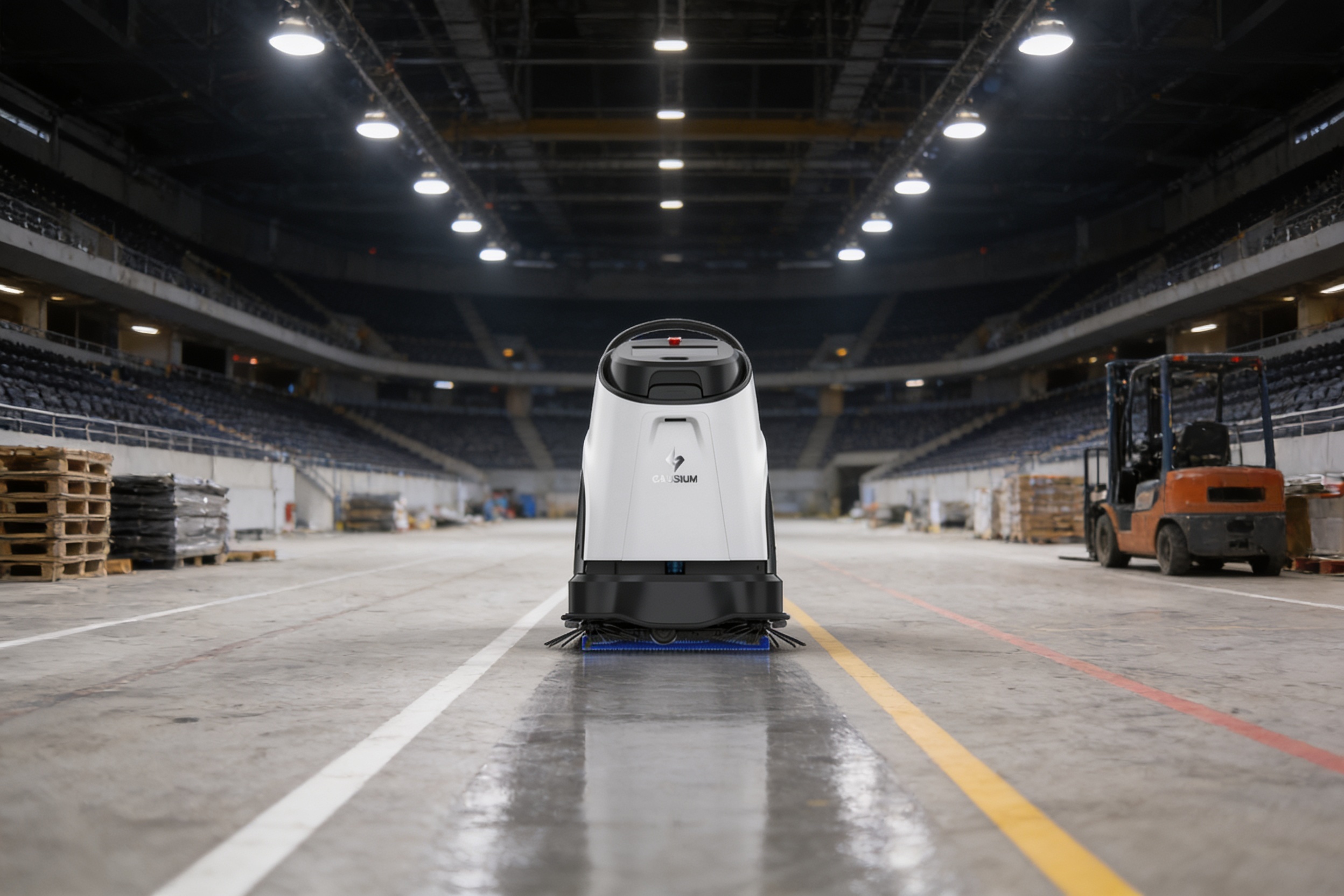
The return comes from large, mostly open hard floors cleaned on a fixed schedule. Retail sales floors, warehouse aisles, office corridors, school halls and clinic corridors with clear routes fit that pattern best. Spaces with furniture, stairs, carpet transitions and many restrooms usually keep a person on the job, which lowers the share the robot can take.
Oklahoma City buildings of these types vary widely, and this page does not give local building counts. The government wage data panel gives the local wage for this job, which is the rate the offset uses. The site assessment is where we map your floor area and confirm which zones qualify.
We pick the right robot for the site, lease it through financing, deploy and integrate it, train your staff, and service it nationwide. The return depends on fit as much as on the lease quote, so the assessment comes before any number is committed.
- Night coverage
Cleaning Robot
Runs a mapped route after close without an operator on site
Staff
Present for the whole shift and can start work at any hour
- Open floor consistency
Cleaning Robot
Repeats the same pass pattern across large areas
Staff
Covers the area, but slows and varies over a long run
- Detail and edges
Cleaning Robot
Limited in tight corners, stairs and cluttered spots
Staff
Handles edges, restrooms and spot cleaning
- Reacting to problems
Cleaning Robot
Stops or reroutes, then waits for a person to clear the issue
Staff
Clears a spill or blocked route the same night
- Staffing gaps
Cleaning Robot
Does not call in sick, but still needs a backup plan for downtime
Staff
Creates open shifts that must be filled through hiring and training
- Flexibility
Cleaning Robot
Works the route it was set up for
Staff
Takes on a new task the same day
How much of the work can a robot realistically take?
The share is the most important input and the one most often overstated. Start with the open floor cleaned on a fixed route, then subtract any area the robot cannot reach safely, such as stairs, tight corners, restrooms and rooms with heavy clutter. The remaining area and its hours are what the calculator should use.
Plan for a person to keep the work the robot cannot take. That includes spot cleaning, trash, restrooms and anything the robot stops for. A robot that takes most of the open floor still leaves a shift of detail work, and that time stays in the cost base at the same wage as before.
Our team sets the share during the site assessment by mapping the building and walking the routes with your staff. The number is based on your floors rather than an average across buildings.
What changes the number up or down?
Several inputs move the savings range more than the rest. The checklist below lists what to confirm before you accept a range. Read it as a set of questions to answer with your own data, not as a list of promises.
Most of these inputs can be measured from records you already keep, such as shift logs, open shift counts and floor plans. Where a input is unknown, the range should stay wide until the assessment fills it in.
What are the risks to the return, and how do you avoid them?
The biggest risk is overstating the share. If the calculator assumes the robot covers areas it cannot reach, the savings range will look better than the site delivers. Avoid this by using the mapped area from the site assessment and by pricing detail work as staff time.
Injury risk is worth checking too. According to the Bureau of Labor Statistics, the private industry total recordable case rate fell to 2.3 per 100 full-time equivalent workers in 2024, from 2.4 in 2023. For janitors and cleaners specifically, the most recent occupation level rate we found is 166.0 cases per 10,000 full-time workers, from 2018, so treat it as older context rather than a current rate.
Operational risks matter as much. A route blocked on a given night, a unit out of service, or staff who stop trusting the output can each erase part of the offset. Run a short pilot, record the stops and hours, and review them before adding units or area.
How common are cleaning robots in janitorial work?
Adoption is still early in most of the market. A cleaning industry benchmarking survey found that 68 percent of respondents did not use autonomous or robotic equipment, about 17 percent were considering it, and under 9 percent were using it. The date of that survey is not shown in the source, so read it as directional.
Interest is rising. A 2025 survey reported in an industry association magazine, fielded September to October 2025, found that 43 percent plan to add autonomous cleaning equipment. Plans are not installations, but they show that more facility managers are working through the same question.
Adoption figures set the context, not the answer. A pilot and a site specific range will tell a building more than a national average does.
What is the timeline from assessment to payback?
The sequence is predictable even though exact durations depend on the building. It starts with a free site assessment that maps the floor, counts the cleaning hours and sets the share of work the robot can take. A lease quote follows the review, and the payment is confirmed in writing before any commitment.
A pilot then starts with one unit. Staff are trained, the unit is deployed and integrated with the site, and go live support covers the first runs. The measured stops, hours on open floor and staff time form the basis for the payback check.
Payback arrives once the measured hours offset the lease cost over the lease term. Our team reviews the actual results with you at set points, so the range becomes a measured figure. We do not promise a payback date, because it depends on your building and the hours you measure.
How do you get a precise figure from a free site assessment?
A free site assessment is the step that turns this page's range into a figure for your building. We map the floor area, the routes, the stops, the staffing pattern and the overnight window, then confirm the share of work the robot can take.
Bring the cleaning schedule you have now, the open shifts you fill each year, any floor plans you have, and the service expectations you hold. That lets the assessment work from your hours instead of assumptions. We also check the downtime plan so the offset holds when a unit is out of service.
The lease quote comes after the site review, not before. It covers the robot, financing, deployment, integration, staff training and service nationwide. The return depends on fit, so this step is where most of the precision comes from.
Frequently asked questions
Put a robot to work in Oklahoma City.
We walk your site, learn the job, and recommend the unit that fits. Then we quote the lease, deploy it, and keep it serviced.
Sources
- US Bureau of Labor Statistics, Occupational Employment and Wage Statistics (OEWS May 2024)
- BLS Occupational Outlook Handbook: Janitors and Building Cleaners
- BLS total recordable case rates table
- BLS occupational injury and illness snapshot, janitors and cleaners
- Cleaning industry benchmarking survey on robotics adoption
- Industry association survey, 2025 magazine edition
- Materials handling trade article on warehouse floor scrubbing robots