
The short answer
A robotic lawn mower makes sense at a golf driving range for the repeatable part of the job: cutting tee lines, landing areas and rough on a fixed schedule, which frees groundskeeper hours for work that needs a person. It does not remove the groundskeeper, because ball and equipment care, repairs, weather calls, target greens and anything that needs judgment still need hands. For most ranges the answer is a robot plus fewer, better-used staff, and the decision should rest on the mowed area and the share of the shift spent mowing.
Read the commercial robot lawn mower guideSee what a robotic mower costsRun the numbers in the ROI calculator
Key takeaways
- A robot fits scheduled mowing on an open range, not the whole groundskeeper job.
- Golf maintenance hiring is hard: 74% of respondents to the GCSAA 2018 Labor Survey called it difficult or very difficult.
- Only the share of the shift spent on mowing can move to a robot, so measure that share on your own range.
- Plan for a robot plus fewer staff, with one trained person who owns the robot and another who covers when they are off.
- Expect a free site assessment and a lease quote before any decision, not a number from a web page.
Is a robotic lawn mower vs groundskeeper choice worth it at a driving range?
This page answers one question: when does a robotic lawn mower make sense at a golf driving range, and when does a groundskeeper still have to do the work? The robotic lawn mower vs groundskeeper choice turns less on the machine than on how much of the crew's week is repeated mowing.
Driving ranges suit a machine better than many grounds sites do. Tee lines, landing areas and rough get cut on a fixed schedule, often before players arrive, and that is the regular mowing a groundskeeper already handles. A robot can take that cycle when the layout is open and the boundary can be mapped.
The job base is large. The U.S. Bureau of Labor Statistics counted 1,296,400 grounds maintenance worker jobs in 2024, and its Occupational Outlook Handbook projects 4% employment growth from 2024 to 2034, about as fast as the average for all occupations. Demand for the work is steady, so the constraint to plan around is the crew you can actually hire.
When does a robotic mower make sense at a driving range, and when does it not?
It makes sense when the mowed area is large and open, the cut runs on a regular cycle, and a meaningful share of the groundskeeper's week goes to that cycle. Golf turf has a track record here. A research project run from 2020 to 2023 on courses in Norway, Denmark, Sweden and Iceland, reported in the USGA Green Section Record, found superintendents rated mowing quality very high and judged robotic rough mowing superior to rotary mowers.
It does not make sense when the range is small, broken up by posts, cart paths and equipment, or when the crew's mowing is already light. It also does not fit a range where the real labor drain is ball work, netting repair or equipment care, because a mower takes none of that. The zones to weigh are the tee line, the landing area, the rough, the netting and fence lines, the target greens, and the paths and parking edges, and only some of them suit a robot.
Sizing is harder than it looks. IBISWorld counts 21,527 golf driving ranges and family fun centers in the US for 2024, a broader category than older stand-alone counts. A small-business research page citing National Golf Foundation reports counted 2,805 stand-alone driving ranges in 2001, about half of all alternative golf facilities, and trade press reports a slight decline over the last ten years without giving a count.
What does a groundskeeper actually do on a driving range shift?
The shift is a mix. Mowing is one block, alongside edging, trimming around posts and netting, checking mats and surfaces, watering checks, line work and quick fixes after weather. Mowing is the most repeatable block, which is why it is the one a robot can take.
Mowing also has the least flexibility. The crew runs the same passes on the same schedule, often while players are on the range or in the hours before opening. That pulls people off other jobs and puts them near golfers, so the mowing window is itself a safety decision, not only a scheduling one.
If the crew is small, one person on a mower means fewer hands for everything else. Golf maintenance is the nearest published sample we found, and it shows the same pattern covered in the labor section below. We did not find published staffing counts for range crews specifically.
Which parts of the groundskeeper job can a robot take, and which can it not?
A robot can take scheduled cutting on open turf, the rough and edges inside a mapped boundary, and repeated passes that follow the same route. In the USGA-reported trials, superintendents judged robotic rough mowing superior to rotary mowers. Golfdom's late 2025 coverage describes a municipal course in Colorado that uses an autonomous fairway mower as supplemental support, not a replacement, freeing crew time for other tasks.
A robot cannot take judgment. It does not spot disease or pests, decide when wet turf should wait, fix netting, handle a stray ball problem, respond to a storm, or work close around target greens and flags, where height and surface need hands. It also cannot clear a cart or a parked piece of equipment from its route without a person.
The useful split is simple. The robot takes the clock, and the person keeps the calls. The comparison below goes point by point, including where the groundskeeper still wins.
- Scheduled cutting of open turf
Robotic Lawn Mower
Runs the same route on a set schedule inside a boundary
Groundskeeper
Cuts to schedule, but can be pulled to other jobs mid-run
- Rough and out-of-play edges
Robotic Lawn Mower
Superintendents in the trials judged robotic rough mowing superior to rotary mowers
Groundskeeper
Adapts to posts, slopes and debris as they appear
- Turf health and irrigation
Robotic Lawn Mower
Can flag stoppages and log runs
Groundskeeper
Spots disease, pests, wet turf and faulty irrigation heads
- Target greens and flags
Robotic Lawn Mower
Not suited to close hand work
Groundskeeper
Handles closer heights and surface checks
- Netting, mats and equipment
Robotic Lawn Mower
Does none of this
Groundskeeper
Repairs and maintains the range's gear
- Weather and players on the day
Robotic Lawn Mower
Runs to its schedule regardless of conditions unless set to stop
Groundskeeper
Adjusts the plan to the day and the people on the range
What do the hours and labor numbers say about range and grounds crews?
The national base is large and steady. The Bureau of Labor Statistics reports 1,296,400 grounds maintenance worker jobs in 2024, and its handbook notes that the typical entry route requires no formal educational credential and that training happens on the job. Because training is on the job, a gap in one person's shift can leave the whole mowing cycle unattended, which makes the repeatable tasks the first place to test a robot.
Labor pressure in golf maintenance is the closest published picture for range crews. In the GCSAA 2018 Labor Survey, reported by Golf Course Management, 74% of respondents called finding and hiring maintenance staff difficult or very difficult. In the GCSAA 2022 survey, 63% rated the labor market bad or very bad, and the GCSAA 2024 Maintenance Budget Survey, as reported, showed average labor expenditures up 17% from 2022 to 2024.
Green Industry Pros' 2025 State of the Green Industry, with 424 respondents, found 29% named labor as their most pressing concern. That is a broader industry sample, so treat it as direction rather than a range benchmark.
Turnover, overtime, night shifts and sick days are where we could not find verified figures. We did not find a seasonal turnover rate for grounds crews from a primary survey, and no verified overtime, night shift or sick-day figures for range crews. The USGA-reported trials scheduled robotic mowers for four hours daily, a research design rather than a benchmark for your range, so ask for your own payroll and schedule records before deciding.
How does a groundskeeper team work with a robot?
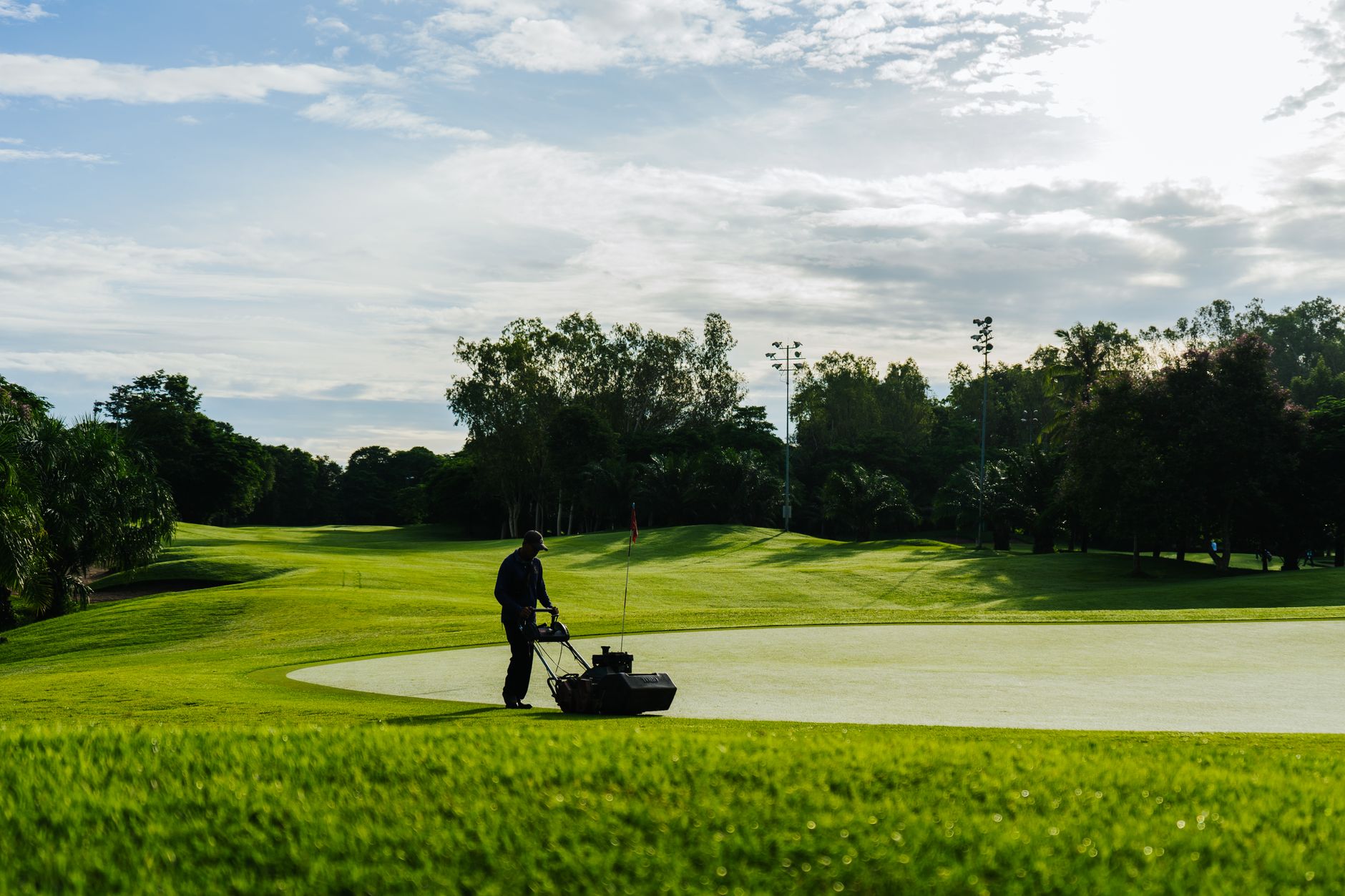
The team is always a robot plus fewer staff, never zero. The groundskeeper stops pushing the mower and starts running the robot: checking the route, clearing the boundary before each window, handling stoppages, and keeping the rest of the range in order. The headcount on the mower can drop, but the person who owns the robot stays on the site plan.
Training matters more than the machine. One trained person should own the robot, know the stop and restart steps, and be the first call when it halts. A second person should cover that role when the owner is off, because a stopped robot with no one assigned is idle time.
We integrate the robot for each site. We map the range, set the boundary and mowing window, train the staff who run it, and service the robot nationwide. The robot is leased through financing, and the lease payment is quoted after a free site assessment.
What can a robotic lawn mower not do on a driving range?
A robotic mower is only as good as its boundary and route. Carts, stray balls, equipment left on the turf, wet ground and layout changes need a person to clear them or reset the boundary. A range that reshapes its hitting areas often will need more setup time than a fixed park.
It cannot replace the eye of the groundskeeper. It will not decide that turf is too wet to cut, that a patch is failing from disease or pests, or that an irrigation head is spraying the wrong place. Those calls still belong to the crew.
Trade coverage also raises a risk worth weighing. A superintendent quoted in Golfdom called the technology expensive and worried that units acquired today could be obsolete within a few years. That is a reason to ask about service, support and upgrade terms before committing, not a reason to skip the question.
- It cannot clear obstacles or reset a boundary without a person.
- It cannot judge disease, pests, irrigation faults or wet turf.
- It cannot do target greens, netting, mats or repairs.
- It stops on a fault unless someone trained is there to restart it.
Is a robotic lawn mower worth it for a driving range, and how do I judge the cost?
The useful question is how many hours move from repeated mowing to other work, and what that is worth against the cost of covering gaps. We do not publish robot prices here. A lease is quoted after a free site assessment, and the number depends on the mowed area, the layout, the boundary work and the service plan.
The case rests on three things: hours freed from the repeated cycle, fewer uncovered gaps when a hire is hard to make, and the overtime that gaps push onto the rest of the crew. The labor baseline is moving, since the GCSAA reported average labor expenditures up 17% from 2022 to 2024 in golf maintenance.
Model it on your own range. Count the hours spent on mowing, count the hours lost to gaps, and compare the lease against those hours rather than against a headline figure from somewhere else. A range with a small or heavily obstructed cut zone will show a weaker case, and that is a valid result.
How do I get started with a robotic mower at a driving range?
Start with a free site assessment. We map the range, mark the zones, set the boundary and mowing window, and measure how much of the groundskeeper's week goes to mowing. That map is the basis for the lease quote, so the quote reflects your range and not an average.
Start small. One leased unit on the fairway and rough, run for a set period with the hours logged, gives you a measured answer before you commit to more. Plan staff roles and training before go-live, and name both the person who owns the robot and the person who covers when they are off.
We deploy and integrate the unit, train the crew, and service it nationwide, with one contact for setup, support and repairs. Ask for the site assessment and the quote, and bring your own hours and staffing records so the comparison is about your range.
Frequently asked questions
Want a robotic mower at your golf driving range?
Tell us about your site. We will recommend the robot, quote the lease, and keep it serviced.
Sources
- U.S. Bureau of Labor Statistics, Occupational Outlook Handbook: Grounds Maintenance Workers
- Reliamag, summarizing BLS fatal injury data
- Golf Course Management, GCSAA labor surveys
- Green Industry Pros, 2025 State of the Green Industry
- IBISWorld, Golf Driving Ranges and Family Fun Centers
- Small Business Development Center research, golf driving ranges
- USGA Green Section Record, robot mowers and turf management
- Golfdom, autonomous mowers and crew time