
The short answer
A cleaning robot vs janitor in Omaha comparison favors the robot when a building has large, open, mostly level floors and a night shift that is mostly repeated scrubbing or sweeping. It does not fit restrooms, trash, spills or cluttered rooms, which stay with staff. The practical result is a robot plus fewer staff, not a robot that replaces the whole crew.
See what a cleaning robot costsRun the numbers in the ROI calculator
Key takeaways
- A robot fits large, open, mostly level floors, while restrooms, trash and spills stay with staff.
- The Omaha metro had about 6,350 janitors and cleaners in May 2024, according to a local ranking article citing BLS data.
- Janitorial services logged 2.5 total recordable cases per 100 full-time workers in 2024, per a state guide citing BLS Table 1, above the all-private rate of 2.3.
- Trade estimates of janitorial turnover range from as low as 75% to as high as 400%, so measure your own from payroll.
- Plan for a robot plus fewer staff, never zero, and ask for a lease quote after a free site assessment.
Is a cleaning robot vs janitor in Omaha the right call for your building?
The answer depends on the floor more than the job title. A cleaning robot works well on large, open floors that are mostly level and clear, such as warehouse aisles, big retail halls and open office corridors. It works poorly where floors are cluttered, where spills need a person to judge and clean, or where most of the work is restrooms and trash.
Think of the decision as a split of the work. The robot takes the repeated floor passes a person would otherwise walk every night. Staff keep the tasks that need hands, judgment or a fast response. For most buildings the workable result is a robot plus fewer staff, not a robot in place of the whole crew.
We are a commercial robot integrator. We pick the robot for the site, lease it through financing, deploy and integrate it, train staff, and service it nationwide. Robots are only leased. The lease payment is quoted after a free site assessment, because the floor plan, hours and staffing decide the answer.
What does a janitor actually do in a shift in Omaha?
Janitors and building cleaners keep occupied buildings clean, safe and stocked. The Bureau of Labor Statistics Occupational Outlook Handbook says most workers learn the job on the job, and no formal credential is required to enter it.
On a typical shift the mix usually includes emptying trash and recycling, restocking paper and soap, cleaning restrooms, wiping high-touch surfaces, spot mopping spills, and sweeping or scrubbing hard floors. Much of that is walking between tasks, and much of it is noticing what needs attention, which is judgment a robot does not have.
Because the mix varies by building, start with a task audit. List each task, where it happens, how often, and who does it today. That list, not a guess at headcount, tells you how much of the shift a robot can actually take.
Median hourly wage, Janitors and Building Cleaners
$3,980
Monthly cost of one full-time worker in Omaha, NE, at the median wage plus payroll costs (an estimate, not a quote).
Which parts of the cleaning can a robot take, and which can't it?
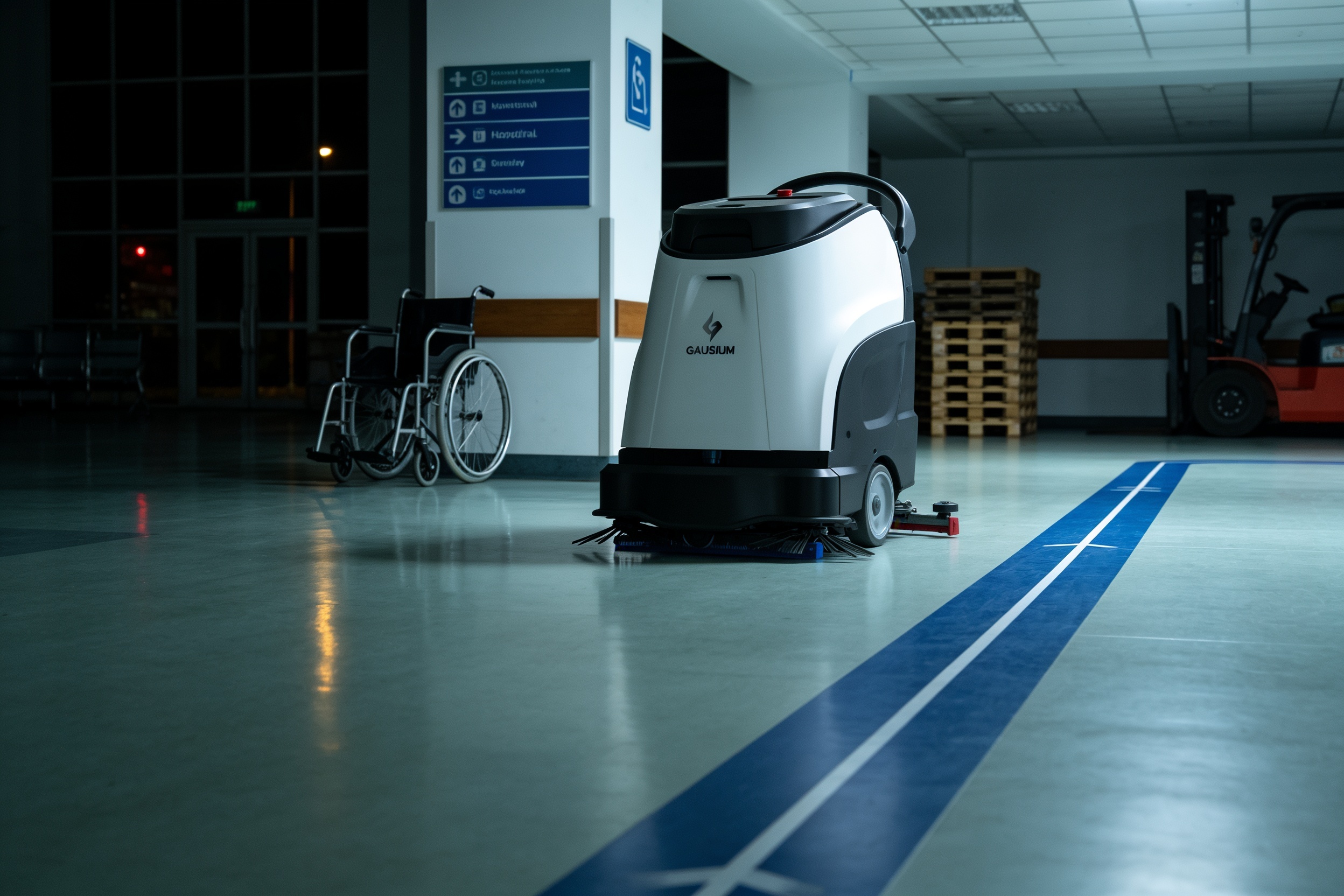
A floor cleaning robot is strongest on the repeated floor passes. Scrubbing and sweeping open corridors, aisles and halls means the same route, run the same way, each night. In a large open building these passes are often the biggest block of floor time, though your audit will show the real split.
The robot cannot take restrooms, trash and recycling, dusting, glass, stairwells with obstacles, or spill response that needs a person to assess and act. It also struggles when furniture or carts block the route, and its map must be updated when the layout changes.
One practical split gives the robot the open floors and keeps people on rooms and restrooms. That keeps the robot on the work it repeats and keeps staff on the work that changes hour to hour.
- Repeated floor passes
Cleaning Robot
Runs the same mapped route the same way each run
Janitor
Covers the same route, but consistency slips over a long shift
- Restrooms and trash
Cleaning Robot
Cannot do this work
Janitor
Does the work and checks that it is done
- Spills and blockages
Cleaning Robot
Stops or routes around, then needs a person to clear it
Janitor
Assesses the spill, cleans it, and decides what to do next
- Changing layouts
Cleaning Robot
Needs a clear route and an updated map
Janitor
Adapts on the spot when furniture or carts move
- Night coverage
Cleaning Robot
Runs unattended after a start and check, but someone still responds to faults
Janitor
Works the shift on site and handles exceptions in person
- Large open floors
Cleaning Robot
Strong, with the same pass and coverage on each run
Janitor
Possible, but the result depends on staffing and time
- Cost driver
Cleaning Robot
Lease quoted after a free site assessment
Janitor
Local wage from the government wage data panel, plus turnover and hiring time
What does the labor picture look like for janitors in Omaha?
Nationally, the Bureau of Labor Statistics Occupational Outlook Handbook reports that janitors and building cleaners held 2,447,700 jobs in 2024. It projects 2% growth from 2024 to 2034, which is slower than average, with about 47,800 jobs added. It also projects about 351,300 openings a year on average over the decade.
Omaha's own count is smaller. According to a local ranking article citing BLS May 2024 data, the Omaha metro had about 6,350 janitors and cleaners, excluding maids and housekeeping cleaners, that month, roughly 12.94 per 1,000 jobs. The BLS Omaha regional release notes that starting with May 2024 the OEWS program uses new metro definitions based on the 2020 census, so Omaha figures may not compare with earlier years.
For the local wage, use the government wage data panel on this page. Wage is only one part of the cost, though. The bigger questions are how many hours of coverage you need and how hard those shifts are to fill.
Turnover is the harder number to pin down. A janitorial trade blog says turnover in the trade is high, higher than in construction, education and retail, and cites estimates as low as 75% and as high as 400%. That spread shows the figure depends on how it is counted, so do not treat any single trade number as your own rate.
We did not find verified figures for overtime, night-shift pay differences or sick days for this occupation in Omaha. Measure your own from twelve months of payroll and attendance records, which will show overtime hours, late-night shifts and call-outs directly.
What injury and illness rates should you know about?
Janitorial work carries a real injury load. A state business guide that reports BLS Table 1 figures for 2024 gives a total recordable case rate of 2.5 per 100 full-time workers for janitorial services, with an approximate 95% interval of 2.25 to 2.75. The same guide gives 2.3 per 100 full-time workers for all private industry, down from 2.4 in 2023, which it describes as the lowest recorded.
The guide also reports an injury-only rate held at 2.2 per 100 full-time workers, and an illness rate of 13.9 per 10,000, down from 19 the year before. It notes that these rates include illnesses, so they are not the share of employees who were injured. We could not check these figures on bls.gov directly, so confirm them on the BLS release before citing them internally.
For the robot decision, the useful point is where strain builds up. Repeated passes, lifting supplies and walking on wet floors add up over a shift, and a robot reduces the number of passes a person makes on the night run. We did not find a verified incident figure that isolates robot-assisted cleaning, so the safety case should rest on your own incident log.
How does a team work with a robot?
Plan for a robot plus fewer staff, never zero. The robot runs its mapped route, but someone still starts it, checks its status, clears a blocked route, responds to a fault or spill, and does the restroom and trash work it cannot touch. The people who used to walk every corridor move to the tasks that need a person.
The shift usually changes in three places. Before close, staff clear the route and move carts. During the night run, the robot works while staff handle rooms and restrooms. At the end, staff review the robot's log, check any area it skipped, and reset anything that failed.
Training is short but real. Staff need to know how to clear an obstacle, how to pause the robot safely, and how to report a fault. Staff who already know the building tend to adapt fastest, which is why the robot works better as a change to the existing crew than as a separate system.
What can a cleaning robot not do?
A robot does not handle everything. It does not clean restrooms, empty trash, handle biohazards, or judge a spill that needs a person. It also needs clear routes, and it cannot plan around a layout it was never mapped on.
Coverage claims need care. Manufacturer datasheets state throughput in square feet per hour, and at least one describes that figure as theoretical, so it does not account for obstacles or blocked aisles. We did not find independent field studies of cleaning robot coverage, so ask for a measured trial on your own floor, counting blocked areas as not cleaned, before relying on any coverage figure.
Robots also need service. A lease should spell out maintenance, repair and replacement while a unit is out, so the night run does not stop when a part fails. Ask what happens when a unit faults at 2 am, not only during business hours.
- Restrooms, toilets and sinks
- Trash and recycling collection
- Spills that need a judgment call
- Cluttered rooms, stairs and changing layouts
Is adoption of cleaning robots growing?
Adoption is real but still early for most buildings. The AACEM/ISSA Autonomous Cleaning Survey, published in 2019 with nearly 23,000 respondents including cleaning service companies, in-house providers and facility managers, found that 69% of facility and property managers had not used autonomous cleaning equipment. About one-third of those non-adopters said they were somewhat likely to adopt within a year.
That survey is several years old, so treat it as a baseline. A market research summary on US commercial robotic scrubbers reports that 42% of facility managers have concerns about job displacement and machine reliability, and that autonomous scrubbers carry higher upfront spending, which limits small and mid-size operators.
Those concerns match the questions this page raises: how staff roles change, and how reliable the unit is on your floor. Both can be tested in a pilot before the lease reaches the whole building.
How do you get started?
Start with the audit. List the floors, hours, and the split between robot and staff work, including the restroom and trash work that stays with people. Then book a free site assessment. We map the route, check obstacles and hours, and quote a fixed robot lease payment through financing, so you can compare it with your own staffing figures.
Pilot before the full building. Start with one floor or one wing, run the robot through complete night cycles, and count what it actually covered. A pilot shows more than a datasheet, and it lets staff learn the routine before the change reaches the whole crew.
Set the review point before the pilot starts. Compare the coverage log, incident log, staff hours and fault time against the plan. If the robot covers its share and staff handle the rest, expand. If not, adjust the route or scope before expanding further.
Frequently asked questions
Put a robot to work in Omaha.
We walk your site, learn the job, and recommend the unit that fits. Then we quote the lease, deploy it, and keep it serviced.
Sources
- US Bureau of Labor Statistics, Occupational Employment and Wage Statistics (OEWS May 2024)
- Bureau of Labor Statistics, Occupational Outlook Handbook: Janitors and Building Cleaners
- Bureau of Labor Statistics, Omaha regional OEWS release (May 2024)
- Omaha lowest-paying jobs article citing BLS May 2024 data
- State business guide reporting BLS 2024 Table 1 injury and illness rates
- AACEM/ISSA Autonomous Cleaning Survey (2019)
- Janitorial trade blog on industry turnover
- US commercial robotic scrubber market research summary