

The short answer
For most Philadelphia buildings, the cleaning robot vs janitor in Philadelphia question is answered by floor layout and staffed hours, not by the robot alone. A robot makes sense when a site has large open hard floors that need scrubbing on a repeatable route, especially outside staffed hours. It does not make sense where most of the work is restrooms, trash, spills, carpets or cluttered rooms, because a janitor stays essential there and a robot would take only a small slice of the shift.
See what a cleaning robot costsRun the numbers in the ROI calculator
Key takeaways
- A cleaning robot fits large, open hard floors on a repeatable route, while a janitor fits restrooms, trash, spills and cluttered space.
- The strongest case for a robot is unattended hours, when it runs and no one is on the floor.
- Most sites that use a robot keep their staff, with fewer people covering what the robot cannot do.
- Janitorial injury rates run well above the all-occupations rate, so cutting repetitive floor work has real value.
- Test the decision with your own hour records and the local wage for this job before requesting a lease quote.
Is a cleaning robot or a janitor the better choice in Philadelphia?
The short answer to cleaning robot vs janitor in Philadelphia is that a cleaning robot earns its place when the floor work is large, repetitive and open, and a janitor earns theirs everywhere else. Philadelphia buildings vary widely. A converted office, a university hall, a hospital wing and a warehouse floor each carry a distinct mix of hard surface, furniture and fixed routines, so the choice is a site question rather than a city-wide answer.
A robot makes sense when three things line up. The site has long, open hard-floor corridors or aisles, the scrubbing follows a stable route, and a meaningful share of that work falls outside staffed hours. It does not make sense when the building is mostly carpet or small rooms, or when most of the day goes to restrooms, trash and spills. In those cases a robot would take a small slice of the shift and leave the labor problem largely in place.
What does a janitor actually do during a shift?
A janitor's shift is rarely one task. It is a chain of short stops: empty trash and recycling, service restrooms and restock supplies, wipe high-touch surfaces like handles and rails, spot clean spills and scuffs, vacuum or mop, clean glass and doors, and report damage or repairs. Many shifts add reactive work, such as a broken dispenser or a mess after an event. Each stop is brief, which is why the work is hard to judge from a distance.
That shape matters for the robot decision. The task a robot does best, a long repeatable pass across an open floor, is often only one block of the shift. The rest is interruptions and judgment. A useful first step is to write down the real sequence for one shift, including the walking between stops, because walking time is easy to overlook when planning floor work.

Median hourly wage, Janitors and Building Cleaners
$4,100
Monthly cost of one full-time worker in Philadelphia, PA, at the median wage plus payroll costs (an estimate, not a quote).
Which parts of the cleaning can a robot take over, and which can it not?
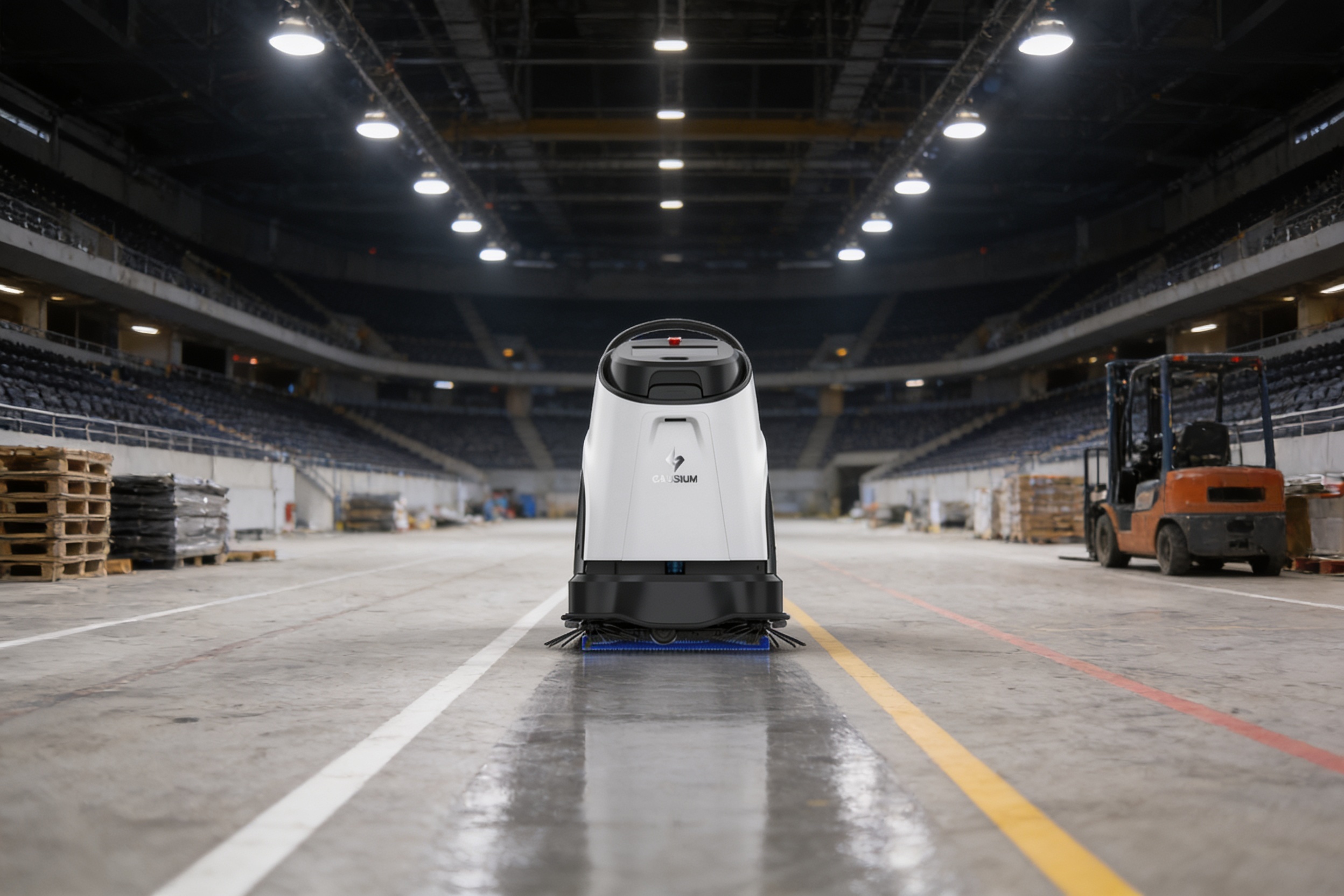
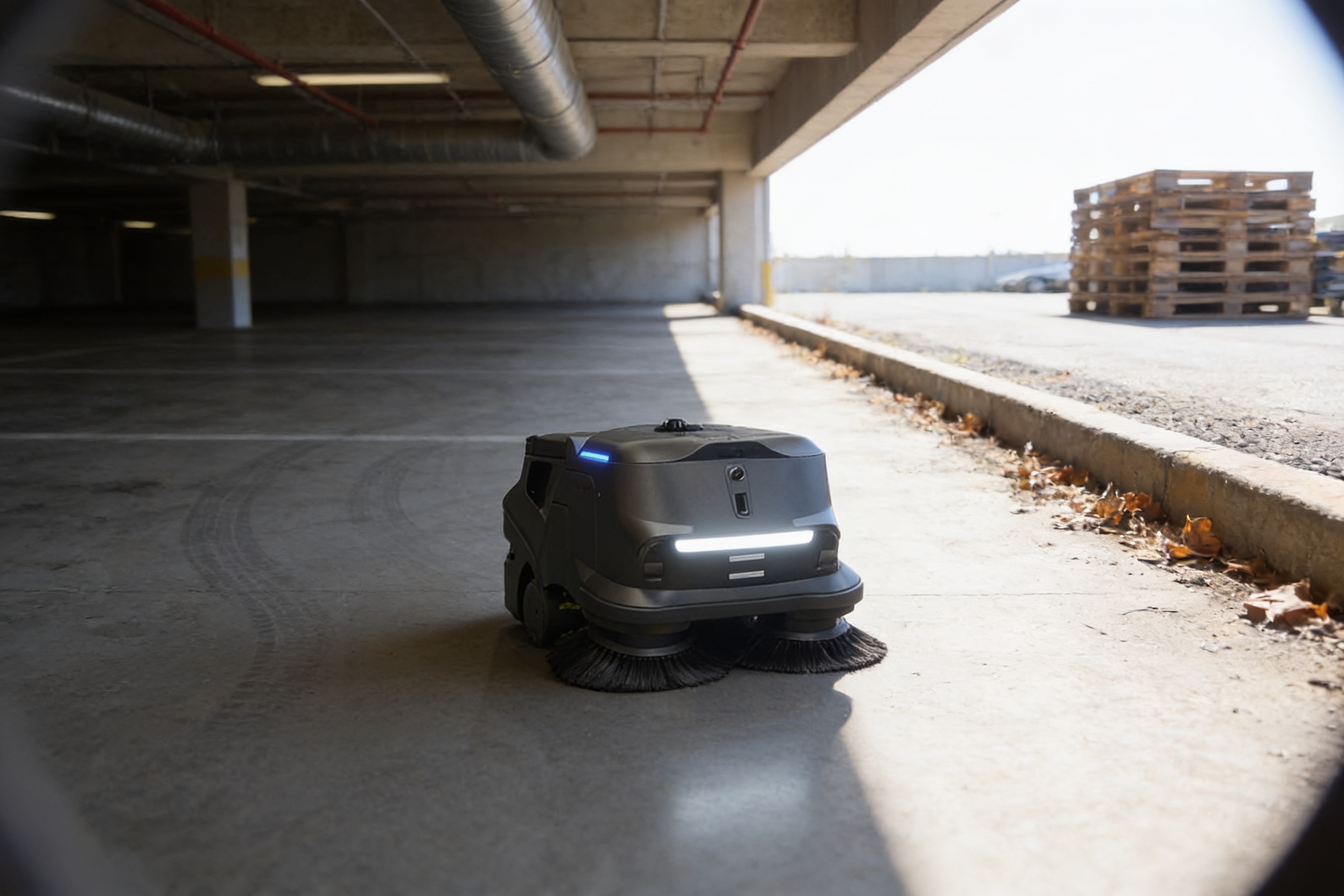
A floor-cleaning robot can take over scrubbing and sweeping on hard floors where it can follow a mapped route: corridors, open lobbies, warehouse aisles, concourses, gym floors and sales floors. Once the route is mapped, it repeats the same pass on a schedule, which gives consistent coverage. It can run unattended, which is the main reason this work fits night hours.
It cannot do the rest. A robot does not clean restrooms, empty trash, wipe high-touch surfaces, respond to a spill it has not been told about, handle stairs, move furniture or choose a different product for a stain. Carpet and cluttered rooms are a poor fit for most floor robots. The comparison below sets out where the person still wins.
- Long open hard floors
Cleaning Robot
Repeats a mapped route on schedule
Janitor
Adjusts to obstacles and changes on the fly
- Night coverage
Cleaning Robot
Runs unattended once the route is mapped
Janitor
Needs someone on shift, with breaks and a lead
- Restrooms and touch points
Cleaning Robot
Cannot do this work
Janitor
Does the work by hand, with supplies
- Trash and spills
Cleaning Robot
Cannot empty bins or respond to an unreported spill
Janitor
Handles them as they appear
- Changes in layout
Cleaning Robot
Needs a map update before it runs well
Janitor
Adapts as soon as the room changes
- Carpet and cluttered rooms
Cleaning Robot
Poor fit for most floor robots
Janitor
Works around furniture and cords
How much labor is in janitorial work, and what do turnover and hours look like?
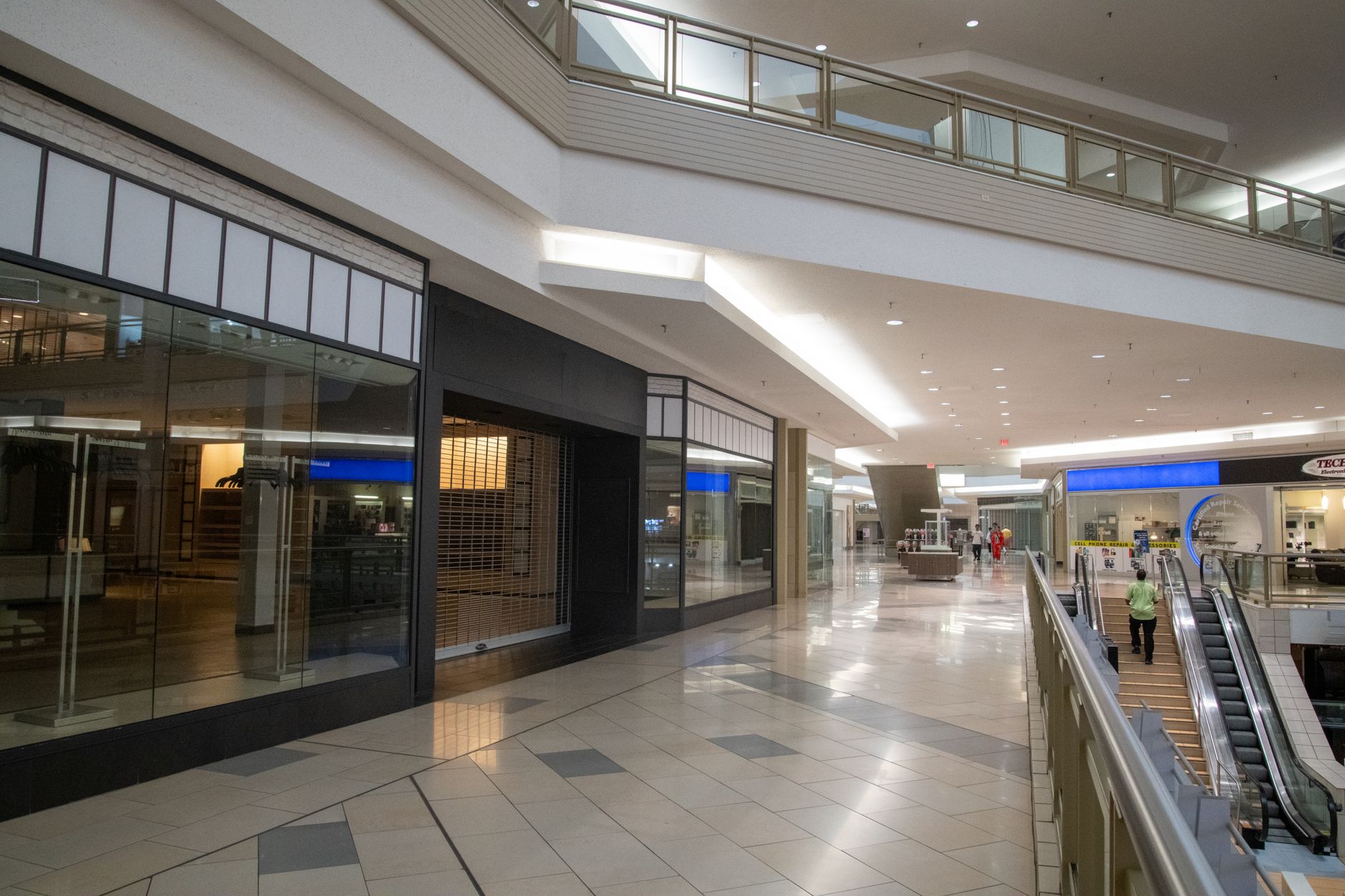
The Bureau of Labor Statistics counts about 2.4 million janitor and building cleaner jobs in 2024, according to its Occupational Outlook Handbook, and projects 2 percent growth from 2024 to 2034, which the handbook describes as slower than average. Slow growth means most openings come from replacing people who leave. The handbook does not split out the replacement share, so an official turnover rate for this occupation is not available in the sources we reviewed.
A career guide on janitorial work describes the job as easy to enter with little training and says relatively high turnover is expected. For a Philadelphia site, that combination means recurring recruiting, training and coverage gaps, especially on late shifts. A robot does not remove those costs, but it lowers how many people you must hire into the same unattended hours, which is where gaps tend to show up.
We did not verify overtime rates, night-shift shares or sick-day figures for this occupation in Philadelphia, so measure them on your own site. Pull the last twelve months of overtime and call-out records for the cleaning team, and count the shifts that went uncovered. Read those alongside the local wage for this job in the government wage data on this page. That comparison shows the labor picture more honestly than any national average.
Is janitorial work dangerous, and does a robot reduce injury risk?
The Bureau of Labor Statistics injury snapshot for janitors and cleaners, except maids and housekeeping cleaners, shows a heavier burden than the average worker. Nonfatal injury and illness cases with days away from work ran at 157.4 per 10,000 full-time equivalent workers in 2019, roughly twice the all-occupations rate of 86.9 for that year. In 2020 the rate rose to 191.6, with 21,100 cases in private industry and 42 fatal work injuries, compared with 45 in 2019.
Repetitive lifting, pushing, reaching and wet-floor work are common in this kind of job, and they are the tasks a floor robot can take off the person. It does not remove trash lifting, ladder work or restroom tasks, and it adds duties of its own: someone must start the unit, watch its route, clear obstacles and respond to alerts. Treat the robot as a way to cut exposure to the heaviest repetitive floor work, and check your own incident log before claiming a safety result.
How are businesses adopting cleaning robots, and what are the early signals?
Adoption is moving, though not everywhere at once. In a benchmarking report summarized by ISSA Today in its September to October 2025 issue, 43 percent of respondents said they planned to add autonomous cleaning equipment. The figure was read from a summary rather than the full report, so treat it as a direction, not a precise market share.
An earlier ISSA survey, with a 2019 baseline sent to nearly 23,000 building service contractors, in-house providers and facility managers, found that 77 percent of respondents cited labor savings as a driver for adoption. Among adopters, 89 percent used scrubbers, and about one-third of non-adopters said they were likely to adopt within a year. Those are 2019 figures, so use them to understand what drives decisions, not as today's adoption rates.
A floor-care vendor's March 2026 press release reported that planned robotic floor equipment adoption roughly doubled from 2025. Vendors have reason to publish strong growth numbers, so read that as a directional claim. For a Philadelphia site, the more useful question is whether your own labor gap is large enough to justify a pilot.
Our company leases commercial robots through financing, selects the right unit for the site, deploys and integrates it, trains the staff and services it nationwide. Where the case holds, the lease is quoted after a free site assessment, so you can compare it against the local wage for this job and your own hour measurements before you commit.
How does a team work with a cleaning robot?
The model that works is always a robot plus fewer staff, never zero staff. The robot covers the repeatable floor passes, often in unattended hours, while people handle restrooms, trash, spills, reactive requests and the robot's own care. Because the robot runs alone, someone still starts it, checks its route, clears obstacles and answers alerts, so the crew shifts in role rather than disappearing.
In practice the work changes in three ways. Daytime staff spend less time on long scrubbing passes and more on restrooms and touch points. Night coverage becomes a light check rather than a full sweep. The supervisor reviews robot logs and missed spots each morning. The timeline below shows one night in a typical setup.
What can a cleaning robot not do?
A cleaning robot is not a general janitor. It does not handle restrooms, trash, dusting, spill response or glass. It struggles with carpet, dense furniture, loose cables, steps and thresholds, and it can stall in rooms where the layout changes often. Mapping takes setup time, and a changed floor needs a map update before the unit runs properly again.
It also depends on people and equipment. Batteries need charging cycles, sensors and brushes need care, and a unit that fails needs repair or a backup. It does not remove the need for supervision, and it does not guarantee a clean floor on its own. Before deciding, ask who responds when it stops at two in the morning, and what happens to the route when the floor changes.
Scope is also limited. A unit that serves one level may not reach a second floor without an elevator or a second unit. Plan for the whole building, not only the best corridor, and be wary of any plan that assumes no staff on site.
How do I get started with a cleaning robot in Philadelphia?
Start with the floor, not the robot. Walk the site at the hour cleaning normally happens, measure the open hard-floor area, mark the rooms that stay with people, and note the hours that fall outside staffed time. That single document lets a provider judge fit quickly and shows whether a pilot is worth running.
Then move in steps. A free site assessment maps the route and checks where the robot can run safely. A pilot with one unit tests the route, the schedule and the hand-off between robot and team. If results hold, you add units or zones. Plan for backup coverage too, because one unit that fails on a night shift leaves that floor unmanaged.
Ask for the lease quote once you have the floor measurements, the comparison against the local wage for this job from the government wage data on this page, and a clear view of which tasks stay with your team. A good provider should show you where the robot will not work and put service coverage and response times in writing.
Frequently asked questions
Upcoming events in Philadelphia, PA
Put a robot to work in Philadelphia.
We walk your site, learn the job, and recommend the unit that fits. Then we quote the lease, deploy it, and keep it serviced.
Sources
- US Bureau of Labor Statistics, Occupational Employment and Wage Statistics (OEWS May 2024)
- BLS Occupational Outlook Handbook, Janitors and Building Cleaners
- BLS injury and illness snapshot, janitors and cleaners, 2016 to 2020
- ISSA Today, September to October 2025
- ISSA autonomous cleaning survey
- Floor-care vendor press release, March 2026
- Career guide on janitorial work