

The short answer
A cleaning robot makes sense in Minneapolis when a building has large, mostly open floors cleaned on a repeating route, especially overnight when no one else is on site. A janitor is still needed for restrooms, spills, entryways, and anything that changes from shift to shift, so the realistic setup is a robot plus fewer staff, not a robot in place of the team. Lease terms are quoted after a free site assessment.
See what a cleaning robot costsRun the numbers in the ROI calculator
Key takeaways
- A robot fits repeating floor routes on large open areas, especially overnight.
- Restrooms, spills, entryways and changing tasks stay with people.
- Turnover, overtime and night shift gaps are the labor risks to measure in your own records.
- The government wage data on this page is the baseline for the labor comparison.
- Plan for a robot plus fewer staff, then measure your hours before deciding.
Cleaning robot vs janitor in Minneapolis: when does a robot make sense?
For most Minneapolis buildings, the question is not whether a robot can clean. It is whether a large share of the janitor's shift is repeatable floor work on open space that a machine can cover on a set route. Warehouses, big-box stores, wide office corridors and gyms often fit that pattern. Small buildings broken into many rooms usually do not.
A robot makes the most sense when the same floor is cleaned every night, the route stays stable, and the building is empty enough for the machine to run without people in its way. It makes less sense when the floor plan changes every week, when most of the work is restrooms, or when the area is so small that setup time eats the gain.
Small offices and multi-room buildings are usually a poor first fit. The robot spends its time on doors, thresholds and furniture, while a person still has to do the restrooms and detail work. A robot pays off on the big open floor, not on the whole building.
The decision is local. The government wage data on this page gives the local wage for this job in the Minneapolis metro, and that sets the labor baseline. The rest depends on your square footage, your hours, and how hard it is to keep the night schedule filled.
What does a janitor actually do in a shift?
A janitor's shift is rarely one task. It usually mixes floor care, restroom service, trash and recycling runs, spill response, supply restocking and a walk-through to catch problems. The floor work is the part a robot can take, but it is broken up by tasks that need a person to stop, decide and move.
Injuries are a reason to look at the job closely. According to the Bureau of Labor Statistics, private industry recorded 21,100 nonfatal injury and illness cases involving days away from work for janitors and cleaners, except maids and housekeeping cleaners, in 2020. The 2019 incidence rate was 157.4 per 10,000 full-time equivalent workers. That is a broad rate, not a breakdown by task, so use it to start a review of the job rather than to draw conclusions about one task.
A secondary site, citing federal injury survey data, reports 2.5 recordable cases per 100 full-time workers in janitorial services for 2024, and 2.3 for private industry overall. We could not confirm the federal table behind those numbers, so treat them as directional. The same secondary site reports 356 fatalities in building and grounds cleaning and maintenance occupations in 2024, up from 337 in 2023.
Median hourly wage, Janitors and Building Cleaners
$4,425
Monthly cost of one full-time worker in Minneapolis, MN, at the median wage plus payroll costs (an estimate, not a quote).
Which parts of the cleaning can a robot take, and which can it not?
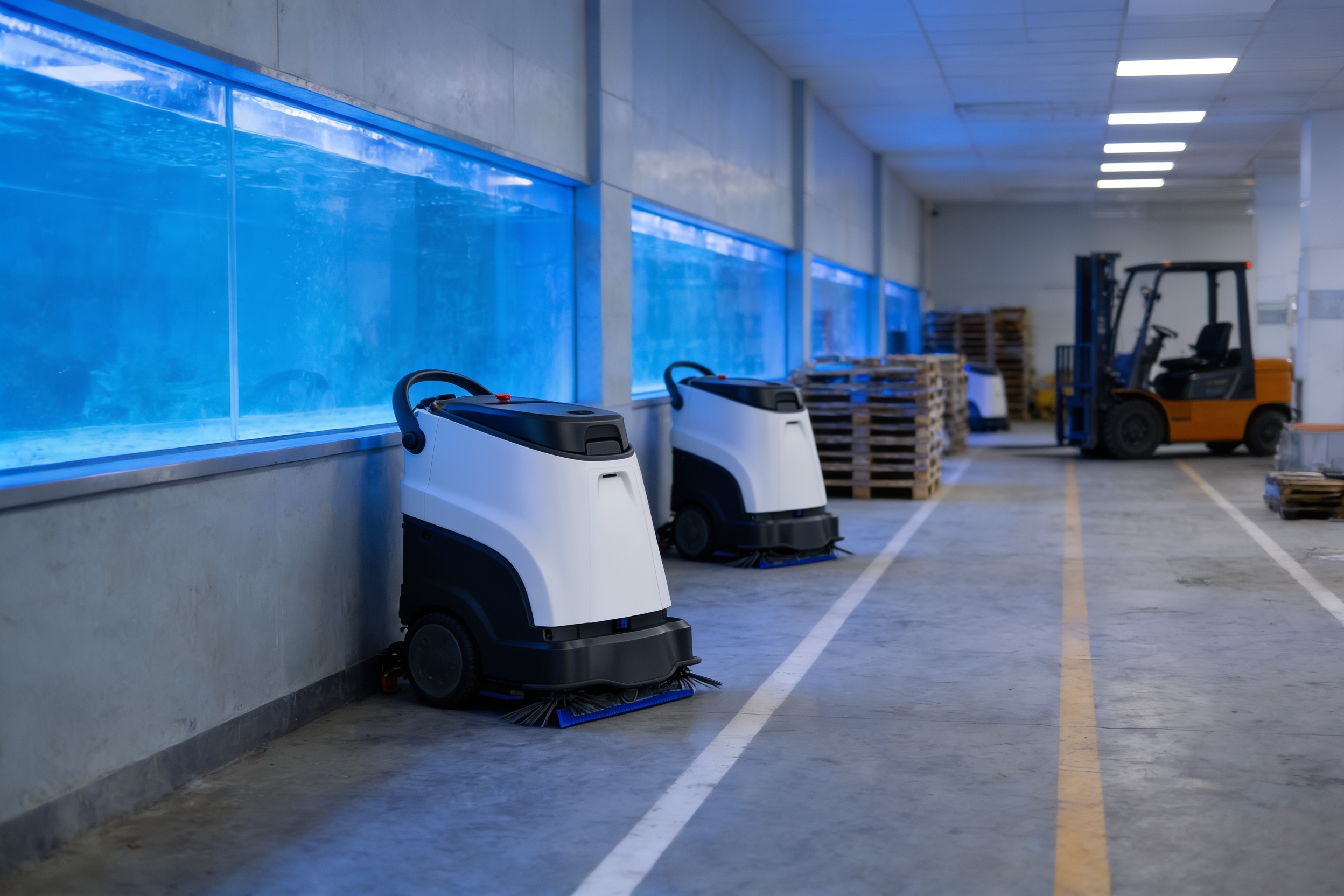
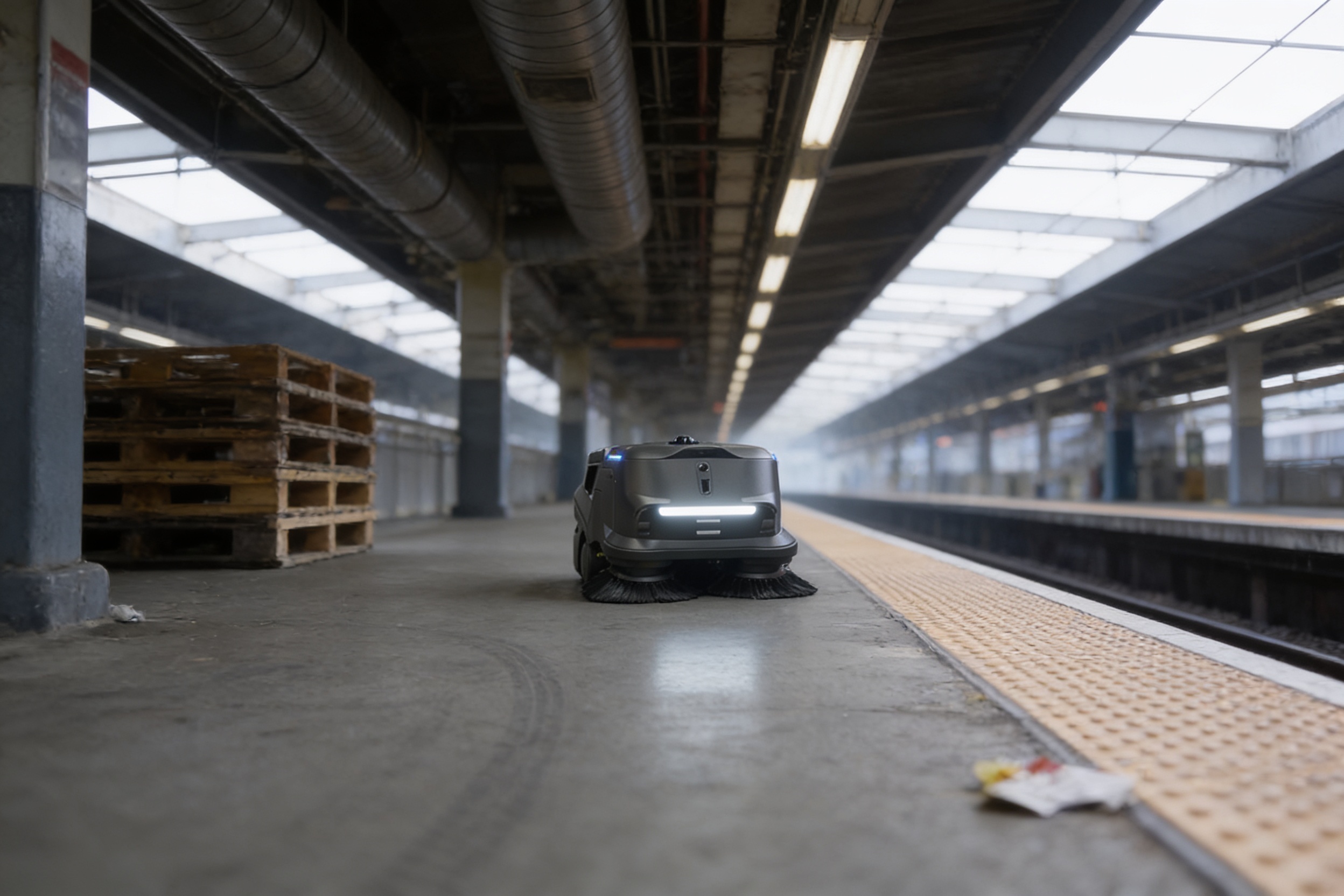
Autonomous floor scrubbers and sweepers handle open, repeatable floor, but vendor speed claims disagree. A vendor blog reports manual mopping at about 2,000 to 2,700 square feet per hour, attributed to the International Sanitary Supply Association, and gives about 28,000 square feet per hour for autonomous scrubbers, citing only industry studies. Another vendor page puts one scrubber model near 21,000 square feet per hour. Measure your own floor before you rely on any of these.
Floor type matters. Polished concrete, sealed epoxy and carpet behave differently under a scrubber, and loose mats or raised thresholds can stop a route. Check the floor type during the site assessment, not after installation.
A robot does not clean a restroom, empty a bin into a dumpster, deal with broken glass, or decide that a wet floor sign is needed. Those tasks stay with people, and they often take the most time per square foot. Winter adds its own problem. Salt and slush at entryways need a person at the door, not a machine on a route.
- Open aisles, corridors and open office floors on a set route
- Repeat passes on the same route each night, with a coverage log
- Restrooms, spills, trash, entryway snow and salt, and tasks that need a judgment call
- Open floor on a set route
Cleaning Robot
Repeats the same pass every night once the route is mapped
Janitor
Can reroute on the fly, but tires over a long pass
- Restrooms and spills
Cleaning Robot
Cannot do them
Janitor
Handles them with judgment and supplies
- Cluttered or tight spaces
Cleaning Robot
Stops or detours around obstacles, so staff must clear the path
Janitor
Works around carts, furniture and people
- Night coverage
Cleaning Robot
Runs unattended on a schedule when the building is empty, with a coverage log
Janitor
Covers breaks, sick days and several floors, but is limited by shift length and absence
- Reporting damage
Cleaning Robot
Logs faults and stops, but cannot judge what is broken
Janitor
Spots and reports damage, leaks and missing items
- Setup and upkeep
Cleaning Robot
Needs mapping, a clear route and scheduled service
Janitor
Needs hiring, training, supplies and supervision
What do the hours and labor numbers look like?

The hours are where the decision gets made. The labor side sits on the local wage for this job, which the government wage data on this page shows for the Minneapolis metro. The hours a robot takes over depend on the square footage on its route, so we measure that on your site rather than assume a figure.
A vendor product page states that a janitor covers about 30,000 square feet per shift and a robot about 100,000, but gives no method. Treat that as a claim to test against your own walk-through, not as a planning figure.
The national picture is large and slow to grow. The Bureau of Labor Statistics reports about 2.4 million janitor and building cleaner jobs in 2024, with projected growth of 2 percent from 2024 to 2034, slower than the average for all occupations. An earlier edition of the same handbook projected about 350,300 openings a year on average, which includes replacement of workers who leave, so the openings count reflects turnover without splitting it out.
How do turnover, overtime and sick days change the math?
Turnover is the labor risk most owners underestimate. According to an undated reader survey reported by a cleaning industry article, average turnover is 73 percent, versus the roughly 300 percent figure often repeated. The survey is not a formal industry study and its date is not shown, so use it as a range marker, not a rate for your building.
Every open shift has a cost, even when it does not show up on a payroll line. When a night janitor leaves or calls in sick, the building either pays overtime to cover the route, leaves the floor uncleaned, or pulls a day staffer into the night. A robot does not cover breaks, sick days or resignations, but it keeps the scheduled open-floor route running on nights when a person is missing, so the question is how often those gaps happen.
We did not find verified Minneapolis data on overnight shift patterns, overtime rates or sick days. Pull those from your own timekeeping before you decide. Your records will tell you more than a regional average, and they become the baseline the quote is checked against.
How does a team work with a cleaning robot?
The right setup is always a robot plus fewer staff. We do not recommend running a robot with no staff in the building, because restrooms, spills and the walk-through still need a person, and a unit that stops needs someone to call it in. The open-floor workload shrinks, and the person who remains does the judgment work.
In practice, a person sets the route, clears it at the start of the night, and checks the robot's log and the floor afterward. The log shows what was covered and where the unit stopped. That person reroutes around a blocked corridor, reports damage and calls for service when a unit needs it.
Staff roles change rather than disappear. The night janitor becomes the person who runs the route, handles exceptions and keeps restrooms and common areas to standard. That role needs a little more training than a pure floor job, and staff training is part of deployment.
What can a cleaning robot not do?
A cleaning robot cannot make a building clean by itself. It does not clean restrooms, empty bins, make a judgment call on a spill, or handle snow and salt at the entry. Heavily soiled carpet, stairs and uneven floors fall outside most floor machines.
The floor limits the robot too. Loose cables, pallets left in aisles and furniture moved between shifts can stop a route. A layout change, a new fixture or a seasonal display can require a new map. Those are the costs people forget when they compare a machine to a janitor on paper.
The honest result is that a robot takes a share of the work, not all of it. In most buildings that share is the open floor, and the rest stays with people. A site without a large, stable open floor is usually better served by changing how the janitor works than by adding a robot.
What should I check before deciding?
Measure the work before you talk to anyone about a lease. Walk the building and note the square footage of open floor, the number of separate rooms, the hours the building is empty, and what staff do in the gaps. A site with large open areas and a repeated night route is the strongest candidate.
Get your own baseline numbers. Record how many hours the open floor takes today, how many shifts go unfilled in a month, and how often overtime covers them. Those three numbers are what any lease quote is checked against.
Then check the factors that change the answer. Winter conditions, floor type, obstacles and how often the layout changes can each move the decision. The checklist below lists what to verify.
How do I get started with a robot lease in Minneapolis?
Start with a free site assessment. We map the floor, identify the route, check obstacles and entryways, and estimate the hours the robot would take over. The lease is quoted after that assessment, based on your site and not on a list figure.
Robots are only leased, through financing, and the lease quote follows the assessment. Our team handles deployment and integration, trains your staff, and services the unit nationwide, with on-site dispatch and remote triage for faults. Expect a phased start. Most sites begin with one unit on one route, measure coverage for a few weeks, and then decide whether to add units while the existing crew stays in place.
We are vendor neutral, so the robot is picked for your floor, not for one brand. Bring the square footage, the route, the schedule and the staffing picture. That gives us what we need for a useful first conversation.

Frequently asked questions
Upcoming events in Minneapolis, MN
Put a robot to work in Minneapolis.
We walk your site, learn the job, and recommend the unit that fits. Then we quote the lease, deploy it, and keep it serviced.
Sources
- US Bureau of Labor Statistics, Occupational Employment and Wage Statistics (OEWS May 2024)
- Bureau of Labor Statistics, Occupational Outlook Handbook: Janitors and Building Cleaners
- Bureau of Labor Statistics, Injury and illness snapshot: janitors and cleaners
- Secondary injury statistics site, janitorial services
- Reliamag, maintenance worker injury and fatality statistics
- Cleanlink, industry turnover article
- Vendor blog on autonomous scrubber throughput
- Vendor product page on cleaning robot coverage
- Vendor product page on scrubber throughput