
The short answer
A cobot makes the most sense for a Denver palletizing line when one line stacks the same cases into the same pattern for most of a shift and the work repeats often enough to justify a fixed lease. A palletizing worker still fits better when products change often, when loads arrive damaged or mixed, or when someone must handle frequent exceptions that a cell cannot. Most sites end up with a cobot working beside fewer people, not a robot in place of the whole team.
Key takeaways
- A cobot fits steady, uniform palletizing with few pattern changes, and it struggles with mixed or damaged loads.
- Handling jobs carry high injury rates, so the physical load belongs in the comparison next to the local wage for this job.
- Public data does not publish hours per shift or turnover for this exact job, so measure those on your own floor.
- A cobot changes the job to fewer people plus a machine, and someone still has to respond to stops.
- Get a fixed lease quote after a site assessment, using your real pattern count, shift count and stop history.
Cobot vs palletizing worker in Denver: which one fits your line?
A cobot makes sense for a Denver palletizing line when the pallet pattern repeats, case sizes stay inside a known range, and enough cases move through the line to keep an arm busy for most of a shift. It makes less sense when the line runs many products with frequent changeovers, when incoming pallets are mixed or damaged, or when the site has no clear floor space for a safe cell. In those cases a trained person keeps the flexibility, and a cobot adds little beyond a narrow task.
Three checks settle most decisions. Count the distinct pallet patterns your line runs in a typical week. Log how often a changeover happens and how long it takes. Then record what happens during a stop and who responds to it. A low pattern count, rare changeovers and a clear plan for stops point toward a cobot. High variety and frequent exceptions point toward keeping the work with people.
What does a palletizing worker actually do in a shift?
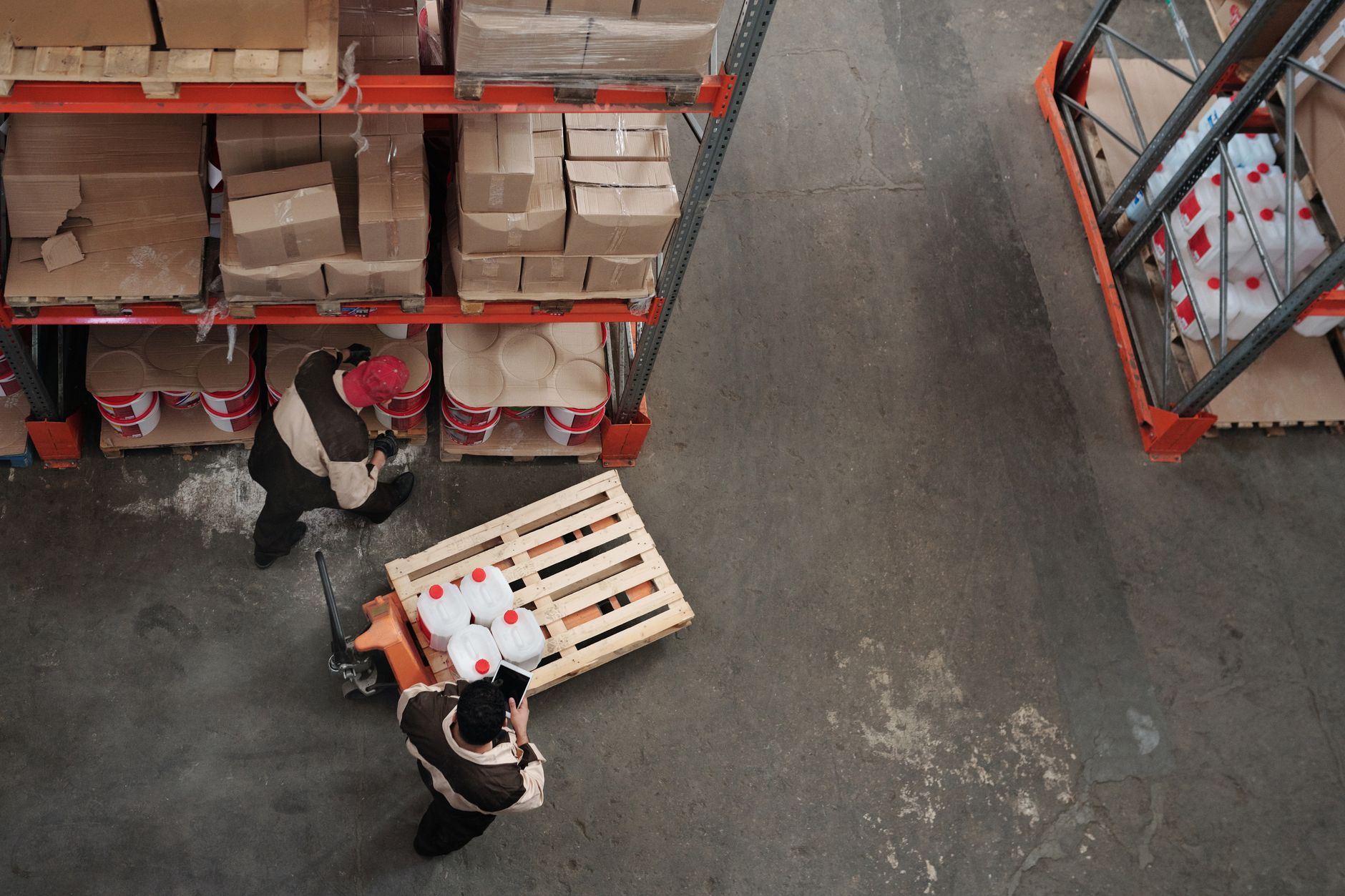
The job is more than stacking. A palletizing worker usually takes cases from a conveyor or staging area, builds each layer to a set pattern, checks that the load is stable, applies wrap or labels, and moves the finished pallet to a staging lane. Between loads the same person clears jams, swaps empty pallets, restocks slip sheets and tags, and logs counts. The occupation falls under Laborers and Freight, Stock, and Material Movers, Hand, which the Bureau of Labor Statistics describes as mostly full-time work usually entered through short on-the-job training.
OSHA's grocery warehousing guidance describes two handling methods that matter here. Layer-by-layer depalletizing means reaching to the back of the load and pulling items forward. Pyramiding means stepping closer to the stack to shorten reach, and OSHA advises against it on unstable pallets or in tight clearance. Both put strain on the shoulder, back and knee, so the physical shape of the job belongs in the decision along with the cost of the labor.
Median hourly wage, Laborers and Freight, Stock, and Material Movers, Hand
$5,141
Monthly cost of one full-time worker in Denver, CO, at the median wage plus payroll costs (an estimate, not a quote).
Which parts of the palletizing job can a cobot take, and which can it not?
A collaborative arm handles the repetitive core: picking uniform cases from a known infeed, placing them into a programmed pattern and repeating the cycle without fatigue. It is well suited to lifts in a fixed zone, especially the high ones. OSHA guidance notes that stacks above shoulder height, weak handles and cases that do not slide easily all stress the shoulder, back and knee, and that push-back racking can force long reaches. Moving those lifts into a fixed cell can take the most stressful part of the job off the person.
What the arm cannot take is the judgment layer. It does not decide that a case is crushed and should be pulled, that a pallet is unstable and needs rebuilding, or that a load no longer matches the program. Those calls, and the work of clearing a stop, stay with a person unless the site adds sensing and a defined exception route. Plan for that split from the start, rather than expecting the cell to absorb it.
- Pace on a steady pattern
Cobot
Holds the same cycle through a shift once the pattern is running
Palletizing Worker
Slows with fatigue, but adjusts on the spot
- Overnight coverage
Cobot
Runs unattended only where stops can be triaged remotely
Palletizing Worker
Present at every stop, if the shift is staffed
- Damaged or mixed loads
Cobot
Limited to the case range it was programmed for, unless sensing is added
Palletizing Worker
Judges a crushed or unstable case by sight and feel
- Product or pattern change
Cobot
Needs a new program or a stored pattern before it runs
Palletizing Worker
Changes pattern after a short briefing
- Lifts above shoulder height
Cobot
Works in a fixed zone without strain on the body
Palletizing Worker
Carries the strain on shoulder, back and knee
- Consistency of placement
Cobot
Places each case the same way on every cycle
Palletizing Worker
Varies with attention, experience and the hour
- Setup before go live
Cobot
Site assessment, integration and staff training come first
Palletizing Worker
Recruiting, onboarding and training for each hire
What do the Denver hours and labor numbers show?
The government wage data on this page gives the local wage for this job in Denver. Read it alongside hours, not on its own. A single steady shift costs a different amount of labor than the same work split across multiple shifts with overtime and cover for sick days. Public data does not give the figures that decide this: hours per shift spent palletizing, overtime, night staffing and sick days for this exact job. Measure them on your own floor.
We found no published turnover or separation rate for this occupation. The closest figure is the BLS quits rate for transportation, warehousing and utilities combined, reported at 2.2% in 2025, 2.2% in 2024, 2.3% in 2023 and 3.0% in 2022 in a BLS annual table reproduced by FRED. That sector includes utilities and covers far more than palletizing, so it describes the wider sector, not the stability of your line.
Denver's supply of this kind of work is growing slowly. FRED's annual series for transportation and warehousing in the Denver-Aurora-Lakewood metro shows 74.8 thousand jobs in 2023, 75.8 thousand in 2024 and 77.5 thousand in 2025. Warehousing and storage alone was about 18.2 thousand jobs in August 2025 in the same series family. Jefferson County's 2025 sector profile says Tri-County transportation and warehousing jobs rose about 1% from 2019 to 2024 and projects limited growth through 2029, about 4%. A line that needs several hires at once may wait longer to fill them than a line in a faster-growing labor market.
How much does injury risk weigh in this decision?
Injury rates belong in the comparison. GAO reported that warehouses and last-mile delivery had the highest serious injury and illness rate of 19 sectors in 2022, at an estimated 3.8 cases per 100 workers. BLS also notes that hand laborers and material movers have some of the highest injury and illness rates of any occupation. A cobot cannot fix a poor layout, but it can take the most stressful lifts out of the person's shift.
OSHA has no standard dedicated to pallet handling, so inspectors rely on general standards. A Nebraska pork cooperative was cited under the general duty clause for ergonomic stressors in its palletizing area. The cited factors included frequency and duration of lifts, weights, repetitive motions, forced exertion and irregular postures. A line that moves those factors into a fixed cell is in a better position to show reduced exposure, but the decision should still rest on an ergonomic review of the people who remain.
How does a team work with a robot in place of a palletizing worker?
Plan the team as a robot plus fewer people, not a robot in place of a shift. Keep a person on the line as lead. That person clears stops, swaps pallets, pulls damaged cases, checks the pattern at intervals and owns the handoff between shifts. Staffing has to cover the hours when the cell is stopped, because a stopped cell is capacity that is not working.
The labor saving depends on what happens to the freed time. Some sites move it to staging, label checks or quality sampling. Others reduce headcount on the line. Either can be valid, but the return holds only if the freed hours are real, scheduled and staffed. We pick the robot for the site, lease it through financing, deploy and integrate it, train the staff and service it nationwide. Stops are triaged remotely first, and a technician is dispatched on site when a remote fix will not do.
What can a cobot not do in a palletizing job?
A cobot is not a complete replacement for a palletizing worker, and any proposal that says otherwise is overselling it. Its limits are specific, and they are worth stating before the decision.
Where a line is high-variety, the better move is often to keep the work with people and apply the robot to one repeat stage instead.
- It cannot judge a damaged, crushed or unstable case by sight and feel without added sensing and a set exception route.
- It cannot handle case shapes or weights outside the range it was programmed and tested for.
- It cannot respond to a stop on its own. Someone must clear the jam, or remote triage must resolve it.
- It does not fix a line that changes product daily, because each new pattern needs programming time.
- It does not remove the ergonomic review of the people still on the floor, who still handle exceptions.
- It does not cut overtime on its own. If the line still needs hours the cell cannot cover, those hours stay with people.
How should I compare cost and get a lease quote?
Compare the government wage data on this page against full labor cost, not the hourly line alone. Full cost includes overtime premiums, sick cover, training time, recruiting in a labor market that is growing slowly, and the injury exposure discussed above. On the robot side, the lease is a fixed payment set in a quote after a site assessment, and service is handled by the same team that deploys the unit. Ask for the quote with the site's real pattern count, shift count and stop history attached, so the number is tested against actual hours.
Is cobot adoption common enough to trust?
According to the International Federation of Robotics, collaborative robot installations reached 66,000 units in 2025, which the IFR puts at 11% of all industrial robot installations. Total industrial robot installations passed 600,000, reported as 603,000 and up 11%. Cobot growth of 7% fell below overall market growth for the first time since the IFR began tracking cobots.
Adoption across the market shows the technology is mature enough to deploy at scale. It does not show that your line fits. Those figures cover all industries, not palletizing in Denver, so treat them as context and let the site assessment answer the fit question.
How do I get started with a cobot for palletizing in Denver?
Start small and measurable. A free site assessment maps the floor, the infeed and the stop process, and checks the case and pallet range. From that we can say which share of the stacking is a fit and which should stay with a person. If the answer is a fit, a pilot on one line with one leased unit lets you measure hours, stops and quality before deciding on more.
Go live support, staff training and a service plan should be in the same scope from the start. Ask who triages a stop during the overnight shift, who is on site, and how a backup unit reaches the floor. A lease quote that does not answer those questions is not yet a quote you can compare.
Frequently asked questions
Put a robot to work in Denver.
We walk your site, learn the job, and recommend the unit that fits. Then we quote the lease, deploy it, and keep it serviced.
Sources
- US Bureau of Labor Statistics, Occupational Employment and Wage Statistics (OEWS May 2024)
- BLS Occupational Outlook Handbook, Hand Laborers and Material Movers
- GAO-24-106413
- BLS quits rate, transportation, warehousing and utilities (via FRED)
- FRED, Denver-Aurora-Lakewood transportation and warehousing employment
- Jefferson County 2025 Sector Profile, Transport and Warehousing
- OSHA Grocery Warehousing, Work Practices
- Food Manufacturing, Nebraska cooperative OSHA general duty citation
- International Federation of Robotics, President's Report