
The short answer
A cleaning robot vs night janitor choice at a medical office building usually favors a robot plus fewer staff when the building has large, repeatable hard-floor areas such as corridors, lobbies and waiting rooms. A robot does not take over restrooms, exam rooms, spill response or the judgment calls a night janitor makes, so a person stays on site every night. Time the work on your own floor before deciding how many hours the robot can take.
See what a cleaning robot costsRun the numbers in the ROI calculator
Key takeaways
- A cleaning robot takes repeatable hard-floor passes, not restrooms, exam rooms or spill judgment.
- The model is a robot plus fewer staff, never zero staff, so a person stays on every night shift.
- BLS projects about 351,300 openings a year, so this job is mostly about replacing people who leave.
- Medical office stock is large, with about 2.2 billion square feet of space according to CommercialSearch citing Yardi Research.
- Decide on hours per square foot times the local wage, measured on your own floor before the lease quote.
When does a cleaning robot vs night janitor choice make sense at a medical office building?
For most medical office buildings, the answer is a cleaning robot working alongside a night janitor, not instead of one. The fit is strongest when the building has large stretches of hard floor, such as the lobby, the main corridors and the waiting areas, that look about the same every night and can be cleaned after the last patient leaves. The fit is weak when the floor is mostly carpet or cluttered with furniture, when the building is small enough that one janitor finishes the hard floors quickly anyway, or when the night work is mostly restroom turnover and spill response.
Look at the decision in two questions. Does the building have enough repeatable hard-floor area that a machine takes a meaningful share of the shift? Is there a person on site who can handle the work the machine cannot? If the first answer is no, a night janitor alone may be the simpler choice. If the second is no, do not add a robot, because the building would be relying on a machine for work it cannot do.
A useful first step is to write down the night routine as it runs today, room by room, with the hours each zone takes. That list shows where the robot fits and where it does not, and it gives the person signing off something concrete to compare against the lease quote.
What does a night janitor actually do in a medical office shift?
A night janitor at a medical office usually starts once the clinicians and front desk staff have left, and finishes before the first patients arrive the next morning. The work is less about raw floor area and more about sequence. The shift typically moves through waste removal, restroom service, waiting room and lobby resets, high-touch surface wiping, exam room cleaning and then the floor passes, with interruptions for spills, supply restocking and anything the day staff left behind.
Cleaning standards for clinics are set by the building owner, the practice and its infection control policies, so the checklist at one site will read differently from the next. Two buildings of the same size can have very unlike night routines, depending on how many exam rooms there are, whether the building has procedure rooms, and how often the waiting room is used in the evening. That variation is why a robot decision should start with a walk through the actual routine, not a generic estimate.
The practical point is that the janitor's shift is a stack of short, interrupted tasks. A robot does not remove those interruptions. It takes the long repetitive passes out of the middle of the shift, which can give the person more time for the work that needs hands and judgment.
Median hourly wage, Janitors and Building Cleaners
$4,041
Monthly cost of one full-time worker, at the median wage plus payroll costs (an estimate, not a quote).
Which parts of the night work can a cleaning robot take, and which can't it?
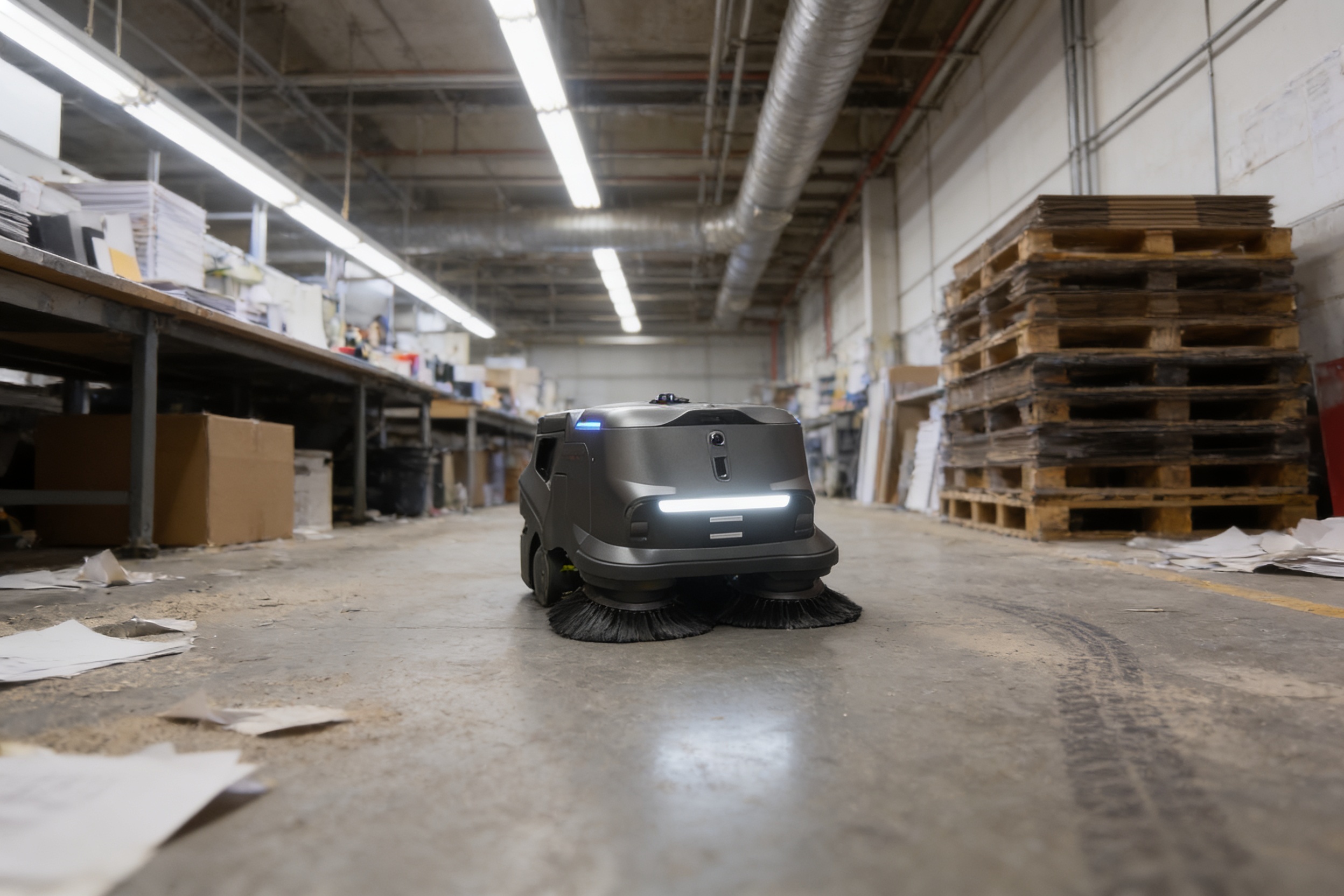
A cleaning robot is best at the wide, repeatable passes on hard floors. Main corridors, lobby floors and open waiting areas with clear sight lines fit well, because the layout rarely changes and the machine can run the same route night after night. Mapping that route once, then running it on a fixed schedule, is where the robot earns its place in the shift.
It cannot do restrooms, exam rooms, sharps or any biohazard response, and it cannot read a room. It will not notice a chair pulled into its path, a cord across the floor, a bag of linens left on the carpet, or a wet area that needs a sign and a block. Carts and deliveries that stop in the corridor can halt a route. Those jobs stay with staff, and the staff member is the one who sets up the route, checks the path and clears it when needed.
Treat the boundary as a map, not a feeling. Mark each zone as robot, staff or shared before any deployment. Shared zones, such as a corridor with several exam room doors off it, usually need the person to clear the doorway before the robot passes.
- Long hard-floor corridors
Cleaning Robot
Repeats the same mapped route each night without tiring
Night Janitor
Covers the route but tires, and may skip areas on a heavy night
- Restrooms and exam rooms
Cleaning Robot
Cannot do this work
Night Janitor
Does it with cleaning supplies and judgment
- Spills and wet floors
Cleaning Robot
Can stop and alert, but cannot block off the area or judge the hazard
Night Janitor
Blocks the area, cleans it and notes the cause
- Route changes
Cleaning Robot
Needs remapping or a staff member to adjust the path
Night Janitor
Adapts on the spot to a moved chair or a closed door
- Sick days and absence
Cleaning Robot
Does not call in sick, but still needs a person on the shift
Night Janitor
Calls in sick, which needs cover or overtime
- Hiring and turnover
Cleaning Robot
Fewer hires needed for the repeatable hard-floor passes
Night Janitor
Vacancies and turnover are a recurring problem in this job, as discussed above
How many medical office buildings are there, and how much floor do they cover?
According to CommercialSearch, citing Yardi Research, the US has 28,726 medical office properties with about 2.2 billion square feet of space. The same source ranks Houston at about 101.2 million square feet across 896 properties and Washington, D.C. at about 101.1 million square feet across 1,059 properties. Those two metros show how much medical space sits in a few large markets, and why a regional service plan matters more than a single install.
CommercialSearch also reports, drawing on 42floors and CommercialEdge analysis, 439 medical office buildings under construction with about 108.3 million square feet. That is a pipeline count, not a count of existing buildings, but it signals that new clinic space is still going up and that a good share of it will need a cleaning plan once occupied.
For a single operator or a property group, the useful number is not the national total. It is the share of your own portfolio where the hard floor is large, the traffic is predictable and the night shift is hard to staff. Map that across your buildings first, then pick the sites where a robot will take the most hours.
What does the labor picture look like: turnover, overtime, night shifts and sick days?
The Bureau of Labor Statistics counts about 2.4 million jobs for janitors and building cleaners in 2024, and projects employment to grow 2% from 2024 to 2034, which it describes as slower than average. The number that matters more for staffing is openings. BLS projects about 351,300 openings a year on average over the decade, mostly from workers who leave and must be replaced. Growth is small. Replacement is the job.
BLS does not publish an occupation-level turnover rate in the source used here, and JOLTS reports separations by industry rather than by job, so the gap has to be filled from other sources. CleanLink, a trade publication, reports in its February 2025 piece that 61% of janitorial companies name labor shortages as a major obstacle to growth. Netchex, an HR software vendor, says annual separation rates in janitorial and cleaning services commonly exceed 50%. Golden Group, also a vendor, reports that 86% of companies plan to raise wages to retain staff. These are directional signals, not audited rates, so verify them with your own contractor or HR records.
Here is how that plays out on a night shift. Labor cost per square foot is the hours of work per square foot multiplied by the local wage for this job, which the government wage data on this page shows. Overtime, sick cover and a vacant night shift push the effective hours up, often without showing in a contract line. A robot does not take a sick day, but it still needs a person on the night shift, so the gain is fewer open hours to cover rather than an empty shift. The saving is real only if the robot takes hours you are already paying for.
Does a cleaning robot change injury risk for night cleaners?
The BLS injury snapshot for janitors and cleaners, except maids and housekeeping cleaners, counted 21,100 nonfatal injury and illness cases involving days away from work in private industry in 2020. That is a substantial number for a job many people think of as low risk, and it is a reason to look at the physical load of the night routine, not only its labor cost.
The snapshot used here does not break down causes, so do not promise that a robot will remove a specific injury type without checking the case mix in your own incident log. What a robot can reduce is hand-pushed scrubbing on long, flat, repetitive floors. What it cannot change is the lifting of waste bags, the ladder and reach work, and the chemical handling that happen during restroom and exam room cleaning. Keep those tasks with trained staff and reduce how many hand passes the person has to make.
Ask your contractor for the incident history on the night shift before deployment, then compare it to the same log after the first few months. That comparison tells you more than any general claim about safety.
How does a team work with a cleaning robot?
The right model is always a robot plus fewer staff, never zero staff. A person sets the robot up at shift start, confirms the route is clear, and checks the finished floors at the end. The janitor's time shifts from pushing a scrubber down the corridor to restroom service, exam room resets and spill response, which is the work that needs judgment.
Staff training covers the stop, pause and manual control functions, the steps to take when the robot halts mid-route, and what to do with a blocked path. Expect the first few weeks to be the slow ones. The route gets adjusted, the staff learns which doors and carts block the path, and the building's habits change around the new routine. Build that time into the plan rather than treating it as a failure.
Give the team a simple escalation path. If the robot stops twice in one night, the person on shift calls the service line rather than attempting repairs alone, and the stop is logged so the route can be fixed. That keeps the robot's record honest and keeps the janitor from becoming an unpaid technician.
What can't a cleaning robot do in a medical office?
A cleaning robot cannot clean restrooms, reset exam rooms, handle waste, or make the judgment calls a night janitor makes every shift. It does not understand a closed door with a sign, a moved chair, a cord on the floor, or a wet patch that needs a warning. It also cannot replace a person when a sensor fails, a battery runs low, or a delivery blocks the route.
Set expectations for uptime and hours too. A robot needs charging, a clear route, and someone who can recover it after a stop. If the building has heavy traffic at odd hours, plan a fixed window for the robot rather than expecting it to run through the whole evening. In most medical office buildings the robot covers part of the floor area, and the person still does the rest.
Published production rates for corridor scrubbing are hard to pin down, so the hour figures for your site should come from timing your own routes. ISSA 612 is the method cited for production rates, where labor hours equal area divided by production rate. Apply that method to your measured rate rather than to a generic benchmark.
How do I get started with a cleaning robot at a medical office building?
Start with a free site assessment. We map the building, measure the hard-floor areas, identify obstacles and traffic, and time the night routine as it runs today, then recommend which zones the robot takes and which stay with staff. We select the robot for the site, lease it through financing, deploy and integrate it, train the staff and service it nationwide. The lease payment comes in a quote after the site assessment, so it reflects your floor, your route and your service plan.
Start small. A pilot on one building or one wing lets you measure real hours before you commit to more. Ask for the site timing data, the route map and the service response plan in writing. Then compare the quote against the labor you cover each night, using the government wage data on this page for the local wage for this job. The person signing off should see both the hours the robot takes and the hours the staff still carries.
One partner, one number is the simplest way to manage a fleet across several buildings. Service calls go through remote triage first, and on-site dispatch follows when needed. Ask how response works in your area before the decision, not after the first stop at two in the morning.
Frequently asked questions
Upcoming hospitals & healthcare events
- ConferenceNew England College Health Association (NECHA) 2026 Annual MeetingNov 11 to 13, 2026Newport Marriott Hotel & Spa, Newport, RI
- ConferenceHLTH USA 2026Nov 15 to 18, 2026The Venetian Expo, Las Vegas, NV
- ConferenceIndiana Safety and Health Conference & Expo, 2027Feb 8 to 10, 2027Indianapolis, IN
- ConferenceHealthcare Project Delivery Conference 2027Feb 10 to 11, 2027Manchester Grand Hyatt, San Diego, CA
Want a cleaning robot at your medical office building?
Tell us about your site. We will recommend the robot, quote the lease, and keep it serviced.
Sources
- US Bureau of Labor Statistics, Occupational Employment and Wage Statistics (OEWS May 2024)
- BLS Occupational Outlook Handbook, Janitors and Building Cleaners
- BLS Injuries, Illnesses and Fatalities, Janitors and Cleaners except Maids and Housekeeping Cleaners, 2016 to 2020
- CleanLink, February 2025
- Golden Group, How Commercial Cleaning Is Changing in 2026
- Netchex, Why Turnover Is High in Janitorial and Cleaning Services
- CommercialSearch, Medical Office Building Report and Construction Inventory
- CommercialSearch, Medical Office Building Report Pipeline 2025