
The short answer
Delivery robot ROI in Dallas comes from the food running and bussing hours that servers spend walking between the kitchen pass, the dining room and the bar on each shift, offset against a fixed lease payment quoted after a free site assessment. The size of the return depends on how many servers a site schedules, how much of their walking a robot can realistically take on its mapped route, and how the floor is laid out. The result is a savings range that the site assessment turns into a measured figure, not a promise.
Key takeaways
- Delivery robot ROI in Dallas is built on server walking time, not on cutting staff.
- The local wage for this job values each offset hour, and the calculator does the rest.
- A robot takes a realistic share of runs, so that share sets the range more than the lease cost does.
- Floor layout, peak volume and service coverage move the payback up or down.
- A free site assessment replaces the calculator range with a measured figure.
Run the numbers for your site
Auto-detected from your location - we use the real BLS wage here. Not right? Pick your city or state above.
What do you want to automate?
The robot walks the repetitive trays; staff stay with guests and tables.
What return can a Dallas restaurant expect from a delivery robot?
Delivery robot ROI in Dallas is mostly a question about server time. In a full-service room, a server spends a large share of each shift carrying plates from the kitchen pass, clearing tables, and returning with drinks, sides and checks. A delivery robot takes over the repeated trips on a mapped route, so the server spends more of the shift at the table, where sales and guest care happen.
The return is a labor offset, not a headcount reduction. The hours the robot takes over are valued at the local wage for this job, which is shown in the government wage data on this page. The payback point arrives when the offset hours, added up over the lease term, pass the total lease payments.
Expect a range rather than one number. Two rooms in the same metro can land far apart, because one runs a short straight route and the other runs a cramped patio with steps and a long walk from the pass.
How does the ROI math work for a delivery robot?
The calculator runs on three inputs. The first is the hours of food running and bussing that a server does on each shift. The second is the share of those trips the robot can realistically complete on its route, because no robot takes every run. The third is the lease cost, which we quote after a free site assessment as a fixed lease payment. The local wage for this job converts the offset hours into value.
In practice the weekly calculation runs in four steps. Take the server hours spent on runs and bussing per shift. Multiply by the number of servers on that shift and by the number of open shifts in a week. Multiply by the share of those trips the robot takes. Then set the result against the lease payment for the same week, and the difference is the weekly return. The calculator repeats this across a low set and a high set of inputs, which is why the output is a range.
Keep the labor side honest. Only the work of waiters and waitresses is priced here. Hosts, managers and kitchen staff are not valued in this calculation, so if a site expects the robot to free up a host or a cook, that benefit does not belong in the savings range.
Median hourly wage, Waiters and Waitresses
$3,217
Monthly cost of one full-time worker in Dallas, TX, at the median wage plus payroll costs (an estimate, not a quote).
How many restaurants and servers are there in the US and Dallas?
The Bureau of Labor Statistics counted 2,329,700 jobs for waiters and waitresses in 2024, according to its Occupational Outlook Handbook. The same handbook projects a 1% decline from 2024 to 2034, about 16,300 jobs, with about 456,700 openings a year, mostly from replacement rather than growth. Food services and drinking places employ about 85% of these workers.
The National Restaurant Association's 2025 Pocket Guide lists 1M+ restaurant locations and 15.9M employees across the industry. The same guide reports that more than 7 in 10 restaurants are single-unit operations. A single-unit owner usually runs one kitchen, one dining room and a short roster, so losing one server on a Friday night takes a bigger share of the floor than it would in a large chain.
Dallas has a large base for this work. According to the Federal Reserve Bank of St. Louis, food services and drinking places employment in the Dallas-Fort Worth-Arlington metro was 336.5 thousand in 2025. Dividing the national waiter and waitress count by the restaurant location count gives a rough average of about two per restaurant. That average includes counter-service and very small rooms, so it is a planning starting point, not a headcount for your site.
Does staff turnover change the return on a delivery robot?
Turnover is the staffing problem behind most restaurant hiring. According to the Occupational Outlook Handbook, the Bureau of Labor Statistics expects about 456,700 openings a year for waiters and waitresses, mostly from replacement rather than new positions. In practice a room is often training someone, and a new hire's first weeks are the least productive on the floor.
Turnover hides cost in training and in shifts that go short while a new hire learns the floor. A delivery robot does not resign, but it still needs trained staff to load it, clear its route and supervise it. Count that training as a real cost in the quote, and count the robot as a steady runner while a new hire learns the section.
Staffing gaps change the picture too. When a shift runs one server short, runs pile up at the pass. The calculator uses the hours you measure on your own roster and your own ticket times, not a national shortage rate.
- Repeated runs on a fixed route
Delivery Robot
Same path and pace on every trip, with no fatigue on a late shift
Staff
Adjusts when a route is blocked or a table moves
- Guest conversation
Delivery Robot
Announces arrivals and delivers, but does not read the table
Staff
Reads the table, suggests dishes, and handles allergies and complaints
- Staffing gaps
Delivery Robot
Runs the same route whether or not a server is free to cover it
Staff
Covers only when scheduled and present, and can be pulled to another section
- Exceptions on the floor
Delivery Robot
Stops and waits when a path is blocked
Staff
Moves a chair, clears a spill and decides on the spot
- Training and turnover
Delivery Robot
Does not resign, but needs trained staff to load, clear and supervise it
Staff
Learns the regulars and the floor, and that knowledge leaves when they do
Where does the labor savings come from in a restaurant?
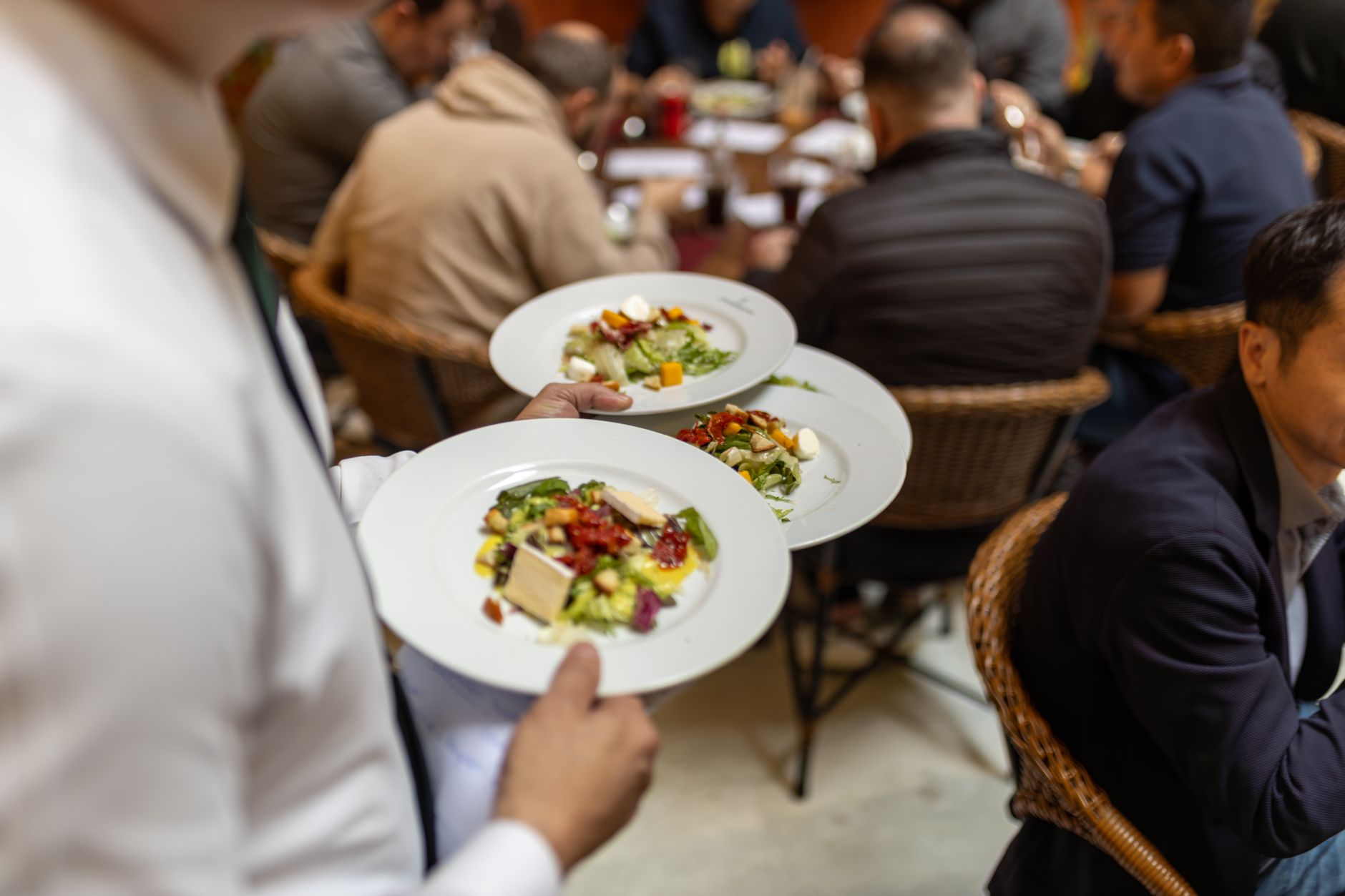
The return comes from a small set of repeated trips. The largest is food running from the kitchen pass to tables, especially in long dining rooms, split-level floors and patios that sit far from the pass. The second is bussing, carrying dirty plates and glasses back to the dish station between seatings. The third is drink and side runs during rush periods, when a server makes many short trips for items missed on the first pass.
What the robot does not take matters as much. Taking orders, explaining a dish, handling allergies, running payment, checking ID, clearing a spill and resolving a complaint all stay with the server. Those tasks are where a server earns tips and keeps guests, so the realistic share of runs a robot takes is always lower than the share of walking a server does.
Carrying loaded trays is physical work. The Bureau of Labor Statistics industry profile for food services and drinking places reports a 2024 total recordable case rate of 2.4 per 100 full-time workers. Fewer heavy tray trips is a safety benefit to count alongside labor, though the calculator does not value it.
Which Dallas restaurant layouts get the best return?
Layout decides most of the return. A route that runs in a straight line from the kitchen pass to a single-level dining room with clear aisles gives the robot the most usable trips. Each step, threshold, narrow gate or door that needs a person to hold it lowers the share of runs the robot can finish alone, and a route that is blocked for part of the night returns very little.
Volume matters too. A room that turns its tables several times a night has more runs to offload than one that serves a few large parties. Hours of operation matter as well: a lunch-only room gets fewer runs per week than a room open for dinner and late service. Patio and bar service each need their own look, because weather, uneven pavers, gates and crowds change the route.
Two checks belong in every assessment. Confirm which floors the robot must reach if a dining area sits above or below the kitchen. Confirm the route at the busiest hour, not the quiet one, because a route that works in the afternoon can jam at the Friday dinner peak.
What does a delivery robot lease cost and how is it quoted?
Robots are leased through financing, and the payment is a fixed lease payment quoted after a free site assessment. The quote depends on the robot that fits your floor, the route and the service terms, so there is no generic figure to compare from a listing. The quote lays out the robot, deployment and integration, staff training and service terms.
Service runs through our team nationwide. When a unit goes down during a busy shift, one partner handles dispatch and triage rather than a separate vendor for each piece. Ask for the response plan in writing and check how a spare unit is covered during repairs, because a stuck robot during a rush erases the offset.
Do not compare the lease payment to a single wage. Compare the weekly labor offset, valued at the local wage for this job, with the lease payment over the same weeks. A lease keeps large upfront spending out of the first budget cycle, which often matters more to a single-unit owner than the sticker figure.
What are the risks to the return and how do you avoid them?
The biggest risk is counting every run. If the model assumes the robot takes every trip, the savings range runs high and the budget gets surprised in the first months. Set the share from a pilot on the busiest lane, keep bussing and guest-facing work with staff, and review the share after the first weeks of service.
Downtime is the second risk. A robot parked in the back during a rush puts the servers back on foot, and the offset disappears on the nights that matter most. Plan for a spare unit, a clear rule for who clears a stuck path, and a dispatch window in writing.
Guest experience is the third. A robot that blocks an aisle, parks in front of a booth or stops at the wrong table costs more than the hours it saves. Set routes, speeds and drop-off points during deployment, and let the staff who work the floor report problems during the first week.
What is a realistic timeline from assessment to payback?
The timeline runs in phases. The free site assessment maps the route, samples runs across several shifts, and sets the realistic share. The quote follows with the robot, lease terms and service plan. After signing, deployment covers mapping on site, integration with the kitchen pass and any service points, and training for the staff who will load, clear and supervise the robot.
Go-live is a controlled start rather than a full switch. Most rooms run the robot on the busiest lane first, compare the measured share of runs with the assessment, and widen the route only after the staff are comfortable with it. Payback arrives once the measured offset hours have passed the total lease payments over the term.
The date depends on your own shift volume and on how quickly the route settles, so we do not promise one. The site assessment gives an expected window based on your numbers, and measured results in the first weeks of service show whether the room is tracking it.
How do I get a precise savings figure for my Dallas restaurant?
The calculator on this page gives a savings range for delivery robot ROI in Dallas, built from the local wage data and typical inputs. A precise figure needs your own numbers: shifts per week, servers scheduled on each shift, the distance from the kitchen pass to the farthest table, peak run counts from your ticket times, and the share of runs a pilot actually completes. The free site assessment collects those and returns a quote with a measured savings range.
Bring a short list to the assessment: the floor plan, your opening hours, your server schedule, and where runs bottleneck during a typical rush. The assessment checks the route on site and returns a range you can take to your owner or lender. Savings are always ranges, never a guarantee, and the quote sets the lease payment you will actually pay.
Frequently asked questions
Put a robot to work in Dallas.
We walk your site, learn the job, and recommend the unit that fits. Then we quote the lease, deploy it, and keep it serviced.
Sources
- US Bureau of Labor Statistics, Occupational Employment and Wage Statistics (OEWS May 2024)
- Occupational Outlook Handbook: Waiters and Waitresses (Bureau of Labor Statistics)
- 2025 Pocket Guide (National Restaurant Association)
- Industry Profile for Food Services and Drinking Places (Bureau of Labor Statistics)
- FRED series SMU48191007072200001A, food services and drinking places, Dallas-Fort Worth-Arlington (Federal Reserve Bank of St. Louis)