
The short answer
For hospital inpatient floors, delivery robot vs food runner is mostly a question of route work. A delivery robot makes sense when covered meal trays travel the same kitchen-to-unit route on set times and corridor and elevator trips make up most of a food runner's job, and it does not make sense when trays must reach patients who cannot manage them, when the route crosses crowds that cannot be planned around, or when the unit is too small to justify a dedicated route. For most units the answer is a robot plus fewer runners, not a robot in place of staff.
Key takeaways
- A delivery robot fits the repeatable meal tray route, not the bedside handoff or the judgment calls.
- NSI reported RN turnover of 17.6% for calendar 2025, so staffing on inpatient floors stays tight.
- The one measured result close to tray work is about supply transport, so test your own meal route.
- Plan for a robot plus fewer runners, never zero staff, with a backup route for blocked corridors.
- Start with a free site assessment and a one-unit pilot before deciding on more units.
Delivery robot vs food runner: which fits hospital inpatient floors?
For most inpatient floors the practical answer is a delivery robot for the route work and a person for the bedside work. A delivery robot makes sense when covered meal trays move from the kitchen to the nursing unit on set routes, and when corridor and elevator trips make up most of a runner's job at each meal. It does not make sense when trays must be handed to patients who cannot manage them, when the route runs through crowds that cannot be routed around, or when the unit is too small to justify a dedicated route at all.
The question is large. According to the AHA's 2025 Fast Facts edition, the US has 6,093 hospitals, 5,112 of them community hospitals, with 913,136 staffed beds. Each building has its own corridors, elevators and kitchen distance, so the same tray problem has a different answer in each one.
Decide on the route first and the staffing second. If you cannot describe the tray route in two sentences, the robot is not ready to schedule.
What does a food runner actually do in a shift on an inpatient unit?
A food runner's work is built around meal windows. Before each meal, trays are built and checked against diet orders, covered, loaded onto carts and sent up. The runner then moves the cart through corridors and elevators to the unit, sorts trays by room and hands them to the nurse or aide who takes the floor.
After the meal the runner collects trays, notes missing items, and returns carts to the kitchen. Between meals the same person may restock supplies, move equipment or cover a gap. That mixed day is why tray running is hard to see on a schedule. The route is one task among several, not the whole job.
Read the government wage data on this page for the local wage for this job, then set it beside your own time logs. The wage gives the cost of one person-hour. The logs show how many person-hours go to tray runs versus restocking and cover. Both numbers are needed before the route decision.
Median hourly wage, Waiters and Waitresses
$3,798
Monthly cost of one full-time worker, at the median wage plus payroll costs (an estimate, not a quote).
Which parts of the tray run can a delivery robot take, and which can't it?
A delivery robot is good at the repeatable part. A covered tray or cart moves from the kitchen to a unit on a fixed route, rides the elevator on its set trip, and returns empty. The route has to be mapped, the stops defined, and the cart sized to the doors and elevators in use. When those three hold, the walking and waiting come out of the run.
The robot cannot take the parts that need judgment or hands. It does not check a tray against a patient's order, notice a meal left untouched, carry a tray to a bedside table, or decide that a room has a new diet. It also cannot answer a call light or deal with a spill in the corridor.
Mapping is where most of the work sits. A route needs a surveyed path, a stop at each kitchen dock and unit staging point, and a way for the robot to pause when a person steps into its path. Each change to the building, such as a new wing, a moved elevator or a relocated supply room, means the route is mapped again. Ask who maintains the map and how fast a change is made.
- Route at set meal times
Delivery Robot
Repeats the same kitchen-to-unit path on schedule
Food Runner
Adjusts when the route is blocked or a meal runs late
- Elevator trips
Delivery Robot
Rides its set elevator on the scheduled trip
Food Runner
Shares elevators with staff and reads the room before boarding
- Bedside handoff
Delivery Robot
Stops at a staging point, never goes to the bedside
Food Runner
Hands the tray to the patient and checks the order
- Exceptions and emergencies
Delivery Robot
Stops and waits until a person clears the path
Food Runner
Handles spills, missing trays and urgent calls
- Night and overlapping coverage
Delivery Robot
Runs the programmed route without a break
Food Runner
Covers gaps and shifts tasks when a colleague is out
- Layout changes
Delivery Robot
Needs the route mapped again after a change
Food Runner
Adapts to a moved supply room without remapping
What does the labor picture look like for inpatient staffing?
Turnover shapes every staffing plan on these floors. NSI's 2026 report, as covered by Becker's Hospital Review, put registered nurse turnover at 17.6% for calendar 2025, up 1.2 points after falling to 16.4% for calendar 2024. Overall hospital turnover was 18.3% in NSI's 2025 report.
Turnover varies by unit. The same 2026 coverage reported 22.5% for behavioral health nurses, 19.5% for telemetry and 19% for step down. NSI's 2026 vacancy rate of 8.6% comes with a method change, so it should not be compared directly with older vacancy figures.
Injury and overtime data point the same way. BLS reported that registered nurses in private industry had a days-away-from-work rate of 220.9 per 10,000 full-time workers for 2021 to 2022, against 112.9 for all occupations. For nursing assistants, BLS reported an incidence rate of 283.5 per 10,000 full-time workers in 2019, rising to 1,023.8 in 2020, a pandemic year, when median days away from work went from 6 to 12. A Canadian union survey of 4,736 nurses in March 2025, with a margin of error of ±1.4%, found 48% work overtime regularly and 26% work more than full-time hours. That survey is Canadian, so treat it as context, not a US benchmark.
Plan staffing with the turnover range, not the average. Training time for new staff is not reduced by a robot, so count it separately, and track vacancies on the units where tray runs are most often short.
| Task | Today | With a robot |
|---|---|---|
| Build and check trays against diet orders | Kitchen and runner staff, every meal | Unchanged, since the robot does not check orders |
| Walk the route from kitchen to unit | Runner walking and waiting for elevators, every meal | Robot covers the same path on its set route |
| Hand trays over at the unit | Runner sorts trays by room and hands them to staff | Staff sign for the cart at the staging point, then sort |
| Return empty carts after the meal | Runner trips back to the kitchen | Robot returns empty carts on the route |
| Restock, cover gaps and clear exceptions | Runner time between meals | Stays with staff, not the robot |
The research did not verify hour figures for tray runs on nursing units. Fill in the today column from your own runner logs before you request a quote.
What does a robot shift look like on a nursing unit?
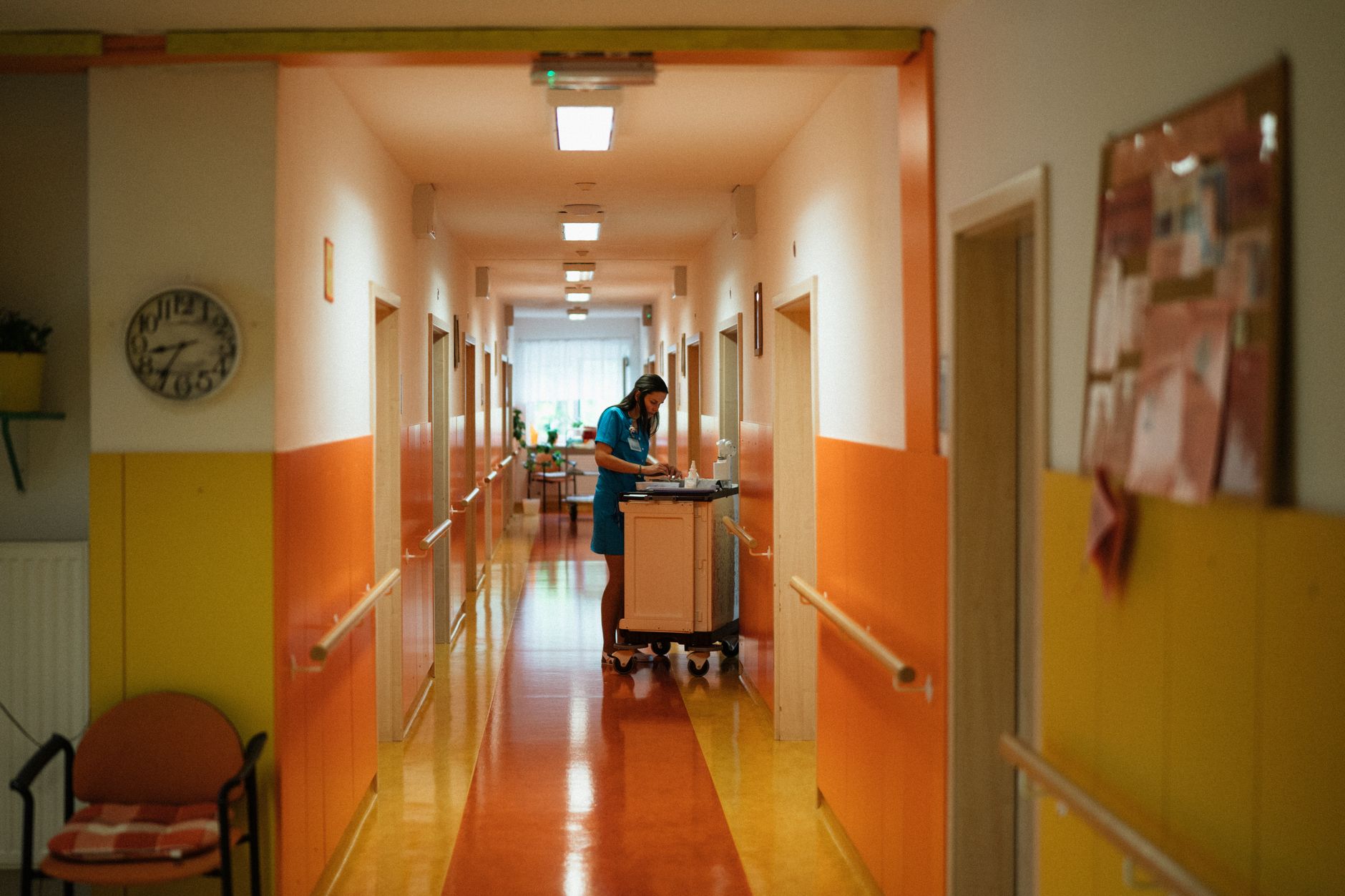
The robot's day follows the meal windows, not the clock. Between windows it waits at a charging point near the kitchen. At each window, staff load the covered trays and the robot takes the cart along its set route, rides the elevator set for that trip, and stops at a staging point on the unit. A person signs for the cart, then staff take trays to the bedside as they do now.
The most measured result in the research is an ICU study in Taiwan, presented as a 2026 ISPOR poster. It tested a zone-based robot program for routine supply transport, not meal trays, and found nurses' active logistics time fell from 111.34 minutes per day to 20.43, about 81.6%. That is a supply result. It shows the time that can come back, not what a meal tray run will save.
Simulation work says the same thing. A simulation of a mid-size hospital reported a 34% cut in turnaround time and a 38% cut in delivery variability, but its deliveries were lab and pharmacy runs, not trays. Meal tray savings have to be measured on the floors where the trays actually move.
How does a team work with a robot without going down to zero staff?
The working model is a robot plus fewer runners, never a robot in place of everyone. The robot takes the walking and the elevator legs. A person still loads the cart, checks trays against orders, makes the bedside handoff and handles exceptions: a missing tray, a room that changed, a blocked corridor.
What changes is the number of person-hours going to tray runs, not whether anyone is on the floor. Plan a smaller runner rota at the busiest meal windows and keep at least one person who can take over the route when a corridor is blocked. A backup route matters more than a backup robot.
Train every shift, not only the day team. Nurses, aides and runners should know what the robot does when it meets a closed door, how a stuck cart is cleared, and who to call. These steps are short, but they fail when only one person knows them.
Staff on the floor also keep the robot useful. A nurse who sees a tray left at a staging point should know whether it belongs to a patient on a diet change, and the unit should have one written process for that. Without it, trays drift to the wrong room, and the robot gets blamed for a gap in the handoff.
What can a delivery robot not do on an inpatient floor?
A robot does not make clinical or patient-facing decisions. It cannot tell which patient is fasting, which tray belongs to a patient who has moved, or when a diet changed overnight. It does not answer a call light, help a patient with a tray, or respond to a spill, an emergency or a visitor standing in the route.
Floors are crowded in ways a route map does not show. Gurneys, linen carts, wheelchairs and staff with rolling equipment change the corridor width during a meal window. A route that works on a quiet floor can stall at the lunch rush, so test it at peak meal time, not on an empty floor.
Before committing, write down the limits and keep these tasks with staff. The research found no controlled study isolating meal tray delivery on nursing units, so your own pilot data will carry more weight than any published figure. Expect early stops during the first weeks. A useful rollout logs each stop with its cause, fixes the route before it expands, and budgets staff time for that review, which is the part most often left out.
- Bedside tray delivery and help with eating
- Diet order checks and any patient-specific changes
- Spills, emergencies and any blocked corridor
How do you decide, and how do you get started?
Start with the route, not the robot. We begin with a free site assessment that maps the corridors, elevators, kitchen dock and staging point. We then pick the robot for the site, lease it through financing, deploy and integrate it, train your staff and service it nationwide. The lease quote comes after that assessment, so it reflects your floors.
Pilot one unit first. Choose a floor with a clear route, a predictable meal window and a charging point near the kitchen. Log runner time for several weeks across every meal, including the busiest one, and compare it with the robot's logs. Then decide whether a second unit or a second robot earns its place. A loaner unit or spare unit approach keeps one fault from stopping a meal.
Work through the checklist below before you request a quote. It is short because the decision mostly turns on the route and the meal windows. If the robot's logs and your runner logs disagree, trust the logs over the forecast and rerun the assessment before the next quote.
Frequently asked questions
Want a delivery robot at your hospital inpatient floor?
Tell us about your site. We will recommend the robot, quote the lease, and keep it serviced.
Sources
- US Bureau of Labor Statistics, Occupational Employment and Wage Statistics (OEWS May 2024)
- AHA 2025 Fast Facts on US Hospitals
- NSI turnover figures as covered by Becker's Hospital Review
- BLS Economics Daily: nonfatal injuries and illnesses to nurses, 2021 to 2022
- BLS snapshot: nursing assistants, 2016 to 2020
- Canadian Federation of Nurses Unions member survey, March 2025
- ISPOR 2026 poster on an automated delivery robot program in an ICU
- Mobile robot simulation study for a hospital (Rossetti, uark.edu)
- Scripps Health news on robotic carts delivering meals