
The short answer
A cobot makes sense in a metal fabrication shop when the same edge on a stable part family is finished again and again, and a fixture or fixed tool path can hold the geometry steady. A cobot vs deburring operator call usually favors a person when part shapes vary, burr locations change from job to job, or each piece needs judgment on weld spatter, fit or rework. Most shops that gain from a cobot keep the operator and move repeat edge work to the arm, so one trained person runs the cell and handles the exceptions.
Key takeaways
- A cobot fits repeat edge work on a stable part family, while a person fits varied parts and judgment calls.
- The BLS projects welder jobs to grow 2% and machinist jobs to decline 2% from 2024 to 2034.
- Published deburring gains come mostly from dedicated robot cells, so they are not measured cobot results.
- Plan for a cobot plus fewer staff, never zero staff, and keep a trained backup for the operator role.
- Time your own edge hours for two weeks before comparing any lease quote.
Cobot vs Deburring Operator: Which Fits a Metal Fabrication Shop?
A cobot vs deburring operator decision comes down to repeatability. A cobot fits when the same edges on the same part family get finished again and again, and a fixture or fixed tool path can hold the geometry steady. A deburring operator fits when part shapes vary, burr locations move from job to job, or each piece needs a call on how much material to take off.
A cobot makes sense when runs are long or repeat often, parts can be clamped in a repeatable fixture, burr size and location are predictable, and there is enough volume to keep a cell busy for a full shift. It does not make sense when runs are short with frequent changeovers, when parts are too large or irregular to hold still, or when the finisher must decide whether a weld bead or fit problem is a rework issue. Most shops that gain from a cobot keep the operator and move the repeat edge work to the arm.
What does a deburring operator do in a shift?
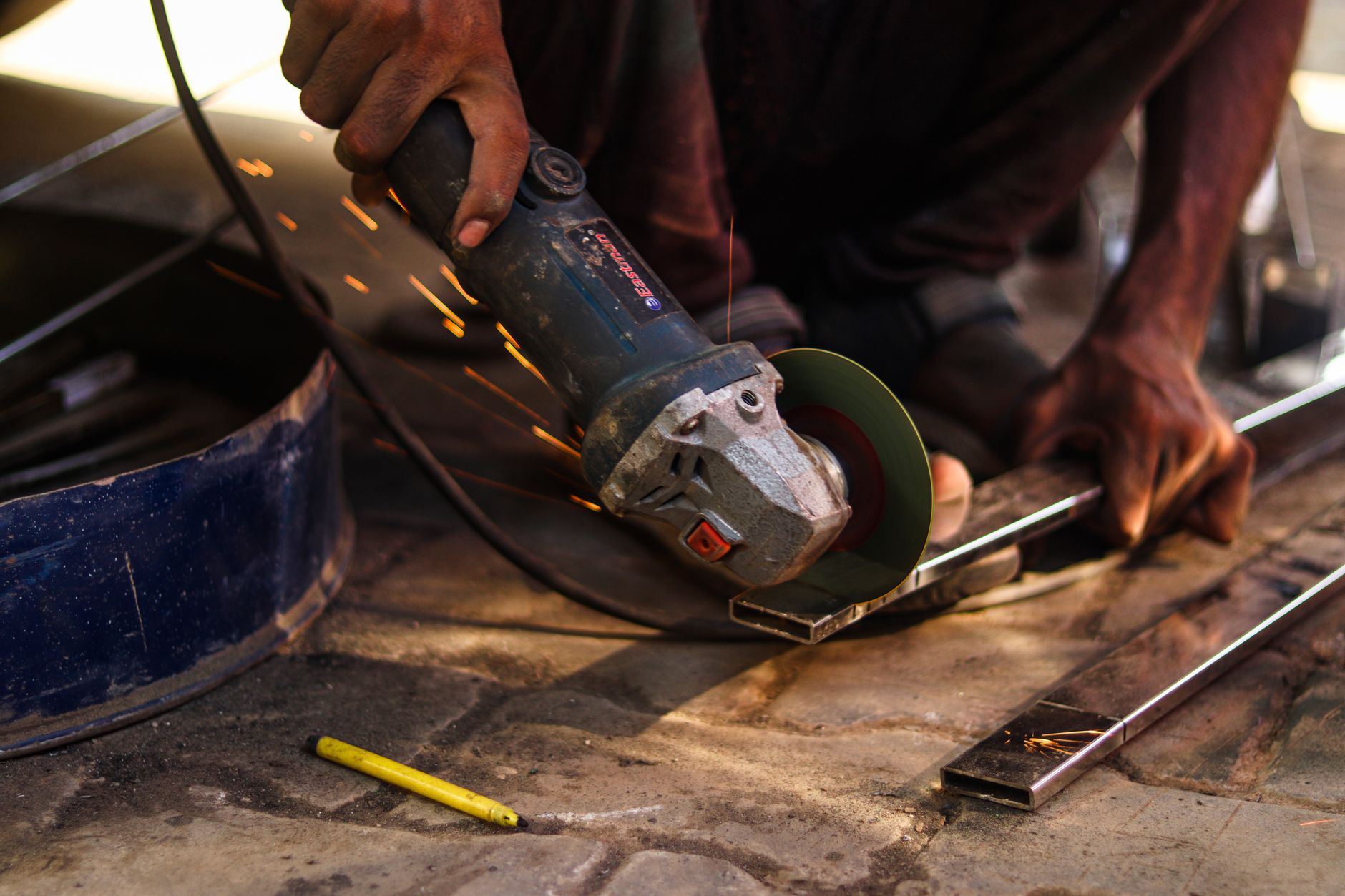
A deburring operator in a fabrication shop usually starts the shift by pulling a batch from staging and checking the work order against the drawing. They pick the tool for each edge, which may be a handheld grinder with a flap disc, a deburring brush, a file or a carbide tool, and work the edge until the burr is gone and the chamfer or radius meets the print. Between parts they inspect, mark or set aside rework, and clear dust and swarf from the bench.
The work is repetitive and physical. The same few edges come up on every part, and the arm and wrist carry the load all day. The skill lies in reading the part: knowing which edge matters for fit, weld prep or coating adhesion, and recognizing a burr that is really a crack or a bad cut. That judgment is what a cobot does not have, which is why the operator role changes rather than disappears.
Which parts can a cobot deburr, and which can it not?
A cobot can take parts with consistent edge geometry: brackets, plates, machined blocks and simple profiles that clamp in a fixture. There are two working setups. In one, the cobot holds the part against a fixed finishing tool. In the other, the cobot holds the deburring tool and follows a fixed path around a part presented in the same position. Part weight, tool reach and the arm's payload decide which setup is practical.
Parts a cobot handles poorly include castings with variable burr and parting lines, large weldments that must be repositioned between edges, parts with internal burrs the tool cannot reach, and mixed batches where material hardness or thickness changes the finishing pass. Each of these forces a change to the fixture or the path, and each change costs setup time. Short-run shops should count those changeovers before they count the hours saved.
- Repeat edge work on a stable part
Cobot
Holds the same path on the same edge all shift without tiring
Deburring Operator
Tires over a long shift, so finish consistency varies with the person
- Burr that varies by part
Cobot
Follows the programmed path and does not adjust on its own
Deburring Operator
Sees the new burr and adjusts the pass by feel
- Weld spatter or fit judgment
Cobot
Cannot judge whether an edge is acceptable
Deburring Operator
Makes the call and flags rework
- Changeover between part numbers
Cobot
Needs fixture swap and path setup before it runs
Deburring Operator
Changes setup quickly on a short run
- Coverage outside day shift
Cobot
Can keep running a loaded batch under a supervised plan
Deburring Operator
Needs a second shift, overtime or a backup to cover
- Skilled welder and machinist hours
Cobot
Frees these hours from repeat edge work
Deburring Operator
Spends these hours on weld and setup work only they can do
What do the labor and turnover numbers show?
According to the U.S. Bureau of Labor Statistics, about 457,300 welders, cutters, solderers and brazers held jobs in 2024, and manufacturing was the largest employer at 61%. The same handbook projects 2% growth from 2024 to 2034, with about 45,600 openings a year, mostly from replacement needs.
For machinists and tool and die makers, the BLS handbook counts about 354,800 jobs combined in 2024, with machinists about 299,500 of them. It projects a 2% decline from 2024 to 2034, with about 34,200 openings a year. Read together, the skilled pool a shop needs for setup and weld work is not growing, so every hour a welder or machinist spends on edge finishing is an hour taken from work only they can do.
The BLS Job Openings and Labor Turnover Survey reported a total quits rate of 1.9% for August 2026, with 3.1 million quits, and quits rose by 28,000 in nondurable goods manufacturing. That is an all-industry rate, not a fabrication benchmark, so use it as context for churn and then check your own records.
We did not verify overtime, night shift or sick day rates for deburring operators in fabrication shops, so this page does not cite them. Pull those figures from your own time records before deciding, because the labor case depends on them more than on any national average.
How many hours does edge finishing take, and what do case studies show?
We did not find a published, measured figure for hours saved per shift by a cobot deburring cell in a fabrication shop, so this page gives no such number. The closest published figures come from dedicated robot cells, not cobots. One integrator case study hosted by the Association for Advancing Automation (A3) covered a machine tending cell with a deburring step and reported cycle time cut by 1 minute 30 seconds over an 8-hour shift, with parts per shift rising from 100 to over 150.
A second A3-hosted case study, on a collaborative deburring project, described about 750 hours a year of automated deburring, which it called the equivalent of an additional half-resource. That is an annual figure for a robot cell, so treat it as a reference point for what a dedicated cell can do, not a forecast for a cobot in your shop. A vendor-reported cobot weld grinding case at one user, published by Machine Design, said output roughly doubled per shift. Weld grinding is not deburring, so read it as a sign of direction only.
Build your own number before any vendor gives you one. Time the edge work per part for two weeks, count parts per shift, and multiply that time by the share of staff hours spent on edge finishing. That baseline is what a quote should be measured against.
How do a cobot and staff share the work?
The pattern that holds up in practice is a cobot plus fewer staff, not zero staff. The person sets up fixtures, loads and unloads, inspects, handles exceptions, changes tools and makes the rework calls. The cobot runs the repeat edge path, so the operator can work the cell while attention goes to the steps that need eyes and hands.
Staffing changes in a specific way. Often one operator moves from full-time edge finishing to cell supervision and inspection, and welders and machinists move back to the weld and setup work they were trained for. We do not promise a headcount reduction, because the answer depends on volume, part mix and shift pattern. A shop that loses its only trained operator without a backup has created a new risk.
What can a cobot not do?
A cobot cannot judge a part. It follows a path. It will not notice that a bead sits proud enough to fail a fit check, that a part is bent before finishing, or that a burr hides a crack. Those calls still need a trained person, and the people who make them are often the welders and machinists you are trying to free up, so plan to keep them in the loop.
Reach and payload set which parts fit, and tool force varies with the tool and the material. A part family change needs fixture and path work, and that setup time counts against the hours saved. Dust, coolant, heat and floor layout are shop conditions to check before any cell goes in. Tools wear, and discs and brushes need scheduled changes, so maintenance is part of the job rather than an afterthought.
Is a cobot deburring cell worth it, and how is the lease cost set?
Whether a cell is worth it depends on whether repeat edge hours are large and steady enough to keep it busy. The market is moving in that direction. The Association for Advancing Automation (A3) reported that North American robot orders in 2025 reached 36,766 robots, up 6.6% in units over 2024, and that collaborative robots were 19.6% of units, or 7,212 units. That shows adoption is growing in general industries, not that any single shop will pay back a cell.
When you weigh the cobot vs deburring operator choice on cost, compare quotes on the same scope. We lease commercial robots through financing, and the lease payment is set in a quote after a free site assessment. The quote should itemize the robot, fixture and integration work, training and service. Ask how changeovers and rework are counted, since they change the real hours saved.
How do you start a cobot deburring pilot?
Start with two or three part numbers that carry the most edge hours. Time the existing edge work for two weeks, photograph the burr locations, record the tools and discs used, and check floor space, power and dust control near the bench. Confirm that the operator and a trained backup can both run the cell before anything is installed.
Our team begins with a free site assessment. We pick the robot that fits the site, lease it through financing, deploy and integrate it, train your staff, and service it nationwide, so the shop has one partner for the whole cell. A pilot on one leased unit lets you test the path, the fixture and the staffing before any wider rollout, and it gives you a measured baseline to compare against the quote.
Frequently asked questions
Want a cobot at your metal fabrication shop?
Tell us about your site. We will recommend the robot, quote the lease, and keep it serviced.
Sources
- U.S. Bureau of Labor Statistics, Occupational Outlook Handbook: Welders, Cutters, Solderers and Brazers
- U.S. Bureau of Labor Statistics, Occupational Outlook Handbook: Machinists and Tool and Die Makers
- U.S. Bureau of Labor Statistics, Job Openings and Labor Turnover Survey release
- Association for Advancing Automation (A3), 2025 North American robot orders
- South Carolina Department of Labor, Licensing and Regulation, 2024 incidence rates by industry table
- A3-hosted integrator case study: machine tending cell with deburring
- A3-hosted integrator case study: collaborative deburring project
- Machine Design: cobots double weld grinding efficiency (vendor-reported)