Key takeaways
- A patrol robot fits a ski yard only after it proves traction, braking, sensing, and docking in the site's worst winter conditions.
- The strongest patrol plan combines autonomous rounds with fixed cameras, access controls, remote review, and a named human responder.
- Mountain terrain demands route-level wireless testing and safe behavior whenever the robot loses its connection or position confidence.
- A seasonal pilot should measure verified alarms, false alerts, missed events, route completion, intervention time, and cold-weather runtime.
Can an autonomous patrol protect an equipment yard?
Yes, under the right operating envelope. An autonomous patrol robot can repeatedly inspect fenced yards containing snowmaking equipment, grooming machines, lift-maintenance parts, fuel areas, cable reels, and portable tools after employees leave. It can provide visible presence, live video, thermal observations, recorded patrol evidence, and alerts when a person or vehicle enters a defined area.
It is not a mechanical guard capable of resolving every incident. Snow accumulation, ice, steep grades, occluded sensors, weak radio coverage, and delayed human response can all break the operating concept. The proper assessment therefore starts with the yard, winter weather, and response plan, not a product demonstration on dry pavement.
The best deployment is layered. The robot covers repeatable routes and brings cameras closer to an event, while fencing, lighting, fixed sensors, locks, remote operators, and local responders retain distinct roles. If nobody can review and act on an alert, robotic surveillance only produces a better recording of a loss.
What should the robot actually watch?
Begin with loss scenarios rather than a generic instruction to patrol. Resort teams should identify attractive assets, likely entry points, blind corners, gates left open during maintenance, fuel or fluid leaks, heat anomalies, and places where employees may remain after normal hours. Each scenario needs an observable trigger and a defined action.
Routes should favor stable travel lanes around asset groups instead of weaving between implements, hoses, attachments, and parked groomers. Cameras need deliberate views of identification plates, gate approaches, control cabinets, and loading points. A mobile platform earns its place when changing position improves verification beyond the fixed-camera view.
Useful alert classes can include a person inside a closed zone, an unexpected vehicle, movement near stored tools, an open gate, smoke or abnormal heat, and a robot health fault. Thermal sensing can flag a temperature difference, but it does not diagnose an electrical defect or prove that a person is an intruder.
- Define authorized people, vehicles, contractors, and maintenance windows before enabling alerts.
- Record which asset groups require close inspection and which need only perimeter observation.
- Set privacy masks for public roads, employee areas, and neighboring property.
- Specify evidence retention, access permissions, and the person allowed to export footage.
Can it handle snow, grades, and deep cold?
A dry-weather specification is only a starting point. Packed snow, loose powder, frozen ruts, plow berms, meltwater, and refrozen ice change traction and stopping distance. Grade capability must cover both the steepest climb and the cross-slope encountered while turning. A robot that can ascend a ramp may still slide sideways or lose control while descending it.
Cold also changes the energy budget. A 2025 National Renewable Energy Laboratory report states that below 0°C, or 32°F, lithium-ion electrolyte becomes more viscous, internal resistance rises, and power output and charging efficiency fall. The pilot should therefore measure usable runtime, charge acceptance, reserve energy, and dock recovery at the yard's actual overnight temperatures.
Snow can coat lenses, obscure markings, scatter light, and make an old map inaccurate after plowing. Require heated or protected sensing where appropriate, a lens-obstruction alert, accessible cleaning points, and conservative stop behavior when localization confidence falls. The charging area needs drainage, snow clearance, weather protection, and enough approach space for repeated docking tests.
Weather limits must be explicit. The National Weather Service defines blizzard conditions as winds or frequent gusts of at least 35 mph with visibility below one-quarter mile in falling or blowing snow for three hours or more. Those conditions are a sensible example of a weather-triggered suspension rule, even if a machine's brochure claims a wider temperature range.
How should connectivity work in mountain terrain?
A coverage icon at the gate does not prove route-wide service. Steel maintenance buildings, parked machinery, cut slopes, ridgelines, and snowbanks can block or reflect signals. The FCC's propagation guidance distinguishes line-of-sight and non-line-of-sight conditions and calls for terrain and clutter effects in coverage modeling. A ski yard needs field measurements at camera-upload load, not a voice-call test.
NIST research on remote robots also notes that reflective and absorptive surroundings plus interference can reduce wireless range, reliability, and timeliness. Test every route segment, turn, dock approach, and sheltered corner during representative operations. Repeat the survey after the yard is full and after plowing changes the landscape.
Loss of cloud connectivity must not become loss of basic safety. Procurement requirements should state what continues locally, how long video is buffered, how an alert is queued, and what the robot does when communications do not recover. Depending on site risk, that behavior may be a controlled stop, movement to a verified safe point, or a return along a recently validated path.
Use more than one communications path when the risk justifies it, but do not mistake redundancy for certainty. Power loss, damaged backhaul, and a common mounting location can defeat both links. The deployment test should include intentional outages and proof that staff receive a health alert through an independent channel.
What makes a geofence trustworthy?
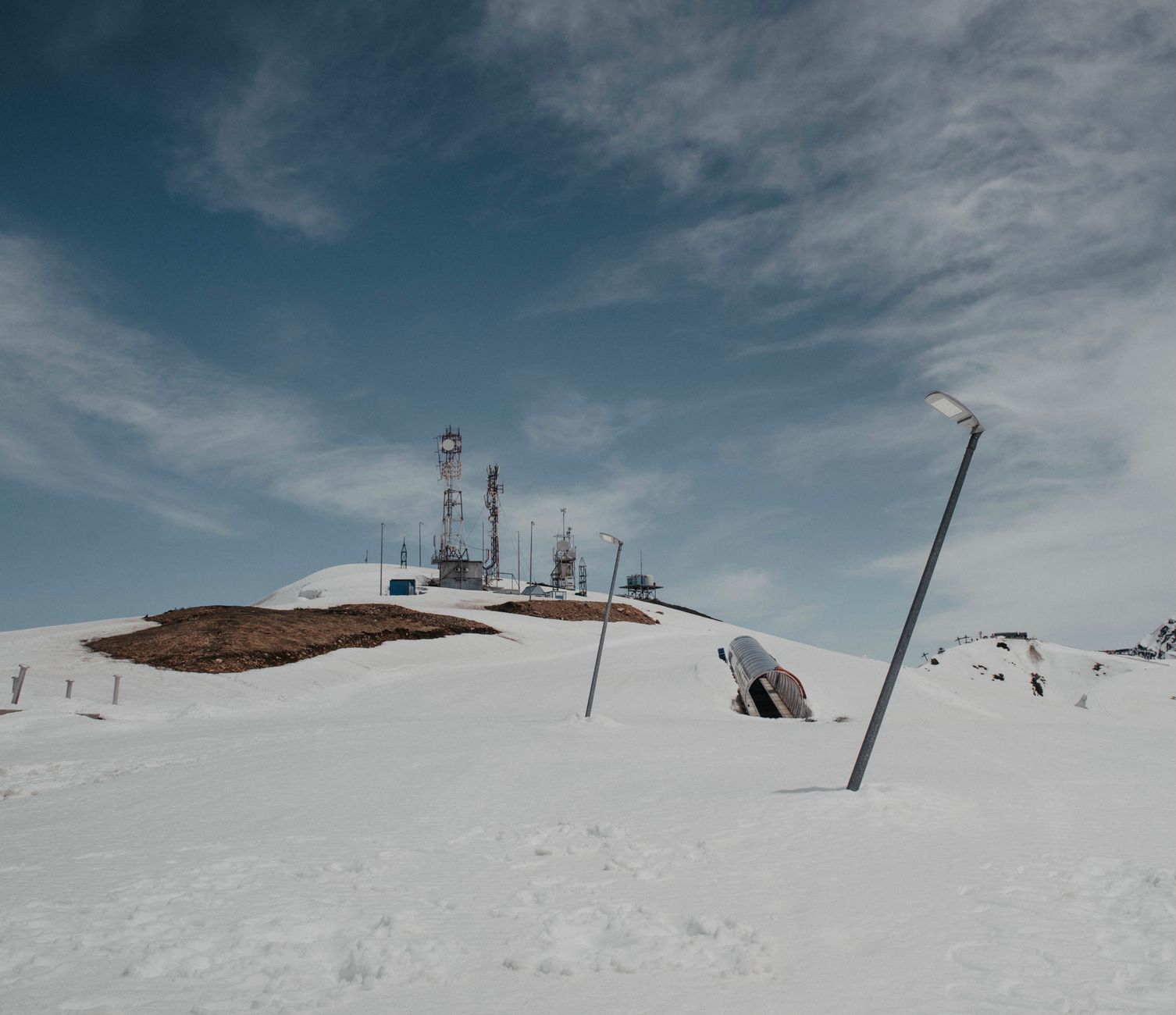
A geofence is a software boundary, not a guardrail. Static no-go zones should cover drop-offs, active lift machinery, fuel-transfer points, high-voltage equipment, snowmaking hoses, unstable shoulders, and any grade outside the approved envelope. Patrol boundaries should also remain inside the resort's property and camera-privacy limits.
Ski yards change by the hour. A groomer can appear in yesterday's travel lane, a plow can narrow a corner, and a maintenance crew can open a trench. Dynamic closures need an owner, an update process, and an expiration rule. A stale temporary zone is dangerous in one direction and needlessly restrictive in the other.
Location confidence matters as much as the drawn boundary. Require the robot to slow or stop when its position uncertainty approaches a hazardous edge. Verify each zone from both directions and test recovery after localization loss. Physical barriers remain appropriate around cliffs, moving machinery, and other hazards where software alone is not an adequate control.
The seasonal map should be versioned. Keep separate approved configurations for early snowmaking, peak winter storage, spring teardown, and summer lift work. Changes should require review before the autonomous patrol robot resumes service.
How fast must a person respond?
Response time is a site measurement, not a universal promise. Time the full chain from detection through transmission, remote review, decision, dispatch, gate access, and arrival at the alert location. Run the exercise during clear weather and again under the slowest conditions in which the resort still permits a responder to travel.
The National Weather Service gives the human constraint starkly: at 0°F with a 15 mph wind, the wind chill is minus 19°F and exposed skin can freeze in 30 minutes. OSHA advises employers to monitor cold conditions, provide warm breaks, use a buddy system, and maintain reliable communication for remote workers. A response plan cannot demand unsafe travel merely because a robot produced an alert.
Remote staff should first classify the event. A person approaching a locked gate, smoke near a power cabinet, a fallen employee, and a robot blocked by a drift require different actions. The robot can hold position at a safe distance, illuminate the area, relay audio if policy permits, or continue observation, but confrontation belongs to trained people and public safety agencies.
Every alert class needs a primary responder, backup, communication method, access credential, and rule for calling emergency services. If measured arrival time is too long for the loss scenario, improve the human arrangement, add fixed detection closer to the asset, or narrow the robot's mission. Do not conceal the gap behind an ambitious service-level target.
What should a winter pilot prove?
A commercial robot demo shows basic movement. A credible robot pilot program proves the operating case across changing weather, parked-equipment patterns, and staffing conditions. Map the yard first, document hazards, and establish baseline patrol work before switching on autonomous rounds.
Run controlled events using authorized participants. Test a gate entry, a person partly hidden by equipment, an approved late-shift technician, a vehicle in an unexpected lane, a blocked route, a coated lens, a wireless outage, and a failed dock attempt. Record detection, operator review, dispatch, arrival, and final disposition separately.
Track route completion, verified alerts, false alerts, missed test events, remote interventions, cold-weather runtime, docking success, and maintenance labor. Inspect performance by weather condition instead of averaging good and bad nights together. Averages can hide a system that works perfectly on clear nights and fails precisely when the yard is hardest to patrol.
The acceptance decision should name excluded routes, weather shutdown thresholds, inspection intervals, and required staffing. It should also include a safe rollback plan. Try before you buy has value only when the test represents the winter job the robot will inherit.
How should a resort structure a seasonal program?
Seasonal asset protection creates a different buying case from a permanent campus patrol. Compare outright purchase, robot leasing for business, and a service robot rental against the months of actual use, storage requirements, preseason recommissioning, and the resort's ability to maintain specialized equipment. A robot as a service arrangement may fit a concentrated winter need, but contract flexibility does not excuse weak field support.
Ask what maintenance is included, who performs remote triage, how on-site dispatch works in a mountain town, and what happens when weather delays access. Also confirm offseason battery care, software updates, spare availability, restart testing, insurance responsibilities, and the process for changing maps as the yard is reconfigured.
Service Robot Co. acts as an OEM-neutral, full-service commercial robot integrator for U.S. businesses. It can compare platforms across manufacturers, arrange financing or commercial robot rental, conduct the site assessment and mapping, deploy and integrate the selected units, train resort staff, and support them through a nationwide U.S. engineer network. That gives the resort one vendor for the lifecycle while preserving the freedom to select the robot that fits the terrain and mission.
A free site assessment should end with a candid go or no-go finding. Some yards need a wheeled patrol platform, some require another mobility form, and some should improve fencing, lighting, connectivity, or response staffing before adding a robot. Seasonal protection succeeds when the operating design is sound, not when automation is forced onto unsuitable ground.