Key takeaways
- Patrol robots extend overnight visibility, but they do not replace blue-signal protection, movement authority, or trained responders.
- Reliable routes favor paved lanes, compacted shoulders, and designated track crossings instead of loose ballast and exposed flangeways.
- Every alert needs a defined remote triage path, escalation threshold, and rule for yielding to active rail movements.
- A site-specific pilot should prove detection, mobility, communications, runtime, and recovery before a yard commits to fleet deployment.
What can an overnight patrol robot actually cover?
A mobile security robot can conduct repeatable overnight rounds through a rail maintenance yard, watching tool storage, parked rolling stock, fence lines, gates, fuel areas, and restricted work zones. It gives remote personnel a moving camera and sensor position, records time-stamped evidence, and directs attention toward activity that fixed cameras or periodic guard rounds may miss.
The robot should supplement the railroad’s security and operating rules, not act as an independent authority around trains. Its route must remain subordinate to yardmasters, dispatchers, roadway workers in charge, blue-signal procedures, and local movement controls. When a route approaches an active track, the safest default is to stop outside a defined boundary until the controlling employee releases it.
This makes an autonomous patrol robot most useful on stable perimeter roads, service lanes, parking areas, building approaches, and protected crossings. It can revisit high-risk points several times per shift without fatigue, then hand ambiguous events to a person through remote triage.
Which assets deserve the closest watch?
Rail maintenance yards contain an unusual mixture of portable assets, heavy equipment, long sight lines, concealed spaces, and rolling stock that may move with little warning. A good patrol plan starts with consequence, not convenience. Routes should visit the places where theft, tampering, unauthorized entry, or a delayed maintenance handoff would hurt operations most.
The Federal Railroad Administration says trespassing is the leading cause of rail-related deaths in the United States, with more than 500 trespass fatalities each year. That national figure is broader than maintenance yards, but it underscores why fence breaches and unauthorized track access require immediate, disciplined escalation.
- Tool cribs, gang boxes, welding equipment, batteries, cable reels, and portable diagnostic instruments
- Locomotives, coaches, work cars, brake hoses, communication cables, access panels, seals, and safety appliances
- Fence corners, drainage channels, vegetation gaps, gates, pedestrian cut-throughs, and areas hidden from fixed cameras
- Blue-signal work areas, inspection pits, lifting zones, fueling points, electrical cabinets, and chemical storage
- Crossings, switches, derails, wheel stops, track barricades, and other locations where an unexpected obstruction could affect movement
Can a patrol robot travel safely over ballast and tracks?
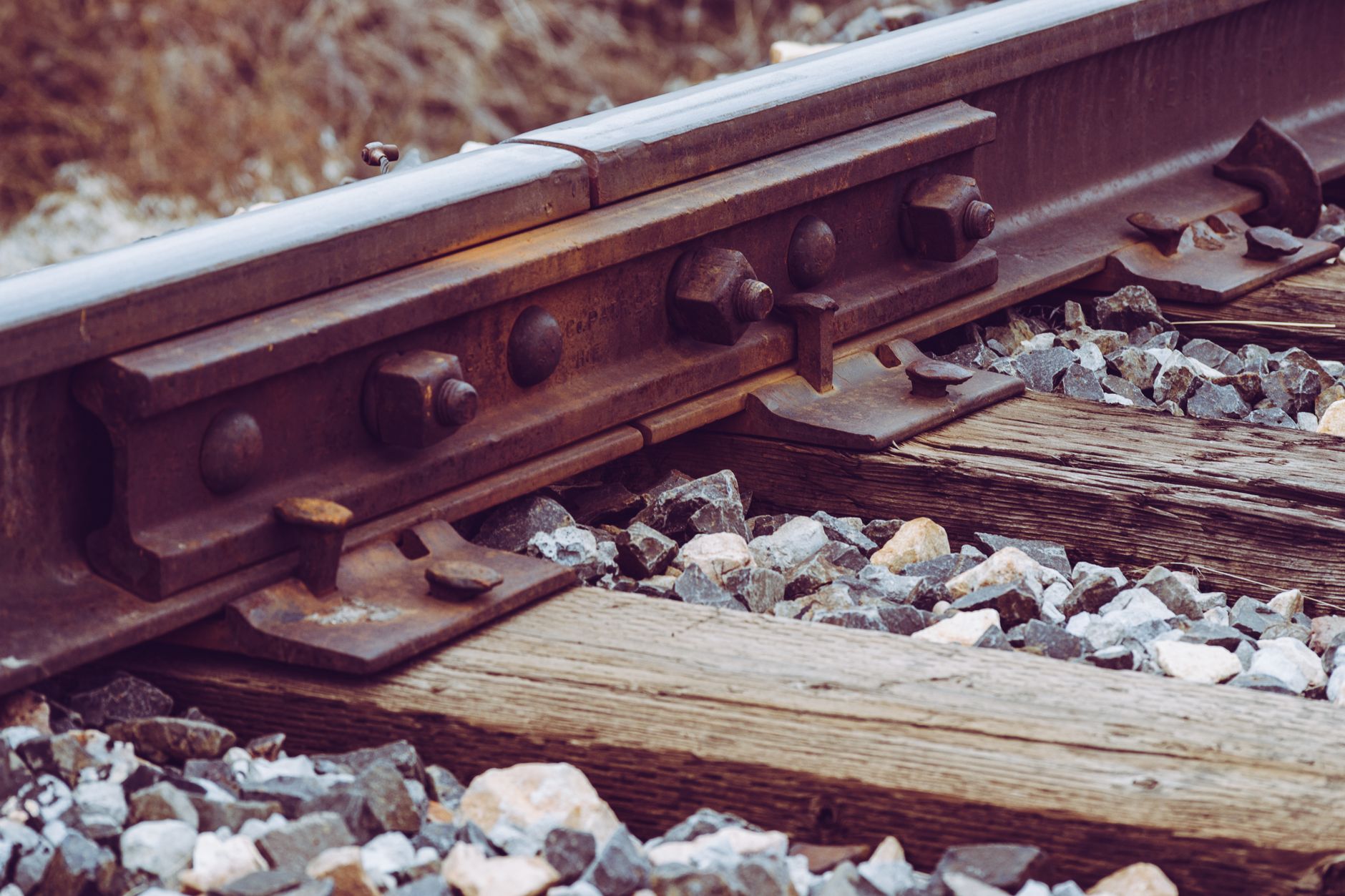
Loose ballast is hostile terrain for many wheeled patrol platforms. Angular stone can reduce traction, jar sensors, trap small casters, and shift beneath a turning wheel. Rails create abrupt height changes, while frogs, guard rails, flangeways, hoses, and temporary cables introduce pinch and entrapment points. A machine that performs well on asphalt may become unreliable within a few feet of track.
The preferred design is usually a network of approved travel lanes: pavement, concrete aprons, compacted shoulders, and crossing panels with verified clearances. Site assessment mapping should record grades, cross-slopes, drainage, standing-water locations, ballast migration, vegetation, gate thresholds, and every rail crossing. Seasonal testing matters because snow, ice, mud, leaf litter, and freeze-thaw damage can change a passable route.
Do not accept a brochure claim as proof of mobility. During a robot pilot program, load the intended sensor package, run the route in darkness, repeat turns near ballast edges, and test controlled recovery from realistic obstructions. The acceptance test should also confirm that a stopped or disabled robot cannot foul a track, switch, walkway, or emergency access lane.
How should robots coordinate with active rail movements?
The patrol system needs a formal interface with yard operations. That interface may be procedural, technical, or both, but the rule must be unmistakable: train and on-track equipment movements have priority. Geofenced hold points should sit well outside the clearance envelope, and route segments near tracks should close automatically during switching, servicing, inspections, or roadway work.
Federal rules provide a firm boundary around protected work. Under 49 CFR 218.23, a displayed blue signal means protected rolling equipment may not be coupled to or moved, other equipment may not obscure the signal, and rolling equipment may not pass it. Under 49 CFR 218.27, workers on, under, or between equipment on non-main track require blue signals at access switches, with those switches lined against movement and locked. A robot must never remove, interpret away, or substitute for those protections.
For roadway work, 49 CFR 214.327 requires working limits on non-controlled track to be made physically inaccessible at each possible point of entry through prescribed controls. Robot routes should treat those limits as hard exclusions. Only the employee controlling the limits should release the exclusion, and every release should be logged.
Integrating directly with signaling or dispatch systems can introduce safety and cybersecurity consequences. Many yards should begin with simpler controls: an operations-approved schedule, physical route separation, digital no-go zones, and a named employee who can pause the robot immediately. Deeper integration belongs behind railroad engineering review, change control, and fail-safe testing.
What works when lighting is poor?
Night patrol quality depends on more than a camera’s advertised resolution. Headlight glare, deep shadows beneath cars, reflective striping, fog, rain, blowing dust, and abrupt transitions between floodlit and dark areas can all degrade detection. The Federal Railroad Administration’s detection guidance says intelligent systems must cope with shadows, headlight glare, rain, snow, night conditions, and fog.
A practical sensor package may combine visible-light cameras, controlled infrared illumination, thermal sensing, lidar, radar, microphones, and two-way audio. Each channel has limits. Thermal sensing can reveal a warm person or overheating component, but it does not establish identity. Audio can flag impacts or voices, but rail equipment and nearby roads create noise that requires careful tuning.
Lighting changes also require operating review. Federal Railroad Administration guidance warns that excessive brightness can impair train crews’ vision and interfere with safe operation. Add light only after checking beam direction, glare, reflections, neighboring property, and the view from locomotive cabs. The robot’s own lights should dim, shield, or switch modes near active tracks.
How does a robot alert become a real response?

Detection has little value without a response chain. Each alert class needs an owner, a verification method, a maximum handling interval, and an escalation destination. Remote operators should be able to inspect live video, compare the event with the route baseline, speak through the robot when policy permits, and preserve relevant recordings.
TSA guidance identifies rail-car tampering, suspicious surveillance of a train or storage yard, weapons, and other facility security breaches as reportable concerns for covered operators. Local procedures should map comparable observations to railroad police, site security, operations control, emergency services, or maintenance personnel without exposing sensitive operating information.
A useful escalation matrix separates low-confidence anomalies from immediate hazards. A displaced cone may create a maintenance ticket. A person inside a restricted zone requires live verification and operations notification. Smoke, fire, a suspected weapon, or an object fouling track demands an emergency response and an immediate robot stand-off.
Remote triage also needs failure rules. Lost communications should make the robot stop or retreat to a preapproved refuge, never continue blindly near track. A 24 hour dispatch promise is meaningful only when the contract defines who answers, who can enter the property, which spare parts are stocked, and how emergency robot replacement is handled.
What should a rail-yard pilot prove?
Begin with one bounded patrol district and several weeks of representative operations. Include active switching periods, quiet hours, poor weather, shift changes, and maintenance activity. The pilot should test the operating concept, not merely demonstrate that the robot can drive around the yard once.
Measure patrol completion, missed checkpoints, nuisance alerts, confirmed events, communications dropouts, operator interventions, charging success, and recovery time. Review detections by location and cause. Repeated false alarms near reflective railcars or moving vegetation are mapping and sensor-tuning problems, not an invitation to lower every threshold.
A pass should require reliable detection at agreed distances and lighting conditions, complete event logs, safe stopping at every hold point, and successful recovery drills. Staff should rehearse a fence intrusion, a person near rolling stock, an active movement that closes the route, a blocked crossing, and a disabled robot. These exercises expose unclear authority before it becomes an overnight incident.
- Confirm that every route preserves track, switch, walkway, and emergency-vehicle clearance
- Verify stop behavior after network loss, sensor obstruction, low battery, localization failure, and emergency command
- Test alert delivery to primary and backup responders, including acknowledgment and escalation records
- Inspect recordings for useful framing, timestamps, retention controls, and access permissions
- Document the exact conditions that require human retrieval, on-site dispatch, or route suspension
Choosing and supporting the right patrol system
Rail yards differ sharply in surface condition, climate, traffic density, communications coverage, and security posture. The right machine may use wheels on a paved service campus or a more terrain-capable mobility system around rough perimeter roads. Payload, runtime, environmental protection, stopping behavior, lighting, and network design should follow the surveyed route.
Service Robot Co. approaches this as a vendor neutral robot integrator for U.S. businesses. The company compares equipment across manufacturers, then handles financing, robot deployment and integration, training, go live support, and continuing robot maintenance service through a nationwide engineer network. That one-partner model is valuable when security, facilities, information technology, and rail operations all own part of the deployment.
Procurement can include purchase, commercial robot rental, robot leasing for business, or robot as a service. A security patrol robot rental or RaaS monthly subscription can make sense when the yard wants to prove seasonal mobility and alert quality before a longer commitment. Contract language should specify maintenance included, software support, response coverage, data ownership, cybersecurity duties, spare-unit access, and end-of-term options.
Operational discipline matters more than novelty
A successful rail-yard patrol is deliberately constrained. The robot travels known lanes, waits at hard boundaries, records consistent evidence, and summons people under written rules. It does not improvise around moving equipment or treat an object detector as movement authority.
Connected patrol equipment should also enter the railroad’s cyber asset inventory. The National Institute of Standards and Technology’s Cybersecurity Framework 2.0 organizes risk management around six functions: Govern, Identify, Protect, Detect, Respond, and Recover. For a patrol fleet, that means controlled identities, documented data flows, managed updates, monitored communications, incident reporting, and a tested recovery plan.
The result is a measured extension of the night security team. Fixed cameras keep their constant views, people retain judgment and authority, and the mobile platform closes observation gaps with repeatable rounds. In a rail facility, that balance is what makes autonomy useful and safe.