
The question, in the buyer's words
I run a 40-person orthodontic appliance lab where technicians bend wire by hand at the bench for eight hours a day, and hand fatigue is slowing everyone down; could a cobot bend and hold wire forms so techs can focus on fitting?
Key takeaways
- A cobot can take over holding, presenting and turning wire, while forming fine archwire bends usually needs a dedicated bender.
- Test accuracy on your own wire and prescriptions first, because published speed and accuracy claims for wire bending machines are vendor reported.
- Hand and wrist strain among dental technicians is documented, though not by a large orthodontic specific study.
- US dental laboratory technician employment rose from 30,800 in May 2020 to 34,190 in May 2023, according to the Bureau of Labor Statistics.
- Lease terms come in a quote after a free site assessment, so the trial on your own bends comes before any commitment.
Can a cobot bend orthodontic wire at the lab bench?
Partly, and the split matters. Wire bending at an orthodontic lab bench is a job of gripping, bending, checking and reshaping, and a technician repeats those motions many times a shift. A cobot can take over the holding and presenting part of that work, while forming a fine bend is usually a job for a dedicated bender or a purpose built bending head.
Dental laboratories are the category that fits your shop. The US Census Bureau defines dental laboratories under NAICS 339116 as establishments primarily making dentures, crowns, bridges and orthodontic appliances customized for individual patients. The hand strain research for dental workers therefore applies to your bench, though most of those studies do not isolate orthodontic wire work.
Your question has two parts, and they deserve different answers. Can a cobot bend? The evidence is thin and mostly vendor reported. Can it hold wire forms so techs keep their focus on fitting? That is the stronger case, because holding and presenting is a steadier and more repetitive job than shaping a precise curve, and it is where a cobot can help most.
What can wire bending robots do today?
Most of the documented work sits in patents and product pages rather than independent trials. A recent US patent describes a wire bending robot for lingual orthodontics that bends wire in three dimensions, with its bending head moved along X, Y and Z axes. An earlier robot patent describes a force sensor that detects forces in the wire after bending, which shows that the forces left in the wire matter enough to measure.
On the equipment side, benchtop CNC wire benders paired with orthodontic design software are sold to labs, taking a scan through to a finished wire form. Vendors report speed and accuracy for these tools, and those figures have not been independently verified, so treat them as claims to test. Other vendors sell wire bending robots aimed at labs, again with vendor reported figures.
Computer aided archwire bending is not new. A review of the field notes that wire bending for dental treatment was done by hand in laboratory production, and an early computer aided archwire bender from the early 1990s is cited in the literature. For your lab, the question is fit to your work, not whether the idea works.
A wire bending machine and a general cobot are different tools. The bending heads in these patents and products are built for the bend itself. A standard cobot arm is best understood as a positioning and holding tool that supports the bend, carrying a fixture to the machine or holding wire while a bend is formed or checked.
How much hand strain do bench technicians face?
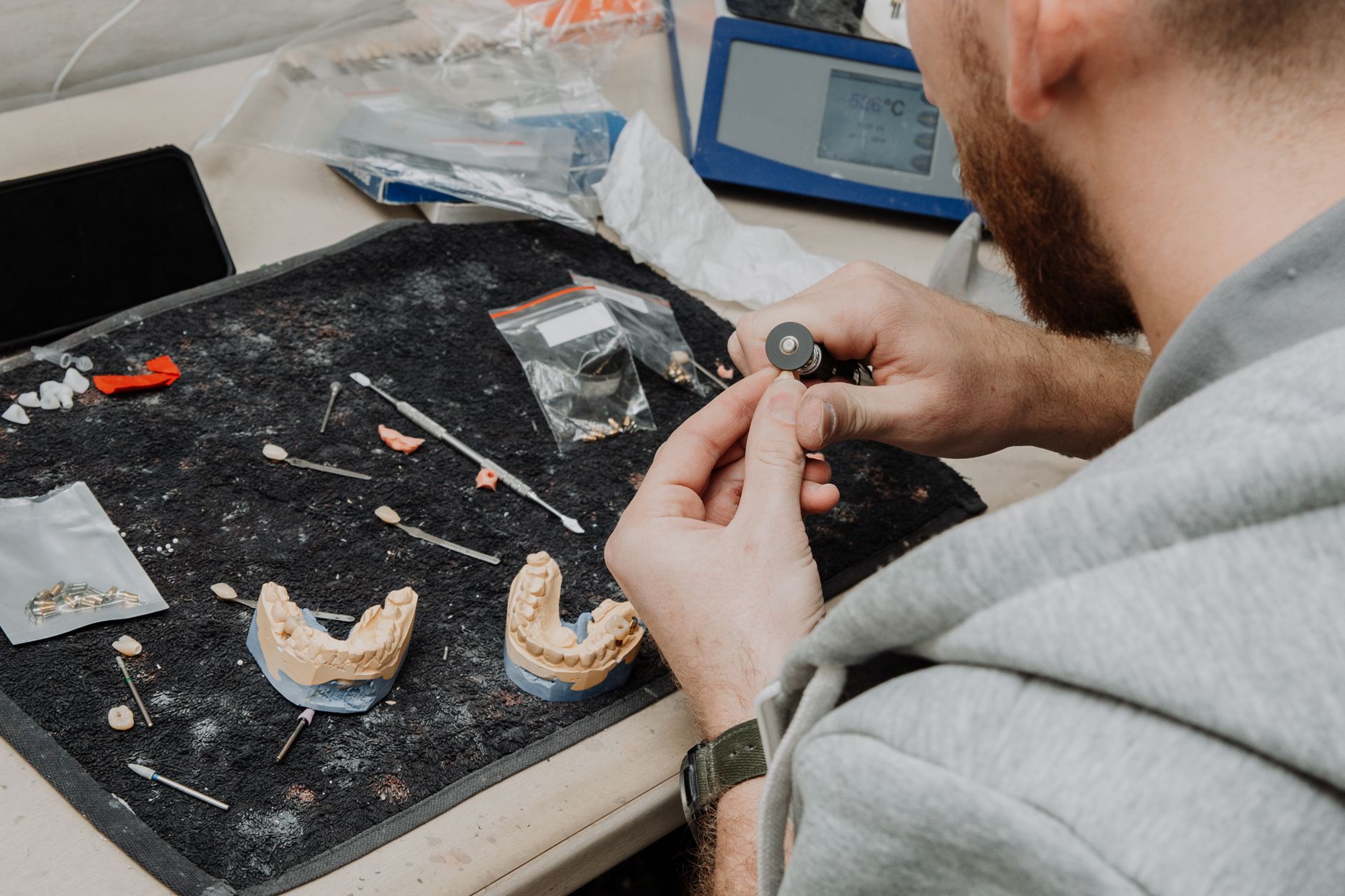
The best hand specific figure comes from a South African master's thesis that surveyed 72 dental technicians. It found a 12 month musculoskeletal disorder prevalence of 90%, and hand or wrist pain was reported by 68.1%, the same rate as neck, upper back and low back pain. Risk factors included age, prolonged standing and vibration. The sample is small and the thesis is not peer reviewed, so use it as a signal rather than a benchmark.
Older federal data shows how serious repetitive motion injuries can be. According to BLS data for 1994, republished in a CDC archive, about 705,800 days away from work cases, about 32%, were attributed to overexertion or repetitive motion. Of those repetitive motion cases, 55% affected the wrist, and the median time away was 18 days.
A later BLS count recorded 253,200 reported repetitive motion illnesses in 1998, which NIOSH described as 65% of reported occupational illnesses that year. A 2004 review also notes that hand and wrist disorders have the longest absences from work. The useful lesson for your lab is the direction, not the exact count.
None of these sources measures hand strain in orthodontic bench work, and none gives hours per day at the bench. NIOSH also notes that BLS figures likely undercount, because about one-third of industries fall outside the annual survey. A short internal log of symptoms, absences and time at the bench will tell you more than these national figures.
How many dental technicians work the bench, and for how long?
The US has a sizable bench workforce. According to the BLS Occupational Employment and Wage Statistics program, 34,190 people held dental laboratory technician jobs in May 2023, up from 30,800 in May 2020. That counts employment in the occupation across all dental labs, not the number of labs or the hours spent at the bench.
Counts of labs themselves are less clean. The Census definition covers establishments primarily making orthodontic appliances for individual patients, but aggregate lab counts found in the research varied by source and year, so this page does not state a total. For a local count, use the Census County Business Patterns tool filtered to NAICS 339116.
On hours, the research found no published figure for how many hours per day technicians spend bending by hand. The eight hour bench day you describe is your own estimate, and it should become a measurement before you decide. Time a sample of bends across a normal week, count bends per technician, and log which steps are gripping, holding, checking and finishing.
That split shows what a cobot could take over and what stays with the technician. Turnover and staffing levels for orthodontic bench work were also not found in the research, so a 40 person lab should pull its own numbers for absences, overtime and open roles before it sizes a cell.
Can a cobot hold the wire so techs keep the fit?
This is the strongest part of your question. Holding and presenting is a steady, repetitive job that a cobot can do for a full shift without the grip fatigue that builds in a hand. The technician still judges the fit, and that judgment is where clinics notice the difference. Fit depends on the case, the design data and the person checking the bend.
In practice, the split looks like this. The arm places a fixture or wire in the same position, holds it while a bend is formed or inspected, and returns it for the next step. The technician checks the bend against the case, decides what to adjust, and handles finishing. A robot does not see the appliance in the mouth, so clinical judgment stays with people.
A cobot is the wrong fit in some cases. Low volume with mostly one off cases, bends that need hand correction at every step, or a bench already set up for quick manual changes may gain little from a cell. A better fixture, a benchtop bender or ergonomic tooling may give more relief for less disruption, and those options belong in the same assessment.
- Holding and presenting
Cobot
Holds the fixture at the same position every cycle without tiring.
Staff
Holds steadily, but gripping strain builds over a long shift.
- Repeat bends
Cobot
Repeats a stored program, and its accuracy must be proven on your wire.
Staff
Varies from bend to bend but adjusts quickly by eye and feel.
- Judging fit
Cobot
Does not see the appliance in the mouth or judge clinical fit.
Staff
Sees, feels and corrects the bend against the case.
- One off cases
Cobot
Needs a new program or fixture for each new case.
Staff
Reshapes a one off case by hand with no setup.
- Endurance
Cobot
Does not tire from repetition.
Staff
Hand and wrist strain is documented among dental technicians.
- Changeover
Cobot
Needs fixture changes and program updates between case types.
Staff
Changes tools and approach by hand, with no programming.
- Clinic communication
Cobot
None.
Staff
Talks through fit and changes with the clinician.
What drives the cost of leasing a cobot for wire work?
Cost moves with the bending method, the number of stations and how many case types need their own fixtures. A cobot that only holds a standard fixture is simpler to set up than one that needs a new program and tooling for every prescription. Fixture design and validation time often weigh more than the arm itself, which is why the first step is an assessment, not a catalog pick.
Integration effort is the second driver. Connecting the arm to your design files, your bending equipment and your bench layout takes time, and training technicians to load, check and reset the cell takes staff hours. Ask for both to be written into the quote so the scope is clear on both sides.
Lease terms come in a quote after a free site assessment, because the bends, floor space and volume drive the answer. Treat any figure given before that assessment as a rough guess, and ask what it assumes about bends per shift.
Are other labs and factories using cobots this way?
Cobot use is growing across manufacturing. According to the A3 figures reported by The Robot Report, cobots accounted for 7,212 units ordered in North America in 2025, about 19.6% of the 36,766 total robots ordered in the region. Total North American robot orders rose 6.6% in units for the year.
The cobot share is reported in more than one way across sources, so check the primary A3 release before you cite it in a board paper. Those figures describe the whole market, not dental labs, and the research found no independent record of cobots bending orthodontic wire in production.
That gap is the honest answer to your question. Adoption is broad, but dental wire bending is a niche use, so the evidence you need is your own trial data rather than an industry statistic. Use the market figures to show that the technology is mature enough to evaluate, not that it is proven for your case.
How should a lab test wire accuracy before leasing?
Run the test on your own material. Pick a set of common archwire forms, including the wire types and gauges you use most, and record each bend against its prescription and case. Judge the result with the same method your clinicians use to check fit, so the test answers the question that matters.
Count the cycles too. Time each bend from pick to placement, including fixture changes, so the cycle time reflects a real shift rather than a best case. Note every adjustment the technician makes after the robot step, because hand correction at every bend removes most of the time savings.
Ask the vendor for the test conditions in writing. A speed or accuracy figure without wire type, gauge, fixture and sample size is not a result you can compare. Keep the test log, so the decision rests on your numbers rather than on a brochure.
How would a cobot lease and setup work with us?
We are an OEM-neutral integrator for US businesses. We pick the right robot across manufacturers for the site, lease it through financing, deploy and integrate it, train the staff, and service it under our service plan. Regional service engineers cover every state we service, so one partner handles the whole lifecycle instead of several.
For a lab like yours, the first job is a free site assessment that maps the bench, the bend types, the floor and the design data path. The assessment should include a test on your own wire and prescriptions, so the fit question is answered with your work rather than a vendor sheet.
A fixed lease payment is quoted after that assessment, and the service plan covers servicing after go live. The lease terms are set in writing before you sign, so the trial results and the scope of integration both feed the decision.
Frequently asked questions
Want a cobot at your dental and orthodontic appliance labs?
Tell us about your site. We will recommend the robot, quote the lease, and keep it serviced.
Sources
- U.S. Bureau of Labor Statistics, OEWS May 2023 (SOC 51-9081)
- U.S. Bureau of Labor Statistics, OEWS May 2020 (SOC 51-9081)
- South African master's thesis on musculoskeletal disorders in dental technicians (DUT OpenScholar)
- CDC stacks, BLS 1994 repetitive motion data
- CDC stacks, NIOSH on repetitive motion illnesses using 1998 BLS data
- The Robot Report, North American robot orders 2025
- U.S. Census Bureau, NAICS 339116 definition (archived)
- US patent US11950979, wire bending robot for lingual orthodontics